
By Robert Houston, Director of Operations, MAG.
October 2026

CW4 Houston completed 3 active-duty rotations to Afghanistan as a Targeting Officer, S3 Plans Officer, Chief of Operations, and G5 Plans Officer. Rob then conducted PCS to Fort Bragg, NC in June 2014, and served in the 18th Airborne Corps and Combined Joint Task Force – OIR as the Targeting Officer, deploying to Iraq and Syria.
Following his deployment to CJTF-OIR, CW4 Houston was assigned to USASOC where he served in the 3rd Special Forces Group, 1st Special Forces Command, and USASOC while deploying to Syria, North and West Africa, and East Africa. Most recently he served as the Fire Support Officer for Joint Special Operations Task Force Somalia and the strike Joint Terminal Attack Controller (JTAC) for the East Africa Strike Cell. CW4 Houston retired in May 2025 as the G3 Operations Warrant Officer for 1st Special Forces Command and established the Special Operations Robotics Detachments.
His awards include the Combat Action Badge, the Parachutist Badge, Legin of Merit, the Bronze Star Medal (4 OLC), the Defense Meritorious Service Medal (2 OLC), Meritorious Service Medal (4 OLC), the Army Commendation Medal w/Valor Device, the Army Commendation Medal (4 OLC) and the Joint Service Achievement Medal.
Global Operations and Innovation: The MAG Footprint
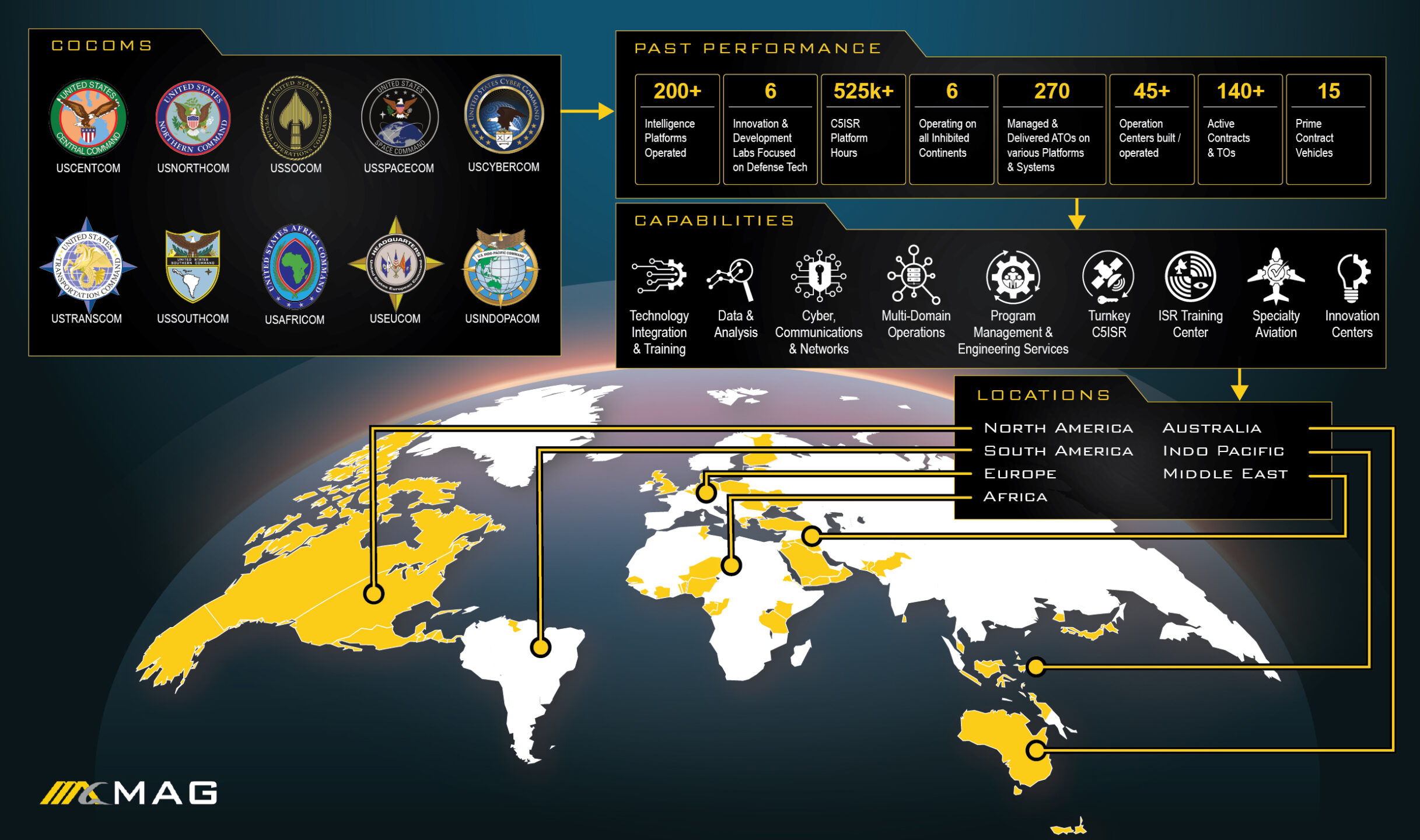
Translating grand strategy, rapid acquisition, and technological capability into actionable readiness requires an exhaustive global footprint and deep domain expertise. With operations spanning all six inhabited continents and over 525,000 C5ISR platform hours logged, MAG serves as a primary mission partner in enabling persistent global competition.
MAG’s extensive portfolio perfectly mirrors the multi-domain necessities of preparing Special Operators for high-intensity conflict. By maintaining strategic presence in key regions around the world, MAG reinforces value to current and future partners through shared operational insights:
- Multi-Domain Data Collection in Austere Environments: MAG provides full-spectrum, turn-key C5ISR services and operations globally. In South America (SOUTHCOM), MAG operates specialized aircraft to gather intelligence on counter-terrorism, drug interdiction, and near-peer influence. In Africa (AFRICOM), MAG’s Counternarcotics Detection & Monitoring (D&M) support achieved a 95% sortie completion rate, disrupting nearly 5.4 tons of narcotics in just 108 days while simultaneously supporting regional stability operations.
- Special Operations Readiness and Support: Operating the Fayetteville-based facility, MAG delivers comprehensive classroom, simulation, and live-fire JTAC training. MAG also provides specialized analytical support to the 389th Military Intelligence Battalion and other USASOC units, ensuring that intelligence units can adequately support precision strike coordination and multi-intelligence fusion.
- Space, Electronic Warfare, and Cyber Systems: MAG drives forward cutting-edge technology development to ensure spectrum and cyberspace superiority. The company provides critical engineering, testing, and sustainment for the Wideband Satellite Communications Operational Management System (WSOMS), ensuring secure communications across security enclaves even in contested, cyber-degraded environments.
- Regional Multi-Domain Awareness (RMAC): Under a comprehensive 5-year IDIQ contract, MAG delivers engineering and technical support for operational technology across the global naval enterprise. This involves installing COTS and GOTS software and sensors that dramatically enhance maritime domain awareness and decision superiority globally.
- EUCOM Command and Control Resilience: Understanding the immediate threat posed by near-peer adversaries in Europe, MAG designs, integrates, and sustains critical C5ISR systems engineered to withstand High-Altitude Electromagnetic Pulse (HEMP) and Chemical, Biological, Radiological, Nuclear, and high-yield Explosive (CBRNE) attacks within the USEUCOM area of responsibility.
Through these highly integrated capabilities, MAG does significantly more than merely supply equipment; we actively design, engineer, and operate the complex multi-domain ecosystem that allows the modern warfighter to train, sense, and act decisively on a global scale.
Introduction: The New Paradigm of High-Intensity Conflict
Following two decades focused predominantly on counter-violent extremist organization (C-VEO) operations, the United States military is undergoing a massive structural and doctrinal pivot toward strategic competition with near-peer adversaries, namely China and Russia. The National Defense Strategy dictates that U.S. forces must be prepared to deter and, if necessary, defeat aggression in highly contested, multi-domain environments spanning the globe. For the United States Special Operations Command (USSOCOM), this paradigm shift requires a fundamental reevaluation of how elite warfighters are prepared, equipped, and sustained. They must be ready to defeat our high threat nations in contested environments, while also remaining flexible and agile enough to shift to threats such as narco-terrorism in the Western Hemisphere.
The age-old military axiom, “Train as You Fight,” remains the absolute bedrock of operational readiness. However, the nature of the “fight” has transformed. Future conflicts will not be characterized by uncontested airspace, permissive electromagnetic environments, and reliable communications. Instead, they will be defined by severe electromagnetic spectrum warfare, GPS-denied environments, hypersonic threats, and the need for instantaneous integration across land, sea, air, space, and cyber domains. To prepare Special Operators for this reality, training regimens must evolve from isolated, domain-specific exercises into comprehensive, interconnected simulations that replicate the immense cognitive and technical demands of the modern battlespace.
The integration of Live, Virtual, and Constructive (LVC) training environments, powered by the Combined Joint All-Domain Command and Control (CJADC2) framework and augmented by Artificial Intelligence (AI), is no longer a luxury—it is an urgent operational necessity. This comprehensive analysis explores the intersection of advanced training methodologies, deep-sensing intelligence, secure communications, and rapid systems engineering. It highlights how leading defense technology integrators, such as MAG, are uniquely positioned to ensure SOF lethality, resilience, and decision superiority in high-intensity conflict.
1. The Strategic Pivot: From Counterterrorism to Near-Peer Competition
The operational tempo of the United States military over the past two decades has been heavily skewed toward asymmetric warfare. Special Operations Forces served as the main effort for counter-VEO operations across Afghanistan, Syria, Iraq, Yemen, and the Sahel. The tactical methodologies developed during this era were highly effective for their intended environments. Operators enjoyed uncontested air superiority, robust and unjammed satellite communications, and intelligence, surveillance, and reconnaissance (ISR) platforms that could loiter over targets without fear of advanced anti-aircraft systems.
However, the Chairman of the Joint Chiefs of Staff and the National Military Strategy have explicitly identified a shift toward enduring threats posed by nation-states, emphasizing Russia and China as pacing challenges. These adversaries possess advanced capabilities designed specifically to fracture the U.S. military’s operational model. Their Anti-Access/Area Denial (A2/AD) networks utilize long-range precision missiles, integrated air defense systems (IADS), and sophisticated cyber and electronic warfare tools.
In this new reality, the fundamental “SOF Truths” remain applicable, but their implementation must evolve. Truth I states: Humans are more important than hardware, and Truth III emphasizes that Special Operations Forces cannot be mass-produced. The hardware has undeniably become exponentially more complex, involving artificial intelligence, synthetic aperture radar (SAR), and beyond-line-of-sight (BLOS) networks. Yet, the ultimate success of a mission still relies on the cognitive agility and decision-making capacity of the individual operator.
The Cognitive Overload Challenge
The primary challenge for the modern operator in a high-intensity conflict is cognitive overload. Warfighters are inundated with data from thousands of sensors, ranging from space-based surveillance to terrestrial electronic warfare intercepts. Furthermore, adversaries employ sophisticated strategies, including narrative warfare and disinformation, to deny, degrade, or spoof these data streams, eroding trust in the information provided.
The “Train as You Fight” philosophy mandates that SOF personnel undergo rigorous conditioning in environments that simulate this data saturation and electromagnetic spectrum degradation. It is no longer sufficient to train operators merely to shoot, move, and communicate; they must be trained to process massive amounts of multi-domain intelligence, identify spoofed or poisoned data, and operate effectively when their primary communication and navigation systems are neutralized by enemy action.
2. The Human Domain and SOF Readiness Challenges
While the technological aspects of multi-domain operations are daunting, the physical and psychological toll on the force is equally concerning. The Government Accountability Office (GAO) has extensively documented the readiness challenges facing the U.S. military, particularly the special operations community.
Over the past two decades, the Department of Defense (DoD) increased the size of SOF to meet the immense demand for counter-terrorism operations. However, this high operational tempo resulted in significant strain. The GAO identified several key vulnerabilities that directly impact SOF readiness in the context of near-peer competition:
| Readiness Challenge | Description and Impact |
|---|---|
| High-Risk Training Accidents | Approximately 80% of reported on-duty, non-combat accidents involving SOF personnel from FY 2012 to 2022 occurred during training activities. Nearly 40% of these accidents were concentrated in high-risk areas such as parachute training and combat dives. This physical attrition during peacetime highlights the urgent need to offload certain risk-heavy repetitions into high-fidelity virtual environments. |
| Language Proficiency Shortfalls | SOF personnel require advanced foreign language skills to build relationships and coordinate with international partners. However, between FY 2018 and 2022, most Army and Marine Corps SOF units did not meet foreign language proficiency goals. Less than half completed any foreign language training due to competing operational demands, severely hindering coalition interoperability. |
| Fatigue and Cognitive Strain | Decades of high deployment tempos have resulted in chronic fatigue. The DoD acknowledges that impairment from fatigue can be equivalent to alcohol intoxication, significantly increasing the risk of physical injury and degrading the rapid cognitive processing required for multi-domain decision-making. |
| Civilian Oversight Constraints | The Assistant Secretary of Defense for Special Operations and Low-Intensity Conflict (ASD-SO/LIC) functions as the civilian oversight mechanism for USSOCOM. However, chronic understaffing and a lack of documented protocols regarding access to acquisition program information have hindered the Secretariat's ability to effectively advocate for and oversee the training and equipping of special operators. |
These findings underscore a critical reality: the physical force cannot simply be trained harder. It must be trained smarter. The integration of high-fidelity virtual and constructive simulations provides a crucial mechanism to safely practice the cognitive and procedural aspects of multi-domain operations. By offloading the rehearsal of complex joint fires coordination, electronic warfare deconfliction, and multi-agency communication to simulator environments, USSOCOM can preserve the force while actually increasing the frequency and complexity of training iterations. This approach aligns directly with the Preservation of the Force and Family (POTFF) initiatives designed to reduce physical and psychological wear on elite operators.
3. Revolutionizing Training with Live, Virtual, and Constructive (LVC) Environments
To bridge the gap between necessary cognitive conditioning and physical force preservation, the defense industry has turned to Live, Virtual, and Constructive (LVC) simulation environments.
- Live Training: Real people operating real weapon systems in physical environments.
- Virtual Training: Real people operating simulated systems (such as flight simulators or mixed-reality headsets).
- Constructive Training: Simulated personnel operating simulated systems, usually driven by complex algorithms to replicate large-scale enemy forces or civilian populations.
Historically, simulation capability has suffered from a “stove-piped” architecture. Simulators were often built as standalone, platform-centric tools that isolated the trainee. A pilot might train in a flight simulator, and a ground controller might train in a dome simulator, but they rarely interacted in a shared synthetic environment. This isolation fails to replicate real-world dynamics; modern warfighting is inherently a team endeavor requiring seamless Joint and Coalition integration.
Modern LVC capabilities overcome this limitation by blending live ranges with virtual feeds. A live operator on a physical training range in North Carolina can seamlessly interact with a virtual aircraft piloted by someone in Nevada, while a constructive enemy air defense network generated by a computer reacts dynamically to their combined actions. This allows operators to train against near-peer threats—such as dense integrated air defense systems (IADS) or hypersonic missile strikes—that are too dangerous, expensive, or highly classified to replicate on a physical live-fire range.
Leading defense integrators have established dedicated Innovation Centers to advance these capabilities. For example, MAG operates an ISRTC and SOF Training Center that delivers state-of-the-art live, virtual, and constructive training in support of next-generation battlefield and multi-domain operations, ensuring that the technology used in training perfectly mirrors the technology deployed at the tactical edge.
4. Next-Generation JTAC Training for Large Scale Combat Operations
Nowhere is the need for highly integrated LVC training more apparent than in the preparation of our Joint Fires Supporters and Joint Terminal Attack Controllers (JTACs). SOF Fire Supporters and SOF JTACs execute one of the most perilous and mathematically complex tasks on the battlefield: coordinating Close Air Support (CAS) and kinetic strikes in close proximity to friendly forces and our partners forces. In a counter-insurgency environment, JTACs often operated with uncontested air superiority. In a high-intensity, near-peer conflict, they must navigate anti-aircraft umbrellas, jammed communications, and the integration of Long-Range Precision Fires (LRPF), network enabled weapons, Robotics and Autonomous Systems. Fires Supporters and JTACs may never even communicate directly with aircraft pilots in this next phase of warfare, rather they will be communicating with the launched effects that have been delivered to them.
Overcoming Range Restrictions and Doctrinal Stagnation
Live training for JTACs has historically been constrained by geographical limitations, strict range restrictions, and the exorbitant cost of flying physical fighter aircraft and bombers. Live ranges often cannot safely replicate the employment of standoff munitions or the dense electronic warfare environment of a peer adversary. Furthermore, NATO studies have highlighted that legacy JTAC simulator training often stagnates, failing to progress beyond minimum accreditation standards, which leaves trainees ill-prepared for the dynamic reality of an interconnected, contested battlespace.
To counter this, MAG has pioneered highly immersive training solutions that blend doctrinal instruction with cutting-edge simulation. MAG operates a premier JTAC training facility in Fayetteville, North Carolina. This facility delivers classroom, simulation, and live-fire JTAC training tailored specifically to support precision strike coordination for USSOCOM and the Air Force Special Operations Command (AFSOC).
Kinetic and Dynamic Strike Training Ecosystem
Addressing the complexities of Large-Scale Combat Operations (LSCO) and multi-domain operations, modern JTAC curricula have expanded far beyond basic close air support. Advanced training now encompasses highly specialized instruction tailored to near-peer threats:
| Training Course | Focus Area and Operational Impact |
|---|---|
| Kinetic Strike Training Course (KSTC) | Builds staff proficiency in the kinetic strike process through command-driven scenarios. Focuses on airspace management, non-standard weaponeering, collateral search, and the integration of advanced tactics, techniques, and procedures (TTPs) such as loitering munitions and offset target engagement. Ensures readiness through USUSSOCOM D350-12 aligned CV2 metrics. |
| Dynamic Strike Training Course (DSTC) | Applies the Find, Fix, Finish, Exploit, Analyze, and Disseminate (F3EAD) process specifically in denied and contested environments. Emphasizes the integration of emerging systems, organic capabilities, and Long-Range Precision Fires during the crisis phase of LSCO. |
| Target Engagement Authority Training Course (TEA-TC) | Provides brigade-and-above staff with the operational law (OPLAW), rules of engagement (ROE), and policy frameworks necessary to oversee complex kinetic strikes. Mitigates confirmation bias and ensures complex operations remain within legal and policy boundaries. |
These courses align seamlessly with the U.S. Army’s number one tactical modernization priority: Long-Range Precision Fires (LRPF). As adversaries deploy missile systems that outrange current U.S. capabilities, the Army is developing the Precision Strike Missile (PrSM) and the Extended Range Cannon Artillery (ERCA) to penetrate and disintegrate enemy A2/AD networks. By training JTACs to integrate both traditional air assets and long-range artillery, the Joint Force ensures that operators can orchestrate convergence across all domains.
Furthermore, to ensure international readiness, U.S. JTACs frequently participate in NATO exercises such as Ample Strike in the Czech Republic. These exercises utilize LVC environments and mixed composite air operations (COMAOs) to validate Air-Land-Integration in accordance with NATO standards (such as STANAG 3797), proving that U.S. operators can seamlessly integrate with allied forces despite differing national hardware.
5. Deep Sensing and the Modernization of Aerial ISR
To truly train as you fight, the simulated environment must accurately represent the intelligence architecture of the future battlefield. The foundation of Long-Range Precision Fires, and indeed all SOF targeting, is “Deep Sensing”— the ability to see beyond the line of sight, penetrate deeply into enemy territory, and identify high-payoff targets long before they can pose a threat to friendly forces.
The U.S. Army and the broader intelligence community are currently executing a massive modernization effort, divesting legacy turboprop Intelligence, Surveillance, and Reconnaissance (ISR) aircraft (such as the RC-12X Guardrail and EO-5C ARL-M) in favor of high-altitude, jet-based platforms. The legacy turboprop fleet, while highly effective in the Middle East, is critically vulnerable to modern air defense systems and lacks the altitude and speed necessary to provide true deep-sensing capabilities in a near-peer fight.
The ATHENA and HADES Programs
The cornerstone of this modernized deep-sensing capability is the High Accuracy Detection and Exploitation System (HADES). Expected to reach the prototype phase by 2026, HADES utilizes a modern business jet airframe (Bombardier Global 6500) to provide transformational increases in speed, range, payload, and endurance. HADES operates at higher altitudes, allowing its sensors to “see” further over the horizon and facilitating global deployment within days rather than the weeks required for legacy turboprops.
“With the ability to fly higher, farther and faster in the various target areas that we’re looking at, we get vast amounts of data every mission that we fly. It is vastly different because we are able to stay in an area for a longer dwell time,” said Sgt. Bryden Jones, a mission manager for ARES with the 104th Military Intelligence Company, PED Battalion, 116th Military Intelligence Brigade, said in an Army essay on HADES. “These capabilities allow us to provide things like pattern-of-life; it allows us to see up and down time locations, potential troop movement or anything else you can think of.”
Because developing a new Program of Record takes years, the Army requires an immediate bridging strategy to maintain overmatch. This is where MAG stepped in. The Army has deployed the Army Theater-level High Altitude Expeditionary Next Aerial ISR (ATHENA) platforms. Supplied through Contractor Owned/Contractor Operated (COCO) models by specialized defense technology integrators like MAG, ATHENA-R and ATHENA-S platforms are currently operating globally to meet immediate Combatant Command requirements.
The ATHENA-R platform is explicitly engineered for Multi-Domain Operations (MDO) survivability. It operates at altitudes exceeding 40,000 feet, providing substantial standoff range and advanced radar warning capabilities while maintaining a continuous 12.5+ hour on-station endurance. The converged sensor suite includes:
- Synthetic Aperture Radar / Moving Target Indicator (SAR/MTI): Identifies and tracks ground vehicles, penetrating foliage and adverse weather, without relying on adversary electronic emissions. Crucially, it uses SAR mode to classify vehicles by type (e.g., distinguishing a tank from a supply truck).
- Electronic Intelligence (ELINT): Detects, classifies, and geolocates threat radar and non-voice emitters, mapping the enemy’s air defense network.
- Communications Intelligence (COMINT): Classifies communications emitters to determine adversary location and intent.
“By leveraging lessons learned from ARES, ARTEMIS and ATHENA platforms and integrating best practices, we’re evolving the training pipeline to meet the demands of next-generation ISR,” Julie Isaac, Project Director for Sensors Aerial Intelligence said, in an Army essay. “The Army uses the ongoing ATHENA missions to build a trained workforce for the HADES rollout. Sensor operators and data analysts practice processing intelligence from 40,000+ feet using ATHENA equipment.”
As part of this, ATHENA’s high fidelity radar technology will continue to be fortified by AI-enabled data collection “at the forward edge of combat.” The ability for software to support data processing and transmission, particularly when supported by AI-generated analytics, will help high altitude fixed wing surveillance technology keep pace with the fast-growing volumes of data collection modern sensors, computers and radar are capable of. Specifically, with more data arriving, advanced AI-enabled algorithms are needed to support PED, Processing Exploitation and Dissemination. In tactical terms, this means that, as opposed to purely “collecting data” at the edge, processing is increasingly critical to finding points of “relevance” amidst a seemingly limitless amount of data. The ATHENA radar supports this process with its forward-operating processing and analytics.
For Special Operators, training to utilize this high-fidelity data is paramount. The integration of SAR/MTI and ELINT cross-cueing must be accurately simulated in the training environment so that an operator on the ground understands how to request, interpret, and action the intelligence provided by these high-altitude assets during a live mission.
6. Making Sense of the Battlespace: TITAN and the CJADC2 Data Fabric
Collecting vast quantities of deep-sensing data from platforms like ATHENA and space-based assets is only the first step; the ultimate strategic challenge lies in transmitting that data securely, analyzing it rapidly, and disseminating actionable intelligence to the tactical edge. This complex ecosystem is governed by the Combined Joint All-Domain Command and Control (CJADC2) framework.
CJADC2 is not a single software program or a specific radio; it is a comprehensive warfighting concept and strategy designed to connect any sensor to any shooter across all domains (land, sea, air, space, and cyber) at the speed of relevance. The DoD’s implementation plan organizes CJADC2 around three core functions: Sense, Make Sense, and Act.
To operationalize these functions, the strategy relies on five Enduring Lines of Effort (LOEs):
- Establish the Data Enterprise: Creating common data standards and interoperability protocols.
- Establish the Human Enterprise: Training personnel to operate within data-centric environments.
- Establish the Technical Enterprise: Developing the physical and software architecture for secure transport.
- Integrate NC2/NC3: Synchronizing conventional command and control with Nuclear Command, Control, and Communications.
- Modernize Mission Partner Information Sharing: Ensuring seamless data sharing with allied nations and coalition partners.
The Tactical Intelligence Targeting Access Node (TITAN)
At the tactical edge, the physical embodiment of the CJADC2 “Make Sense” function is the Tactical Intelligence Targeting Access Node (TITAN). Developed as a rapid prototyping initiative, TITAN is a next-generation, expeditionary intelligence ground station designed to ingest and process data from space, high-altitude, aerial, and terrestrial sensors.
By fusing this multi-domain data using advanced analytics, TITAN dramatically reduces the sensor-to-shooter timeline. It allows ground force commanders to “see past the close fight” and deliver targetable intelligence directly to lethal networks, such as the Advanced Field Artillery Tactical Data System (AFATDS) used for Long-Range Precision Fires. For Special Operators, interfacing with TITAN means receiving fused, actionable intelligence regarding moving targets, electronic order of battle, and patterns of life, rather than being overwhelmed by raw, unanalyzed data feeds.
Secure Communications, AB2, and Coalition Interoperability
Transmitting this volume of data requires highly resilient, secure transport architectures. In contested environments, adversaries will aggressively attempt to jam or degrade legacy satellite communications. Advanced systems engineering is required to build Beyond Line-of-Sight (BLOS) digital transport architectures that utilize commercial-off-the-shelf (COTS) equipment to maintain continuous connectivity.
Defense integrators like MAG have demonstrated profound success in developing multi-layered, software-defined ecosystems for the DoD. For example, MAG developed the Airborne Beyond Line-of-Sight (AB2) system for the Special Operations Command Pacific (SOCPAC). This architecture securely distributes full-motion video (FMV) and C2 data from COCO aerial platforms across multiple nodes, ensuring operators receive critical information without relying on a single, vulnerable network.
Furthermore, CJADC2 mandates seamless coalition interoperability. As demonstrated by NATO operations, U.S. forces will rarely fight alone. Initiatives like Project Olympus, led by the Joint Staff J-6, are actively working to break down policy hurdles and disparate technological standards among Five-Eyes and NATO partners. By implementing zero-trust architectures and data-centric security models, the Joint Force ensures that vital tactical data is shared securely with international partners at the end-user level, a capability regularly tested in high-stakes environments like the Global Information Dominance Experiment (GIDE).
7. Project Linchpin, Replicator, and the AI Pipeline
As the volume of multi-domain sensor data grows exponentially, human analysts simply cannot process the influx of information fast enough to support dynamic targeting. To maintain decision superiority, the Army and USSOCOM are heavily investing in Artificial Intelligence and Machine Learning (AI/ML).
Project Linchpin: Securing the AI Pipeline
Leading the integration of AI into military intelligence is Project Linchpin, a centrally managed AI operations and services (AIOps) ecosystem overseen by the Program Executive Office for Intelligence, Electronic Warfare and Sensors (PEO IEW&S). Project Linchpin establishes the secure infrastructure, standards, and governance necessary to deploy trusted AI capabilities affordably and at scale.
The goal of Project Linchpin is to integrate AI algorithms directly into sensor systems and platforms like TITAN. The pipeline concept mirrors the way commercial software updates are pushed to smartphones; user data from the operational edge is fed back to developers to generate continuous patches, security upgrades, and improved AI models. For a Special Operator, an AI-enabled system can automatically differentiate between a civilian bus and a threat missile launcher, filter out irrelevant electronic noise, and immediately alert the operator to actionable targets. This capability fundamentally addresses the USSOCOM requirement for “Reduced Operator Workload,” utilizing cognitive decision-aiding technologies to automate routine analysis and allow the warfighter to focus on lethal execution.
Through strategic funding mechanisms like the Small Business Innovation Research (SBIR) and xTech prize competitions, Project Linchpin leverages private-sector excellence. By investing over $100 million annually in AI initiatives, the Army ensures a continuous pipeline of cutting-edge, commercially developed algorithms tailored for military applications, from natural language processing to computer vision.
The Replicator Initiative and Autonomous Mass
The urgency of deploying autonomous and AI-enabled systems is further codified by the Department of Defense’s Replicator initiative. Championed by Deputy Secretary of Defense Kathleen Hicks, Replicator is designed to overcome traditional acquisition delays and field thousands of attritable, autonomous systems across multiple domains by August 2025.
“Attritable” refers to platforms that are unmanned and built affordably enough that commanders can tolerate a higher degree of risk in employing them, allowing for “precise mass” on the battlefield. By familiarizing Special Operators with the deployment, management, and tactical employment of these autonomous swarms during LVC training today, USSOCOM ensures readiness for the battlefields of tomorrow.
8. Bridging the “Valley of Death” in Defense Acquisition
A persistent challenge in military modernization is the “Valley of Death”—the perilous funding and bureaucratic gap between the successful demonstration of a new technology and its transition into a fully funded, scalable Program of Record. In an era of rapid technological advancement by near-peer adversaries, the U.S. military cannot afford decadal acquisition cycles.
To rapidly field capabilities like advanced electronic warfare suites, counter-UAS systems, and secure communications architectures, the DoD increasingly relies on agile industry partners. Mechanisms such as Mid-Tier Acquisition (MTA) pathways and Other Transaction Authorities (OTAs) are leveraged to bypass traditional bureaucratic delays and immediately prototype promising technologies.
Organizations operating under hybrid business models—possessing the contract portfolio, security clearances, and experience of a large prime contractor, coupled with the agility of a small business—are vital to crossing this Valley of Death. MAG exemplifies this approach through its network of specialized Innovation Centers:
| Innovation Center | Key Capabilities and Focus Areas |
|---|---|
| Space Coast Rapid Integration Facility | Delivers cost-effective, quick-reaction development for next-generation defense technologies. Focuses on advanced manufacturing, digital engineering, and rapid prototyping for commercial and defense customers. |
| ISR and SOF Training Center | Provides a state-of-the-art facility delivering live, virtual, and constructive (LVC) training tailored specifically to support next-generation multi-domain operations for elite warfighters. |
| Tactical Networks Innovation Center | Serves as a critical testbed for the rapid insertion of emerging networking and communications technology. |
| Electronic Warfare Innovation Center | Aligns customer architecture to software-defined radio, electronic warfare, and cyber capabilities, rapidly adapting to adversary actions in the electromagnetic spectrum. |
By actively developing solutions in response to urgent operational requirements—and by operating systems on a Contractor-Owned/Contractor-Operated (COCO) basis—industry partners absorb much of the upfront developmental risk. This allows Combatant Commands to operationalize cutting-edge technologies, such as the ATHENA ISR platforms or Beyond Line-of-Sight digital transport systems, years before a traditional acquisition program could deliver them.
Conclusion
The character of warfare has fundamentally changed, transitioning from a localized focus on counterterrorism to global, multi-domain operations against technologically advanced near-peer adversaries. This strategic pivot requires United States Special Operations Forces to possess unparalleled cognitive agility, technological fluency, and lethal precision.
The enduring doctrine of “Train as You Fight” now dictates that training environments must seamlessly blend Live, Virtual, and Constructive simulations. These environments must accurately replicate the complexities of deep sensing, electronic warfare degradation, and artificial intelligence-driven targeting, all while mitigating the physical fatigue and injury risks associated with traditional live-only training.
Achieving this requisite level of readiness is not solely a military endeavor; it requires the continuous, rapid integration of commercial innovation. By leveraging advanced deep-sensing platforms like ATHENA and HADES, synthesizing multi-domain data through the CJADC2 and TITAN frameworks, and bypassing traditional acquisition bottlenecks via rapid systems engineering, the United States and its allies can maintain an enduring technological overmatch.
Ultimately, it is through the synergetic partnerships between the Department of Defense and agile technology integrators like MAG that the modern Special Operator is empowered to deter aggression and ensure decision success in any domain, at any time.
Frequently Asked Questions (FAQ)
1. What is Live, Virtual, and Constructive (LVC) training? LVC training is a highly integrated simulation methodology utilized by the military to replicate complex operational environments. “Live” involves real people operating real equipment on physical ranges. “Virtual” involves real people operating simulated equipment (such as a mixed-reality flight simulator). “Constructive” involves computer-generated forces (simulated people operating simulated equipment) reacting to the live and virtual operators. Integrating all three allows for large-scale, multi-domain training scenarios that would be too dangerous, prohibitively expensive, or geographically impossible to conduct purely in the real world.
2. How does CJADC2 impact Special Operations Forces? Combined Joint All-Domain Command and Control (CJADC2) is a strategic warfighting concept designed to connect sensors and shooters across all military services and domains (land, sea, air, space, cyber) into a unified, secure data network. For Special Operators, CJADC2 enables rapid access to critical, multi-domain intelligence and allows for the near-instantaneous coordination of Joint Fires and long-range artillery, vastly accelerating the decision cycle and increasing lethality in combat.
3. What is the role of the TITAN system in modern warfare? The Tactical Intelligence Targeting Access Node (TITAN) is an advanced, expeditionary ground station that ingests massive amounts of data from space, high-altitude, aerial, and terrestrial sensors. Using Artificial Intelligence and Machine Learning, TITAN fuses this data to quickly identify threats, filter out electronic noise, and deliver targetable intelligence directly to lethal networks, significantly reducing the sensor-to-shooter timeline for ground commanders.
4. Why is the U.S. Army replacing turboprop aircraft with jet platforms for ISR? The military is transitioning to modern business jets (such as the Bombardier Global 6500 utilized in the ATHENA program) because they fly significantly higher, faster, and farther than legacy turboprop aircraft. Operating at altitudes above 40,000 feet allows these jets to maintain a safer standoff distance from advanced enemy anti-aircraft systems while utilizing sensors to scan a much larger geographic area, a capability critical for “deep sensing” in contested environments.
5. How does the Replicator Initiative accelerate military capabilities? The Replicator Initiative is a Department of Defense effort designed to bypass traditional, slow acquisition cycles to field thousands of attritable, autonomous systems across multiple warfighting domains by late 2025. It focuses on rapidly scaling commercial innovation to provide “precise mass” on the battlefield, overwhelming adversary defenses with affordable, unmanned systems.
6. What are MAG’s core capabilities supporting the DoD? MAG is a leading defense technology integrator providing turn-key capabilities across five primary domains: Multi-Domain Data Collection and Analysis (Aerial ISR); Rapid Development and Systems Engineering; Space, Electronic Warfare, and Cyber operations; Secure and Resilient Communications; and Special Operations Readiness and Support. This includes providing advanced JTAC training, LVC simulation, and operating contractor-owned/contractor-operated (COCO) aircraft globally.
What Does MAG Aerospace Do?
MAG is a leader in delivering Command, Control, Communication, Computers, Cyber, Intelligence, Surveillance and Reconnaissance (C5ISR) services at the tactical edge with premier engineering and operational solutions around the world.
As the Lead Systems Integrator (LSI) and a proven U.S. Government Prime Contractor, MAG brings operational excellence and technical understanding with program management and systems engineering expertise to manage large, complex DOD systems development and deployment contracts.
MAG’s expertise in “Turnkey C5ISR” services involves taking commercial-off-the-shelf (COTS) technology and “missionizing” it for military use. MAG partners with non-traditional technology providers to accelerate adoption and compliance within the DoW (DoD) markets. By acting as a bridge between the commercial tech sector and the defense establishment, MAG ensures the warfighter has access to the latest defense technology on relevant timelines and across all domains.
MAG’s hybrid, technology and platform-agnostic business model enables us to work with the largest military OEMs, while avoiding vendor lock-in, as well as with small businesses and startups, to deliver large programs while accelerating deployment to the field and maximizing customer mission success. Solutions that require novel and state-of-the-art technologies with niche partners gives MAG the ability to continuously improve solutions with innovation. MAG experts are on the leading edge of technological advances, which enables MAG to rapidly prototype, integrate, and connect joint, next generation capabilities across Air, Land, Maritime, Space and Cyberspace Domains. Focused on making the world smaller and safer, MAG is defined by our core values of Serve. Win. Perform.
