
September 2026

By Matt Jessup, Chief Engineer, MAG.
Introduction: The Strategic Imperative for Multi-Intelligence Sensor Fusion
The character of modern warfare is undergoing an irrevocable paradigm shift driven by the proliferation of advanced, multi-domain threats and the exponential growth of battlespace data. In an era defined by Great Power Competition against near-peer adversaries, the ability to maintain strategic dominance relies less on the sheer mass of localized kinetic forces and heavily on information superiority and decision advantage
The core enabler of this decision advantage is Multi-Intelligence (Multi-INT) Sensor Fusion—the rigorous, automated synthesis of disparate data streams, including Signals Intelligence (SIGINT), Geospatial Intelligence (GEOINT), Electronic Intelligence (ELINT), and Measurement and Signature Intelligence (MASINT), into a single, actionable common operating picture.
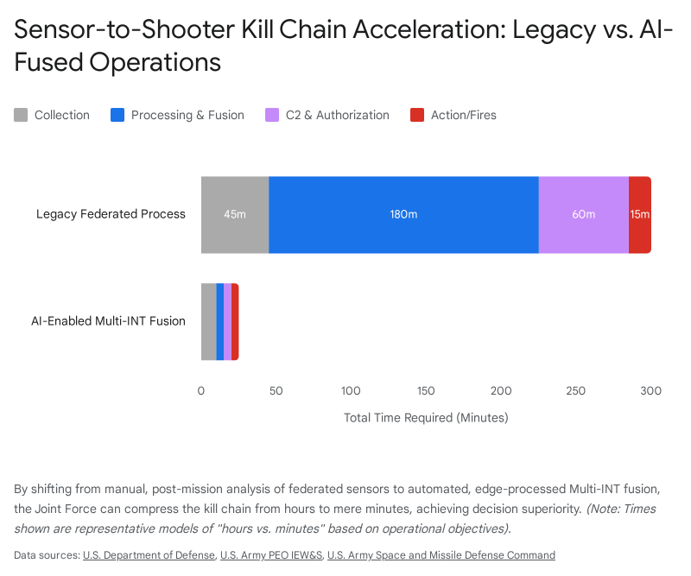
- CJADC2 Minimum Viable Capability (MVC): The Department of Defense (DoD) has successfully delivered the MVC for Combined Joint All-Domain Command and Control, integrating AI and data fabrics to reduce sensor-to-shooter timelines from hours to seconds.
- False Target Reduction via AI: Artificial intelligence-enabled multi-sensor fusion systems deployed in battlefield reconnaissance environments have lowered false target identification rates by 27% to 32%, drastically reducing operational misfires in contested domains.
- Market Expansion & Investment: Multi-domain Intelligence, Surveillance, and Reconnaissance (ISR) sensor fusion technologies are projected to generate approximately $11.4 billion in incremental market value by 2030, driven by autonomous systems and modern airborne ISR fleets.
- Infrastructure Modernization Funding: The DoD’s recent $9.7 billion Enterprise Software Agreement (ESA) secures the foundational zero-trust cloud infrastructure and digital ecosystem essential for powering CJADC2 data fabrics at the tactical edge.
Historically, the military operated with federated, stovepiped intelligence collection systems. An aircraft would collect Synthetic Aperture Radar (SAR) imagery, a separate satellite would collect Communications Intelligence (COMINT), and human analysts would manually attempt to correlate these independent data streams in post-mission processing centers.
Today, near-peer adversaries possess the capability to actively contest the electromagnetic spectrum (EMS) and disrupt communications, rendering post-mission, reach-back analysis obsolete. The future fight will be faster, vastly more distributed, and heavily contested, requiring the Joint Force to sense, make sense, and act at machine speed.
To overcome these challenges, the architectural flow of modern Multi-INT Sensor Fusion transitions from disparate edge sensors—including Electro-Optical/Infrared (EO/IR), SAR, and SIGINT—feeding directly into edge computing nodes for automated target recognition. This processed intelligence is subsequently routed through a secure data fabric to Combined Joint All-Domain Command and Control (CJADC2) command nodes, bypassing legacy post-mission analysis bottlenecks completely.
By shifting from transmitting massive raw data files to transmitting lightweight, fused targeting metadata, the architecture preserves bandwidth in Denied, Degraded, Intermittent, and Limited (DDIL) environments and allows commanders to apply Long-Range Precision Fires (LRPF) with unprecedented velocity and lethality.
The CJADC2 Framework and the Realization of Decision Advantage
The Delivery of the Minimum Viable Capability (MVC)
Combined Joint All-Domain Command and Control (CJADC2) is the Department of Defense’s strategic approach to connecting sensors from all military services—the Air Force, Army, Marine Corps, Navy, and Space Force—alongside allied partners, into a unified, decentralized mesh network.
The ultimate objective is to replace rigid, linear kill chains with dynamic, interconnected “kill webs,” allowing commanders to seamlessly pair the best available sensor with the optimal shooter, regardless of the domain or service branch.
In early 2024, Deputy Secretary of Defense Kathleen Hicks formally announced the delivery of the initial Minimum Viable Capability (MVC) for CJADC2, marking a watershed moment in U.S. military modernization. Forged through rigorous software acquisition pathways and rapid defense experimentation—including the Global Information Dominance Experiments (GIDE) and the U.S. Army’s Project Convergence—this MVC proves that software-defined, data-centric warfare is an operational reality.
The GIDE 8 iteration specifically culminated a year of rapid experimentation that successfully integrated international partners and U.S. forces in a sandbox environment to stress-test real-world data pipelines and architectures.
Mitigating Data Overload via Tactical Edge Fusion
CJADC2 is fundamentally predicated on the idea that data is the primary ammunition of future warfare. The challenge, however, lies not in the collection of data, but in its processing and dissemination. Unfiltered sensor data is a liability; it induces cognitive overload, saturates finite bandwidth, and paralyzes tactical decision-making.
There is a pervasive misconception that CJADC2 simply involves transmitting all raw data to a centralized cloud for processing. This “all data, everywhere” approach is technically unfeasible in a contested EMS environment where adversaries actively employ jamming and cyber warfare. If every platform attempts to transmit raw, high-fidelity Full Motion Video (FMV) or uncompressed SAR imagery simultaneously, the resulting bandwidth bottleneck will collapse the tactical network.
To solve this, Multi-INT Sensor Fusion must occur at the tactical edge. By employing onboard processing, artificial intelligence, and machine learning (AI/ML) algorithms directly on the collection platform (e.g., a UAV, a ground radar station, or a naval vessel), the system synthesizes raw data locally. Instead of transmitting gigabytes of raw pixels, the fused system transmits only a few kilobytes of highly structured metadata—such as a target’s precise geolocation, classification, and confidence score—via standardized protocols like Cursor on Target (CoT) or Link-16.
This paradigm shift from raw data transport to actionable intelligence transport is the lifeblood of CJADC2 and the key to operating inside the adversary’s Observe, Orient, Decide, and Act (OODA) loop.
Operationalizing the Architecture: MAG Capabilities
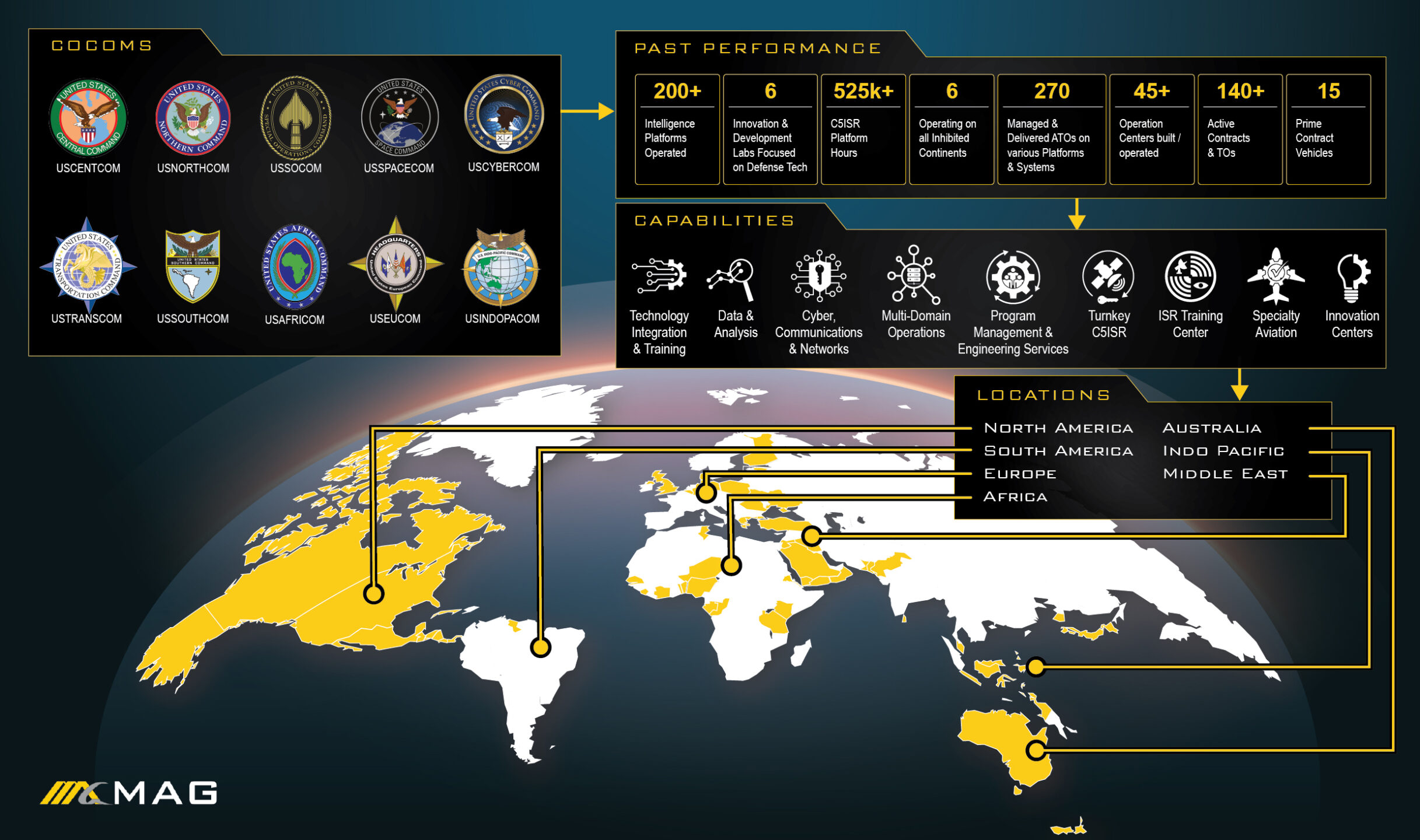
To understand how Multi-INT Sensor Fusion is executed in the modern battlespace, one must analyze the integrated capabilities of defense technology providers. Examining the portfolio of MAG—a premier provider of C5ISR (Command, Control, Computers, Communications, Cyber, Intelligence, Surveillance, and Reconnaissance) solutions—reveals the critical competencies required to support global Combatant Commands (COCOMs) in contested environments.
Multi-Domain Data Collection and the ATHENA-R Initiative
The foundation of sensor fusion is persistent, multi-domain data collection. MAG provides full-spectrum, Contractor-Owned/Contractor-Operated (COCO) ISR services, encompassing pilots, mission system operators, aircraft, and sensor integration. A prime example is the deployment of high-altitude, near-peer optimized aerial sensor platforms supporting the U.S. Army’s ATHENA-R (Army Airborne Reconnaissance and Electronic Warfare System).
The ATHENA-R platform exemplifies Multi-Domain Operations (MDO) survivability by operating at altitudes exceeding 40,000 feet, providing standoff range, and utilizing advanced radar warning receivers to achieve 12.5+ hours of sustained mission endurance.
By mathematically correlating a Moving Target Indicator (MTI) track of a moving convoy with a COMINT intercept originating from the identical coordinates, Multi-INT fusion algorithms exponentially increase the confidence score of the target track.
This fused intelligence allows commanders to authorize Long Range Precision Fires (LRPF) with unprecedented speed, effectively shortening the sensor-to-shooter timeline.
Secure, Resilient Digital Transport and C2 Architectures
Fusing intelligence is practically useless if the resulting insights cannot reach the decision-maker. Next-generation capabilities involve bridging tactical and enterprise systems using a multi-layered, transport-agnostic approach.
For Special Operations Command Pacific (SOCPAC), MAG developed an Airborne Beyond Line-of-Sight (AB2) digital transport architecture. This system distributes secure, fully compliant 1080p, 25 FPS Full Motion Video and C2 information from COCO aerial platforms across multiple theater nodes utilizing a Managed Private Service (MPS) commercial backhaul.
Crucially, this architecture enabled the subsequent tech insertion of AI/ML and Edge Computing capabilities directly into the BLOS C2 distribution system, demonstrating the vital link between resilient communications and advanced analytics.
Similarly, the U.S. Navy’s STING 2.0 (Systems Training and Integration Network Group) capability showcases a U.S. Government-owned multi-domain C2 Common Operational Platform. The STING 2.0 roadmap includes the integration of Lloyd’s List Intelligence for AI/ML Contact Behavior Recognition, Automatic Target Recognition (ATR) across sensors, and Counter-UAS (C-UAS) domain awareness, driving actionable intelligence visualization via the Android Tactical Assault Kit (ATAK).
Global C5ISR Operations and Special Operations Readiness
The scale of multi-domain operations requires physical infrastructure and operational expertise across all inhabited continents. MAG has built and operated over 17 remote and split operations centers for the U.S. Air Force, Royal Air Force, and U.S. Army Intelligence and Security Command (INSCOM), demonstrating the logistics required to support ATHENA-R and MQ-9 Reaper platforms globally. In South America and Africa, these systems deploy LiDAR and SAR to combat narcotics, human trafficking, and near-peer influence, logging thousands of AIS detections and significantly disrupting illicit activities.
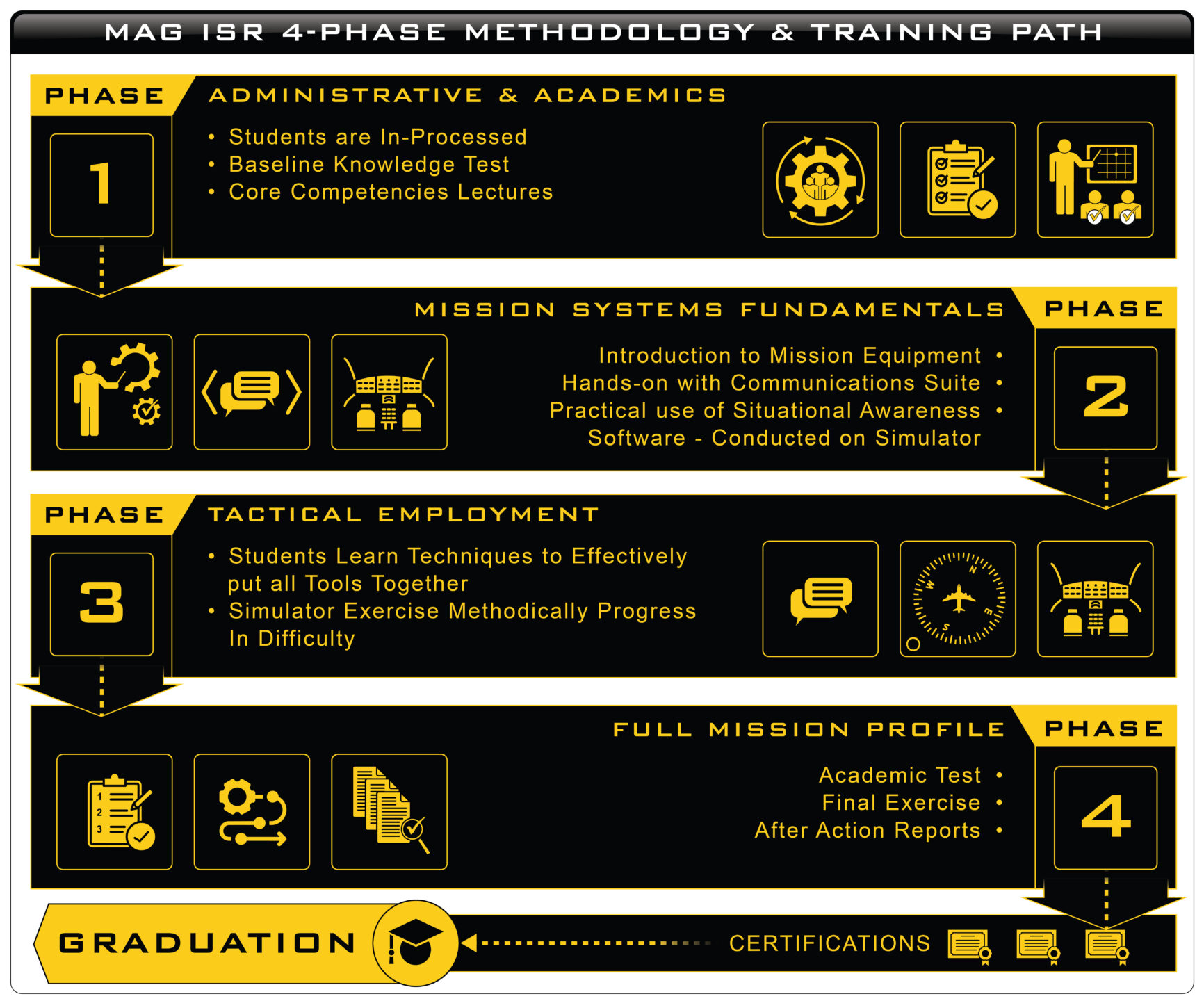
The tactical culmination of this fusion is kinetic and dynamic strike execution. Through MAG’s Intelligence Surveillance Reconnaissance Training Center (ISRTC) advanced training courses like the Kinetic Strike Training Course (KSTC), Dynamic Strike Training Course (DSTC), and Target Engagement Authority Training Course (TEA-TC), industry partners support Special Operations Forces (SOCOM) and AFSOC by providing Joint Terminal Attack Controller (JTAC) certification, loiter munition TTPs, and F3EAD (Find, Fix, Finish, Exploit, Analyze, and Disseminate) process oversight in denied environments.
The Technological Pillars of Next-Generation Fusion
Achieving true Multi-INT Sensor Fusion requires several foundational technologies to work in concert. The transition from legacy, hardware-defined systems to modern, software-defined ecosystems is driven by three critical pillars: Artificial Intelligence (AI) and Automatic Target Recognition (ATR), Modular Open Systems Approach (MOSA), and Data Fabrics underpinned by Zero Trust architectures.
1. Artificial Intelligence and Automatic Target Recognition (ATR)
The sheer volume of data generated by modern multi-domain sensors far exceeds human cognitive processing capacity. A single high-altitude SAR sweep or hyperspectral imaging pass can generate terabytes of data.
To bridge this gap, AI and Machine Learning (ML)—specifically deep learning architectures like Convolutional Neural Networks (CNNs)—are deployed at the tactical edge to perform Automatic Target Recognition (ATR).
CNN-based models, such as OverFeat, YOLO, or Faster R-CNN, are trained on vast datasets of synthetic, scale-model, and real sensor data to autonomously identify, classify, and track high-value targets.
These models streamline the detection process by combining localization (creating bounding boxes) and classification into a single processing pipeline, evaluated against Intersection over Union (IoU) metrics to determine detection accuracy.
- Algorithmic Fusion: Advanced fusion algorithms do not simply overlay images; they mathematically combine the probability vectors from multiple sensors. For example, utilizing Optimal Bayesian Fusion (OBF), a system can aggregate the classification probability vectors from multiple individual radar observations at a given time step, or combine a radar’s High Range Resolution Profile (HRRP) with an EO/IR visual feed. This method significantly outperforms single-radar or suboptimal soft-voting fusion methods, driving higher classification accuracy in high-noise environments.
- Behavioral Recognition and Cognitive EW: AI is also revolutionizing Electronic Warfare. Programs like DARPA’s Behavioral Learning for Adaptive Electronic Warfare (BLADE) and Adaptive Radar Countermeasures (ARC) utilize machine learning to automatically characterize new, dynamic radio threats and synthesize novel countermeasures in real-time, moving away from reliance on static, pre-programmed threat libraries.
The operational impact is profound. By filtering out benign clutter and autonomously prioritizing threats, AI-driven ATR systems reduce operator cognitive load, minimize the sensor-to-shooter timeline, and drastically lower the rate of false target identifications.
2. Modular Open Systems Approach (MOSA) and SOSA Standards
Historically, military sensor payloads and C2 systems were developed as proprietary, “black box” solutions by prime contractors. This vertical integration resulted in rigid vendor lock-in, where upgrading a single sensor required a complete, highly expensive system overhaul, severely hindering the speed of modernization and horizontal interoperability.
To counter this, the DoD issued a Tri-Service acquisition memorandum mandating the adoption of a Modular Open Systems Approach (MOSA) across all weapon systems. At the forefront of this initiative is the Sensor Open Systems Architecture (SOSA) Consortium, managed by The Open Group, which provides a unified framework for transitioning sensor systems based on industry-government consensus.
The SOSA Technical Standard defines strict architectural modules containing functions and behaviors with defined open interfaces for software components, hardware elements, and electrical/mechanical interfaces. By adhering to SOSA standards, a commander can “plug and play” a new hyperspectral camera or an upgraded ELINT receiver into an existing platform without requiring a multi-year integration contract.
This modularity allows the military to leverage the rapid innovation cycles of Commercial Leap Ahead Technologies, ensuring that the latest AI algorithms or edge computing hardware can be seamlessly swapped into legacy systems to maintain a competitive advantage.
3. Data Fabrics and Zero Trust Security
If sensors and AI algorithms are the brain and eyes of the system, the Data Fabric is the central nervous system. A Data Fabric is a federated, secure data environment that connects disparate data lakes, cloud architectures, and tactical edge nodes, ensuring that authoritative data is discoverable, accessible, and understandable across the Joint Force.
As the Army transitions to a data-centric culture via modernization efforts like the cARMY cloud and Project Olympus, the Data Fabric becomes the mechanism through which Multi-INT fusion is presented as a Joint Common Operating Picture (COP).
However, sharing data dynamically across multi-national coalitions (e.g., NATO or FVEY partners) presents massive security challenges. The traditional perimeter-based security model is inadequate. Therefore, the Data Fabric must be underpinned by a Zero Trust Architecture (ZTA).
Zero Trust assumes the network is always hostile. Through robust Identity, Credential, and Access Management (ICAM), the system dynamically tags data and authenticates users on a granular, attribute-based level. This allows a U.S. Army artillery commander, a Navy carrier strike group, and a British allied unit to operate securely within the same Data Fabric, with the AI-driven network automatically filtering and rendering data based strictly on each user’s real-time “need to know” and clearance level.
Overcoming Challenges in the Contested Environment
While the vision of CJADC2 and Multi-INT fusion is compelling, realizing it in a peer-adversary conflict involves significant operational and technical friction, specifically regarding interoperability and contested environments.
The Interoperability Gap and “Loose Couplers”
A primary hurdle is horizontal interoperability across the military branches. The services have historically acquired systems vertically, optimizing for domain-specific tasks rather than joint integration. For example, integrating 5th-generation stealth aircraft (F-35, F-22) with 4th-generation platforms or ground C2 nodes has frequently required specialized “workaround” gateways such as customized Link-16 translation systems to create a unified tactical data link network.
Attempting to force universal, complete interoperability across every legacy system is a futile and overly expensive endeavor. Instead, modern CJADC2 doctrine advocates for integration via “loose couplers”. Rather than sharing raw data seamlessly across every platform, loose coupling involves exchanging a minimal amount of highly structured, high-impact information (e.g., fused targeting metadata) through standardized Application Programming Interfaces (APIs). What this approach sacrifices in data richness, it makes up for in flexibility, efficiency, and the ability to dynamically connect the widest possible array of diverse systems in real-time without overwhelming the network architecture.
The DDIL Reality and Adaptive Networking
Peer adversaries will actively employ jamming, cyber attacks, and anti-satellite (ASAT) weapons to deny the electromagnetic spectrum. Operating in Denied, Degraded, Intermittent, and Limited (DDIL) environments requires adaptive, transport-agnostic networks.
Future C5ISR architectures will rely on resilient, self-healing mesh networks. Systems must possess Primary, Alternate, Contingency, and Emergency (PACE) communications pathways, capable of automatically routing fused intelligence through whichever node is available—whether that is a tactical radio, a low-earth orbit (LEO) commercial satellite constellation, or an optical intersatellite link (OISL).
To achieve this, initiatives like DARPA’s Space-Based Adaptive Communications Node (Space-BACN) are creating reconfigurable, multi-protocol intersatellite optical communications terminals. These low size, weight, power, and cost (SWaP-C) terminals are designed to connect heterogeneous satellite constellations that operate on different OISL specifications, eliminating isolated “islands of connectivity” in space and ensuring continuous data transport for the joint all-domain fight.
Future Outlook: Mosaic Warfare and the Next Generation of Warfare
As the DoD looks beyond the initial implementation of CJADC2, the paradigm of Multi-INT sensor fusion is evolving toward DARPA’s concept of Mosaic Warfare.
Traditional military acquisition focused on monolithic “system of systems” architectures—highly complex, expensive platforms (like a fifth-generation fighter or an advanced destroyer) that represented single points of failure.
Mosaic Warfare, conversely, treats the battlespace like a mosaic composed of many smaller, individual, and highly fluid pieces. Under this construct, lower-cost, less complex, and attritable systems—such as swarms of autonomous UAVs and unmanned surface vessels—are dynamically linked together.
| Legacy "System of Systems" | Mosaic Warfare Framework |
|---|---|
| Monolithic, highly complex platforms (e.g., F-35, Destroyers). | Disaggregated, attritable platforms (e.g., UAV swarms, USVs). |
| Rigid, predefined communication architectures. | Fluid, ad-hoc, self-healing mesh networks. |
| Single point of failure; loss of platform degrades entire capability. | Highly resilient; loss of a node is instantly bypassed by the network. |
| Vulnerable to targeted kinetic or cyber attacks. | Overwhelms adversary decision-making via complexity and scale. |
If an adversary destroys a node in the mosaic, the AI-driven network instantly reconfigures, utilizing remaining sensors to maintain the Multi-INT common operating picture. By distributing the “sense-decide-act” systems across a vast array of platforms, commanders can mass firepower and kinetic effects without having to physically mass vulnerable troop formations, introducing insurmountable complexity to the adversary’s targeting cycle.
Advancing Sensor Modalities and Evaluation
The sensors feeding this mosaic are also rapidly advancing. While traditional radar and EO/IR remain fundamental, the future of Multi-INT fusion will heavily incorporate Hyperspectral Imaging, capable of detecting hidden explosives, camouflaged objects, and chemical traces by analyzing a vast spectrum of electromagnetic bands. Furthermore, Quantum Sensing offers the potential for magnetic anomaly detection and highly precise inertial navigation entirely independent of GPS, ensuring operational continuity even if the space domain is compromised.
To evaluate and manage this complexity, the Air Force Research Laboratory (AFRL) relies on the COMPrehensive Assessment of Sensor Exploitation (COMPASE) Center to conduct independent sensor exploitation technology assessments, ensuring algorithmic integrity and fusion accuracy before deployment.
Additionally, tools like DARPA’s CyPhER Forge will deploy AI test agents and multi-physics digital twins to automate the planning and execution of combat systems testing, accelerating the deployment timeline for these vast, interlocking sensor webs.
Conclusion
Multi-Intelligence Sensor Fusion is no longer an abstract technological aspiration; it is the fundamental prerequisite for survival and victory in the modern, multi-domain battlespace. As adversarial capabilities in electronic warfare, hypersonic weaponry, and cyber operations mature, the United States and its allies cannot rely on the slow, federated intelligence models of the past.
The successful implementation of the CJADC2 Minimum Viable Capability proves that the DoD, in close partnership with agile defense technology integrators, can field the data fabrics, edge AI processing, and open-architecture hardware necessary to achieve true decision advantage. By continuously fusing SIGINT, GEOINT, and radar data at the tactical edge, the Joint Force can pierce the fog of war and operate inside the adversary’s decision cycle.
Frequently Asked Questions (FAQ)
- What is Multi-Intelligence (Multi-INT) Sensor Fusion? Multi-INT Sensor Fusion is the automated process of combining data from multiple, distinct intelligence sources—such as visual imagery (EO/IR), radar (SAR/ISAR), and intercepted signals (SIGINT/COMINT)—into a single, comprehensive, and highly accurate tactical picture. This process utilizes Artificial Intelligence and edge computing to correlate data in real-time, reducing uncertainty, minimizing false alarms, and creating a unified common operating picture.
- How does Sensor Fusion enable CJADC2? Combined Joint All-Domain Command and Control (CJADC2) relies on linking every sensor to every shooter across all military branches. Sensor fusion acts as the critical processing layer; rather than flooding the network with raw data, fusion algorithms at the edge process the information and send only lightweight, actionable targeting metadata (using protocols like Cursor on Target) across the CJADC2 data fabric, preserving bandwidth and accelerating decision-making.
- What is the Tactical Edge in military operations? The tactical edge refers to the front lines of an operation where warfighters, sensors, and platforms directly interact with the operational environment. Computing at the tactical edge means processing data locally on the aircraft, drone, or ground vehicle, rather than transmitting the data back to a centralized cloud or headquarters for analysis, which is critical in environments where communications are jammed or degraded.
- What is MOSA, and why is it important for defense sensors? The Modular Open Systems Approach (MOSA) is a DoD acquisition mandate requiring systems to be built using standardized, open hardware and software interfaces. Initiated by groups like the SOSA Consortium, it prevents vendor lock-in, reduces total lifecycle costs, and allows the military to rapidly upgrade individual sensor payloads without redesigning entire aircraft or vehicles.
- How does Zero Trust apply to military Data Fabrics? In a multi-domain operational environment, a Data Fabric connects disparate military and allied networks. A Zero Trust architecture operates on the assumption that the network is always hostile. It requires strict, continuous authentication and uses Identity, Credential, and Access Management (ICAM) to ensure that users—whether human or machine—only receive the specific data they are explicitly authorized to access, preventing widespread data breaches if a single node is compromised.
- What is DARPA’s concept of Mosaic Warfare? Mosaic Warfare is a strategic concept that moves away from relying on a few highly complex, monolithic weapon systems (like a single advanced fighter jet). Instead, it advocates for deploying a “mosaic” of numerous smaller, lower-cost, and attritable systems (like drone swarms and distributed sensors) networked together. If one piece is lost, the AI-driven network rapidly reconfigures, making the overall force highly resilient and overwhelmingly complex for an adversary to counter.
What Does MAG Aerospace Do?
MAG is a leader in delivering Command, Control, Communication, Computers, Cyber, Intelligence, Surveillance and Reconnaissance (C5ISR) services at the tactical edge with premier engineering and operational solutions around the world.
As the Lead Systems Integrator (LSI) and a proven U.S. Government Prime Contractor, MAG brings operational excellence and technical understanding with program management and systems engineering expertise to manage large, complex DOD systems development and deployment contracts.
MAG’s expertise in “Turnkey C5ISR” services involves taking commercial-off-the-shelf (COTS) technology and “missionizing” it for military use. MAG partners with non-traditional technology providers to accelerate adoption and compliance within the DoW (DoD) markets. By acting as a bridge between the commercial tech sector and the defense establishment, MAG ensures the warfighter has access to the latest defense technology on relevant timelines and across all domains.
MAG’s hybrid, technology and platform-agnostic business model enables us to work with the largest military OEMs, while avoiding vendor lock-in, as well as with small businesses and startups, to deliver large programs while accelerating deployment to the field and maximizing customer mission success. Solutions that require novel and state-of-the-art technologies with niche partners gives MAG the ability to continuously improve solutions with innovation. MAG experts are on the leading edge of technological advances, which enables MAG to rapidly prototype, integrate, and connect joint, next generation capabilities across Air, Land, Maritime, Space and Cyberspace Domains. Focused on making the world smaller and safer, MAG is defined by our core values of Serve. Win. Perform.
