
What Are the Key Cybersecurity Threats in Modern Space and Cyber Domains?
The key cybersecurity threats in modern space and cyber domains include identity-driven network intrusions, software supply chain compromises, and remote digital attacks targeting the communication links between ground stations and orbiting satellites. Adversaries frequently exploit legacy hardware and systems lacking robust encryption, leveraging artificial intelligence as a force multiplier to accelerate the attack lifecycle and disrupt critical space operations.
- Space Attack Frequency: The Space Information Sharing and Analysis Center (Space ISAC) records over 100 cyberattacks per week targeting infrastructure related to space systems, highlighting a massive underreporting discrepancy compared to public disclosures.
- Electromagnetic Spectrum Threats: Global shipping and aviation sectors have witnessed a 50% surge in satellite jamming and spoofing incidents, with over 1,100 vessels experiencing Global Navigation Satellite System (GNSS) interference in a single day during March 2026.
- Cost of Cyber Escalation: The global average cost of a data breach reached $4.88 million in 2024, while global cybercrime costs are projected to grow by 15% annually, reaching an estimated $10.5 trillion.
The Escalation of Cyber Incidents in Space
Space is no longer the quiet frontier it once was; it has transitioned into a highly contested and congested warfighting domain. Modern military, commercial, and civilian infrastructures are inextricably linked to space-based assets for communications, navigation, and real-time surveillance. This heavy dependence has transformed satellites and their supporting ground networks into high-value targets for nation-state actors and sophisticated cybercriminal syndicates.
The 2025 Space Threat Assessment by the Center for Strategic and International Studies (CSIS) reveals a severe escalation in threats targeting space systems. While kinetic direct-ascent anti-satellite (DA ASAT) missile tests have seen a temporary pause, digital and electronic warfare operations have multiplied exponentially. A critical challenge in assessing the true scope of these threats is the massive underreporting of cyber incidents. While the European Repository of Cyber Incidents (ERCI) documented only five successful attacks targeting the space sector in 2024, telemetry from the Space Information Sharing and Analysis Center (Space ISAC) indicates over 100 cyberattacks per week directed at space infrastructure. This discrepancy underscores the stealthy, persistent nature of modern cyber espionage and disruption campaigns in the space domain.
Furthermore, the conflict in Ukraine has served as a real-world testing ground for space-cyber warfare. Between February 2022 and September 2024, researchers documented over 120 publicly known cyber operations targeting the space sector, primarily involving distributed denial of service (DDoS) attacks (65%), network intrusions (11%), and data leak operations (9%). The 2022 Viasat cyberattack, which utilized AcidRain wiper malware to disable modems across Europe just before the Russian invasion, demonstrated unequivocally that space and cyber warfare are no longer separate domains. A single breach in a ground station or uplink can cascade into catastrophic failures across an entire satellite constellation, affecting GPS, communications, and military operations.
Identity-Driven Attacks and Supply Chain Vulnerabilities
The methodology of attackers targeting space and multidomain systems has evolved. According to incident response data from 2026, threat actors are shifting away from traditional brute-force tactics—which declined to 8% of initial access vectors—and are instead prioritizing identity-based attacks and social engineering. Identity weaknesses played a material role in nearly 90% of investigated cyber intrusions. Attackers recognize that it is often easier to steal valid credentials and log into a network than to hack through its perimeter defenses.
Simultaneously, the software supply chain has emerged as a critical vulnerability for the space and defense industrial bases. Adversaries are no longer merely looking for vulnerable code; they are actively exploiting trusted connectivity between government agencies, prime contractors, and third-party vendors. In April 2026, multiple major data breaches were traced back to shared third-party vendors and broad OAuth application permissions, highlighting that an organization’s security posture is inextricably linked to the vulnerabilities of its external partners. The growing reliance on commercial off-the-shelf (COTS) components in satellite manufacturing expands the attack surface, making commercial space systems highly attractive targets for state-sponsored actors seeking to disrupt military logistics and command structures.
Legacy Hardware and Encryption Gaps
Compounding these modern threats is the presence of legacy hardware in orbit. Many older satellite models were designed and launched during an era when space was considered a sanctuary, free from the immediate threat of cyber exploitation. Consequently, these space vehicles often lack robust, end-to-end encryption and the processing power required to support modern cryptographic standards.
Unlike terrestrial IT infrastructure, satellites in orbit cannot be easily serviced or upgraded. If an adversary successfully targets the communications link between a ground station and an older satellite, they may be able to intercept sensitive data flows or, in severe cases, inject malicious command-and-control (C2) instructions. This reality highlights the urgent need for proactive security measures and the implementation of zero-trust architectures that do not implicitly trust commands merely because they originate from a recognized ground station.
How Do Adversaries Exploit the Electromagnetic Spectrum?
Adversaries exploit the electromagnetic spectrum primarily through electronic warfare tactics known as jamming and spoofing. Jamming involves overwhelming a specific frequency with high-power noise to sever the connection between a satellite and its receivers, while spoofing broadcasts fraudulent, manipulated signals that imitate legitimate ones, deceiving navigation and communication systems into accepting false position, navigation, and timing (PNT) data.
The Mechanics of Jamming and Spoofing
Every interaction with a satellite—whether for communications, remote sensing, or navigation—depends on the electromagnetic spectrum. Maintaining operational superiority requires effective management of this spectrum, especially as adversaries increasingly deploy advanced radio frequency (RF) tools to disrupt critical services.
- Jamming: This tactic is essentially a denial-of-service attack executed via radio waves. By broadcasting a powerful signal on the same frequency utilized by a satellite, an adversary raises the noise floor to a point where the legitimate signal is drowned out. Modern ground-based jammers are highly effective at blocking the uplinks and downlinks of communication satellites, paralyzing both civilian and military operations in the affected area.
- Spoofing: A far more insidious threat, spoofing does not block the signal; it replaces it. The attacker broadcasts a counterfeit signal that is slightly stronger than the authentic satellite transmission. The receiver locks onto this fraudulent signal, and the attacker gradually manipulates the data. In the context of the Global Positioning System (GPS), this allows adversaries to feed false coordinates or alter the perceived time, a tactic that can steer ships off course or disrupt the synchronized timing networks essential for financial transactions and power grid operations.
Global Hotspots and Commercial Impact
The theoretical threat of spectrum exploitation has become a daily operational hazard. According to the 2026 Global Counterspace Capabilities report and maritime analytics data, thousands of jamming and spoofing attacks have been recorded, primarily clustered around active conflict zones.
In March 2026, maritime operators experienced a 50% surge in satellite jamming and spoofing incidents globally. In a single day, over 1,100 vessels experienced severe GPS interference, causing their Automatic Identification Systems (AIS) to report wildly inaccurate locations—placing ships deep inland at airports, near nuclear power plants, or inside adversarial territory while they were actually transiting critical maritime chokepoints like the Strait of Hormuz. These incidents represent a profound hazard to navigation, safety, and supply chain logistics. The threat has grown so severe that major aviation platforms report regular hacking attempts; the FBI issued an aviation-specific warning in 2025 regarding criminal groups targeting airlines, urging stronger identity checks and vendor controls.
Aviation has similarly fallen victim to these electronic warfare tactics. Crowdsourced data from Automatic Dependent Surveillance-Broadcast (ADS-B) systems has revealed widespread GNSS spoofing affecting commercial flights. Incidents are heavily concentrated in regions such as the Black Sea, where aircraft are spoofed to appear on approach to airports in Crimea, and the eastern Mediterranean, where flights are falsely positioned over Beirut or Cairo. In regions like Kaliningrad, analysts have documented clear evidence of multi-frequency jamming, indicating highly sophisticated, state-backed electronic warfare capabilities.
Lingering Effects on Navigation Systems
The danger of spoofing extends beyond the immediate area of interference due to the architecture of modern avionics and maritime navigation systems. The Federal Aviation Administration (FAA) notes that spoofing can have severe lingering effects.
When an aircraft’s receiver accepts false PNT data, that corrupted data is often fed into the Inertial Navigation System (INS) and the Flight Management System (FMS). Because these systems integrate data over time to calculate position, the injection of false coordinates corrupts the mathematical baseline. Consequently, the aircraft may continue to calculate an incorrect position for hours after it has flown out of the spoofing zone and reacquired authentic satellite signals. Pilots may experience unexpected turns, gross course deviations, and terrain pull-up warnings, requiring complete ground resets or factory resets of the navigation equipment to clear the corrupted algorithms.
Mitigation Strategies and Cognitive Radio Technologies
Countering these pervasive spectrum threats requires a transition from static defense to agile, intelligent systems. Advanced communication architectures are increasingly leveraging dynamic spectrum allocation, which allows systems to automatically detect interference and rapidly hop to clearer, uncontested frequencies.
Furthermore, the integration of Artificial Intelligence (AI) and machine learning into RF systems is yielding cognitive radio technologies. These AI-driven radios continuously monitor the electromagnetic environment in real-time, learning the patterns of adversarial jamming and spoofing attempts. By predicting interference before it causes a complete loss of link, cognitive radios can autonomously outmaneuver electronic attacks, ensuring that critical data flows remain uninterrupted even in highly contested multidomain environments.
What Strategies Ensure Complete Satellite and Space Vehicle Protection?
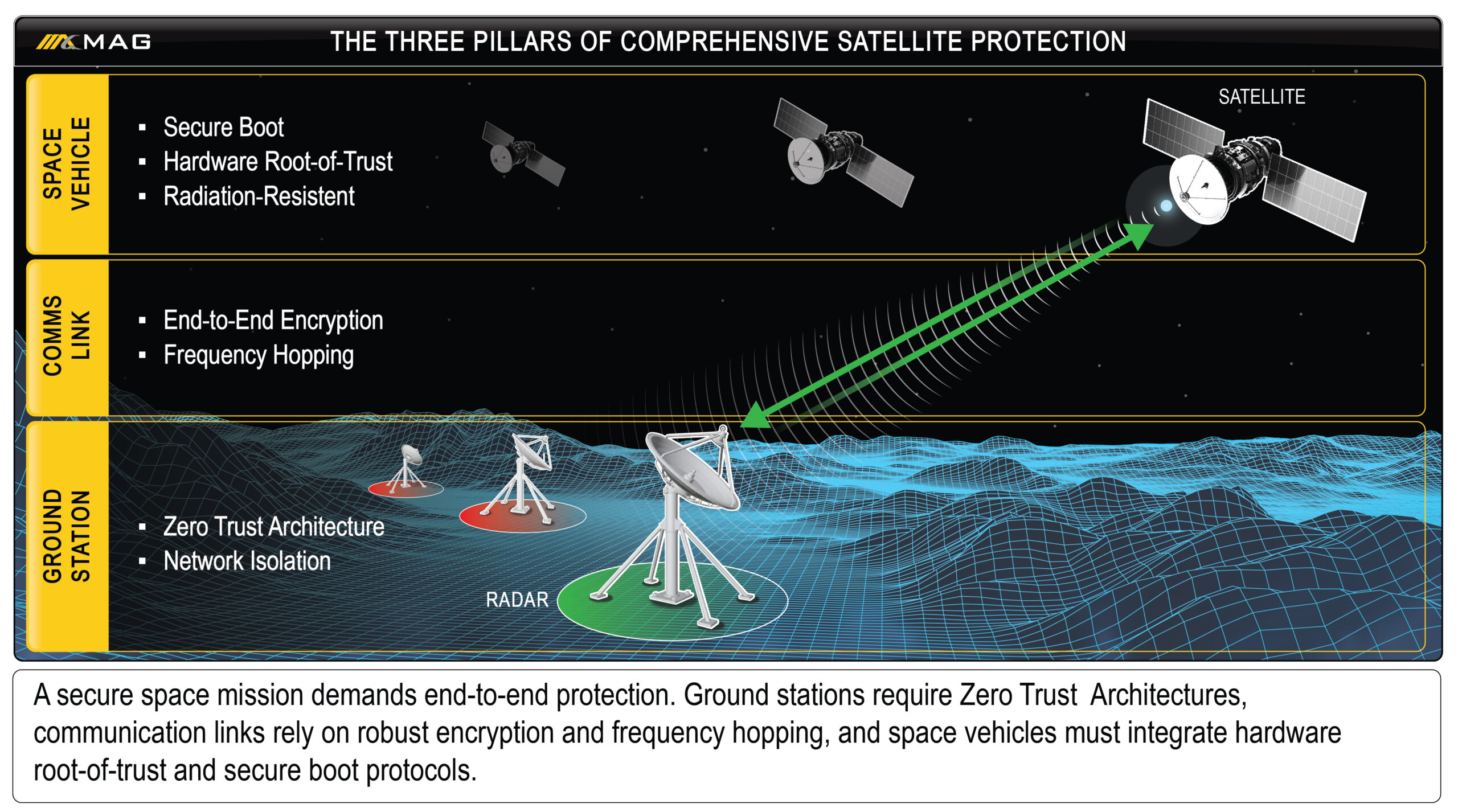
Ensuring complete satellite protection requires an integrated defense strategy that hardens three fundamental segments: the ground station, the communication link, and the space vehicle itself. Organizations must deploy strict access controls, robust cryptographic protocols, dynamic frequency hopping, and hardware root-of-trust mechanisms integrated with secure boot processes to defend against advanced persistent threats.
A vulnerability in any one of these three nodes can compromise an entire mission. As the Department of Defense (DoD) issues stringent new cybersecurity rules for commercial satellite vendors, operators must adopt a holistic security posture.
Ground Station Security and Zero Trust Architecture
Ground stations operate as the nerve centers for space missions. Because they are terrestrial and highly interconnected, they face the same gamut of cybersecurity threats as enterprise IT networks, including malware, phishing, ransomware, and insider threats.
Protecting the ground segment demands the implementation of a Zero Trust Architecture (ZTA). Traditional perimeter-based security—which assumes that any user or device inside the corporate firewall is trustworthy—is entirely inadequate for multidomain operations. Zero trust mandates the continuous verification of every user, device, and application attempting to access the network, regardless of their location. Strict access controls, multi-factor authentication, and the logical isolation of essential satellite command-and-control systems from the public internet are critical steps. By enforcing the principle of least privilege, zero trust minimizes the blast radius of a successful breach, preventing an attacker who compromises an administrative workstation from pivoting laterally into the satellite uplink systems.
Securing the Communication Link
The uplink (Earth-to-space) and downlink (space-to-Earth) channels transmit highly sensitive telemetry, tracking, and command (TT&C) data, as well as mission payloads. Adversaries actively target these RF links to intercept intelligence or inject malicious commands.
To secure the data in transit, organizations must employ advanced cryptographic standards. End-to-end encryption ensures that even if an adversary successfully intercepts the transmission, the data remains unintelligible. Furthermore, the deployment of spread-spectrum technologies and rapid frequency hopping makes it exceptionally difficult for attackers to lock onto and jam the signal, preserving the integrity and availability of the communication link.
Hardening the Space Vehicle and CNSS Requirements
The physical and digital hardening of the satellite itself is the final, and arguably most complex, defensive layer. Satellites operate in a harsh radiation environment that can cause bit flips in memory, leading to system anomalies that attackers can exploit. Utilizing radiation-hardened components is essential to maintain baseline operational stability.
Recognizing the escalating threat, the Pentagon’s Committee on National Security Systems (CNSS) has issued stringent new cybersecurity rules for commercial satellite operators supporting U.S. intelligence or military missions. The latest policy guidance mandates that space vehicles must:
- Be equipped with real-time on-board intrusion detection and prevention systems (IDPS).
- Employ a hardware root-of-trust to ensure secure reboot capabilities.
- Implement rigorous security patch management for both on-board and ground segment software.
Implementing secure boot protocols guarantees that when a satellite reboots—whether due to a cosmic ray strike or a scheduled update—it only executes cryptographically verified and digitally signed software. This prevents adversaries from establishing persistent backdoors or loading malicious firmware onto the spacecraft.
Consequence-Driven Cyber-Informed Engineering (CCE)
Forward-leaning organizations in the aerospace sector are adopting methodologies like Consequence-driven Cyber-informed Engineering (CCE) to build resilience from the ground up. Developed by the Idaho National Laboratory, CCE requires engineers to adopt a “think like the adversary” mindset during the design phase.
By identifying the most catastrophic consequences—such as the loss of satellite propulsion control or the permanent corruption of payload data—engineers can determine the exact pathways an attacker would take to achieve those outcomes. The system is then engineered to remove or mitigate those specific risks at the hardware and architectural level, prioritizing the defense of critical functions over general network security.
What Does Cyber Resilience Look Like in Multi-Domain Operations?
Cyber resilience in multi-domain operations (MDO) looks like a decentralized, interconnected architecture across land, sea, air, space, and cyberspace that can absorb digital strikes, adapt to degraded communication environments, and maintain critical mission functions without catastrophic failure. It relies heavily on mesh networking, Joint All-Domain Command and Control (JADC2) integration, and automated, AI-driven threat detection.
The Convergence of MDO and C5ISR
Modern military doctrine has moved decisively away from the platform-centric models of the past, where the superiority of a single weapon system determined battlefield outcomes. Today, warfare is defined by Multi-Domain Operations (MDO), which seeks to synchronize effects across land, sea, air, space, and cyberspace at a speed that outpaces the adversary’s ability to react. Critics of MDO have occasionally characterized the doctrine as “all facade and no filler,” arguing that it risks becoming a bureaucratic buzzword lacking intellectual clarity. However, operations such as the simulated integration seen in recent wargames prove that MDO is evolving into a tangible operational framework.
This doctrinal shift is heavily reliant on Command, Control, Communications, Computers, Cyber, Intelligence, Surveillance, and Reconnaissance (C5ISR) systems. C5ISR provides the technological backbone for MDO, fusing sensor data from satellites, drones, and ground radars to create a unified, real-time common operating picture (COP). The financial commitment to this architecture is immense; the global C5ISR market size was estimated at $144.23 billion in 2024 and is projected to expand to $189.00 billion by 2030, reflecting the urgent need for enhanced situational awareness and data processing capabilities.
| C5ISR Market Metric | 2024 Valuation | 2030 Projection | Growth Rate (CAGR) | Key Drivers |
|---|---|---|---|---|
| Global Market Size | $144.23 Billion | $189.00 Billion | 4.7% (2025-2030) | Demand for situational awareness, AI integration, modernization programs. |
| U.S. Market Size | $51.58 Billion | $67.88 Billion | 4.8% (2025-2030) | High defense budgets, multi-domain integration (JADC2). |
| Leading Component | Hardware (Largest Share) | Software (Fastest Growth) | 11.74% (Software) | Transition toward AI-enabled battle management and cyber applications. |
| Leading End-User | Army Formations | Air Force (Fastest Growth) | 12.55% (Air Force) | Development of sixth-generation platforms and autonomous systems. |
However, this unprecedented interconnectivity drastically expands the digital attack surface. In an MDO environment, a vulnerability in a naval vessel’s communication array could theoretically be exploited by hackers to pivot into linked satellite systems or land-based command centers. Therefore, cyber resilience—the ability to anticipate, withstand, recover from, and adapt to adverse conditions, stresses, attacks, or compromises—is not merely an IT concern; it is a fundamental operational imperative. The Department of War’s 2026 National Defense Strategy actively emphasizes this shift, prioritizing hemispheric security and integrated deterrence over outdated conventional conflict models.
Decentralized Command and Control
A resilient MDO architecture must prevent single points of failure. If an adversary successfully jams or physically destroys a primary ground control station, the entire data network cannot be allowed to collapse.
To achieve this, modern C5ISR networks utilize decentralized command and control frameworks powered by mesh networking. In a mesh architecture, satellites in a constellation communicate directly with one another via optical inter-satellite links, rather than relying solely on vertical “bent-pipe” connections to the ground. If a specific node is compromised or jammed, the network’s routing algorithms automatically detect the disruption and seamlessly reroute the data through alternative, secure pathways. This self-healing capability is central to the Pentagon’s Joint All-Domain Command and Control (JADC2) initiative, which aims to connect sensors from all military services into a single, highly resilient cloud-like network.
Programs like the Army’s Project Convergence, the Air Force’s Advanced Battle Management System (ABMS), and the Navy’s Project Overmatch are actively testing these integration endeavors. By testing platforms like the F-35 and Aegis systems in overlapping network environments, these initiatives resolve the technical hurdles of linking sensors to shooters across disparate domains.
Case Study: Operation Bunyanum Marsoos
The theoretical capabilities of MDO were vividly demonstrated in May 2025 during Pakistan’s Operation Bunyanum Marsoos. Following a regional escalation, military forces executed a coordinated, multi-domain campaign that fused missile systems, drone swarms, electronic warfare, and offensive cyber operations into a single integrated operational tempo.
This operation represented a major combat demonstration of an evolved MDO doctrine, proving that modern warfare is decided by the speed and coherence with which effects across multiple domains are synchronized. It underscored that legacy, service-based siloed operations are obsolete against an adversary capable of achieving convergence across kinetic and non-kinetic lines of effort.
The Role of Artificial Intelligence in Threat Detection
The sheer volume, velocity, and variety of data flowing through a multidomain battlespace make human-only monitoring practically impossible. Cyber resilience in this environment requires the deployment of Artificial Intelligence and Machine Learning (ML). Furthermore, the NATO alliance has recognized this necessity, actively pursuing a digital transformation strategy that incorporates AI to harness large datasets, secure communications, and accelerate the commander’s ability to react.
Automated threat detection systems utilize ML algorithms to establish a complex baseline of “normal” network behavior across thousands of endpoints and data streams. These systems can identify microscopic anomalies—such as an unusual spike in data transmission from a specific sensor, or a subtle change in a user’s access patterns—that may indicate the early stages of a cyber intrusion.
When a threat is detected, AI-driven security orchestration tools can respond at machine speed, autonomously isolating the compromised asset, revoking access credentials, and applying network micro-segmentation rules to prevent lateral movement. The integration of human-AI teaming approaches is also closing the talent gap in critical infrastructure, allowing human operators to manage situational autonomy while AI handles routine threat suppression. By addressing threats in milliseconds rather than hours, AI preserves the integrity of the C5ISR network and ensures that commanders maintain the decisive information advantage required for multidomain dominance.
How Does MAG Aerospace Neutralize Threats in Multi-Domain Environments?
MAG Aerospace neutralizes threats in multi-domain environments by delivering end-to-end C5ISR solutions, leveraging advanced engineering, rapid prototyping, and specialized aviation assets. By securing the entire data chain from collection to dissemination, MAG Aerospace ensures seamless Joint All-Domain Command and Control (JADC2) integration and operational resilience.
Comprehensive C5ISR and Situational Awareness
As operations span across air, land, maritime, space, and cyberspace, the demand for actionable, real-time intelligence is paramount. MAG Aerospace, headquartered in Fairfax, Virginia, has established itself as a premier provider of full-spectrum C5ISR services, dedicated to providing real-time situational awareness that makes the world smaller and safer.
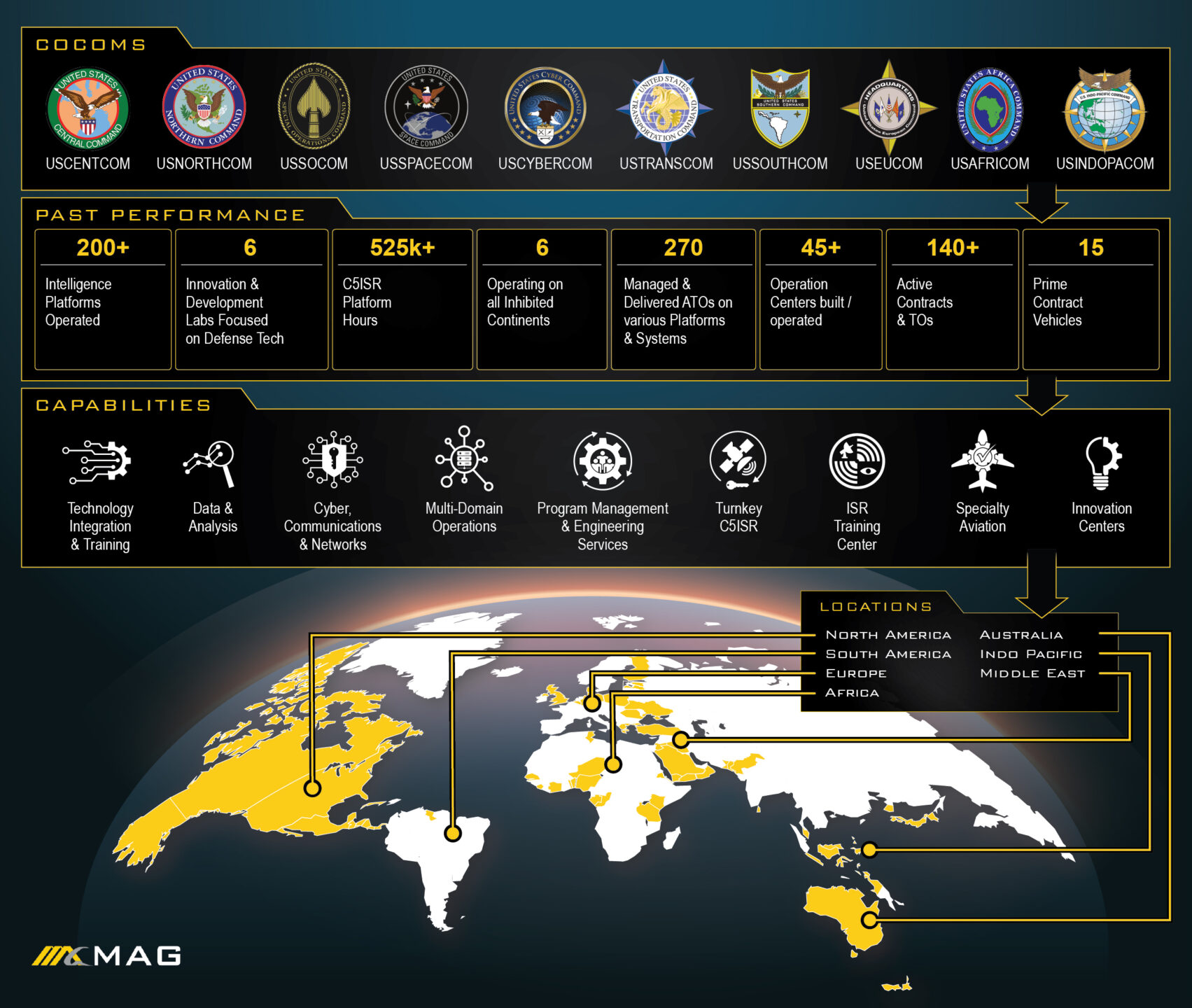
With a workforce of skilled professionals—where roughly 80% are veterans bringing direct combat and operational experience—MAG Aerospace operates on six continents, delivering approximately 100,000 flight hours annually. Their expertise encompasses airborne operations, unmanned aerial systems (UAS), technical training, systems integration, and cybersecurity. By securing the entire data chain across all operational theaters, MAG ensures that vital intelligence reaches decision-makers securely and without interruption, even in highly contested electromagnetic environments.
MAG Aerospace’s commitment to cyber resilience is further evidenced by their adoption of the Consequence-driven Cyber-informed Engineering (CCE) framework. By integrating CCE into their government services operations, MAG proactively identifies and mitigates the most critical vulnerabilities within their aviation and intelligence platforms, ensuring that their C5ISR networks can withstand advanced adversarial targeting.
Furthermore, MAG’s innovation centers—such as the Maryland Interoperability Innovation Center and the New Jersey Innovation Center—specialize in rapid prototyping, software engineering, and hardware design for communications. By staying at the forefront of technological advances, MAG Aerospace enables the rapid integration of next-generation JADC2 capabilities across all domains.
Conclusion
The character of modern conflict has fundamentally shifted. Space and cyberspace are no longer supporting environments; they are active, highly contested primary domains. As global adversaries rapidly deploy advanced electronic warfare tools, from GNSS spoofing to autonomous cyber intrusions targeting software supply chains, the reliance on legacy space infrastructure poses a severe strategic risk.
Securing the future of Multi-Domain Operations requires a paradigm shift away from perimeter-based defenses toward deep cyber resilience. This mandates the implementation of Zero Trust architectures at ground stations, dynamic frequency hopping for communications, and hardware-level root-of-trust for orbiting satellites. Furthermore, the immense volume of data generated by modern C5ISR networks necessitates the integration of artificial intelligence to achieve threat detection and mitigation at machine speed, thereby preventing cascading system failures.
Organizations and defense agencies must rely on proven defense technology integrators capable of securing the entire data lifecycle. With its vast operational footprint, commitment to consequence-driven cyber-informed engineering, and deployment of versatile ISR assets, MAG Aerospace continues to lead the charge in neutralizing complex threats.
Frequently Asked Questions
1. What are the main cybersecurity threats to satellites? The main cybersecurity threats to satellites involve digital exploits targeting ground stations, advanced attacks on the communication links between Earth and orbiting assets, and signal interference such as electronic jamming and spoofing. Adversaries frequently exploit software vulnerabilities in legacy hardware, utilize stolen identity credentials to bypass network perimeters, and target software supply chains to disrupt critical space operations.
2. How can organizations ensure complete satellite protection? Organizations ensure complete satellite protection by actively defending three critical segments: the ground station, the communication link, and the space vehicle. Securing these areas requires the implementation of strict Zero Trust access controls, robust end-to-end cryptographic protocols to protect data streams in transit, and the integration of radiation-hardened components alongside secure boot processes on the satellite itself.
3. Why is electromagnetic spectrum management important in space operations? Electromagnetic spectrum management is vital because space operations rely entirely on radio frequencies for telemetry, communication, and command. Effective spectrum management defends against active electronic warfare threats—such as GPS jamming and signal spoofing—by utilizing dynamic spectrum allocation and AI-driven cognitive radio technologies to detect interference and switch to uncontested frequencies, thereby maintaining operational superiority.
4. What does cyber resilience look like in multidomain operations? Cyber resilience in multidomain operations (MDO) ensures that interconnected systems across land, sea, air, space, and cyberspace continue functioning even while under sustained digital attack. This resilience is achieved by implementing decentralized command nodes and mesh networking to prevent single points of failure, strictly enforcing Zero Trust architectures, and deploying machine learning tools for automated threat detection and immediate isolation.
5. How does MAG Aerospace neutralize cybersecurity threats in multidomain environments? MAG Aerospace neutralizes cybersecurity threats in multidomain environments by delivering advanced C5ISR engineering, rapid system integration, and global operational support. By utilizing frameworks like Consequence-driven Cyber-informed Engineering (CCE) and deploying multi-role platforms, MAG secures the entire intelligence data chain, ensuring that critical systems remain protected and Joint All-Domain Command and Control (JADC2) networks function seamlessly.
What Does MAG Aerospace Do?
MAG is a leader in delivering Command, Control, Communication, Computers, Cyber, Intelligence, Surveillance and Reconnaissance (C5ISR) services at the tactical edge with premier engineering and operational solutions around the world.
As the Lead Systems Integrator (LSI) and a proven U.S. Government Prime Contractor, MAG brings operational excellence and technical understanding with program management and systems engineering expertise to manage large, complex DOD systems development and deployment contracts.
MAG’s expertise in “Turnkey C5ISR” services involves taking commercial-off-the-shelf (COTS) technology and “missionizing” it for military use. MAG partners with non-traditional technology providers to accelerate adoption and compliance within the DoW (DoD) markets. By acting as a bridge between the commercial tech sector and the defense establishment, MAG ensures the warfighter has access to the latest defense technology on relevant timelines and across all domains.
MAG’s hybrid, technology and platform-agnostic business model enables us to work with the largest military OEMs, while avoiding vendor lock-in, as well as with small businesses and startups, to deliver large programs while accelerating deployment to the field and maximizing customer mission success. Solutions that require novel and state-of-the-art technologies with niche partners gives MAG the ability to continuously improve solutions with innovation. MAG experts are on the leading edge of technological advances, which enables MAG to rapidly prototype, integrate, and connect joint, next generation capabilities across Air, Land, Maritime, Space and Cyberspace Domains. Focused on making the world smaller and safer, MAG is defined by our core values of Serve. Win. Perform.
