
Understanding Decentralized Execution in ISR Operations
Decentralized execution is the delegation of tactical decision-making and operational authority to lower-echelon units, empowering field operatives to take immediate, autonomous action based on real-time Intelligence, Surveillance, and Reconnaissance (ISR) data. This paradigm shift minimizes the latency inherent in centralized command, maximizes operational agility, and allows forward-deployed assets to operate decisively inside an adversary’s decision cycle.
In the modern theater of Great Power Competition (GPC), the sheer volume, velocity, and variety of ISR data generated by multi-domain sensors have rendered traditional, highly centralized Command and Control (C2) structures structurally obsolete. The Cold War-era reliance on centralized collection management—a paradigm historically focused on deliberate production rather than dynamic operational goals—lacks the agility required to meet the challenges of Information Age warfare. Today, optimizing for decision dominance and operational superiority requires an inverted approach to information dissemination: pushing critical insights, AI-enabled analytics, and execution authorities directly to the tactical edge.
This comprehensive report delves into the doctrinal foundations, technological enablers, and strategic applications of decentralized execution in ISR operations. It further highlights how leading defense integrators, such as MAG Aerospace, are pioneering the next generation of Combined Joint All-Domain Command and Control (CJADC2) capabilities to support this critical operational methodology.
The Impact of Decentralized Execution
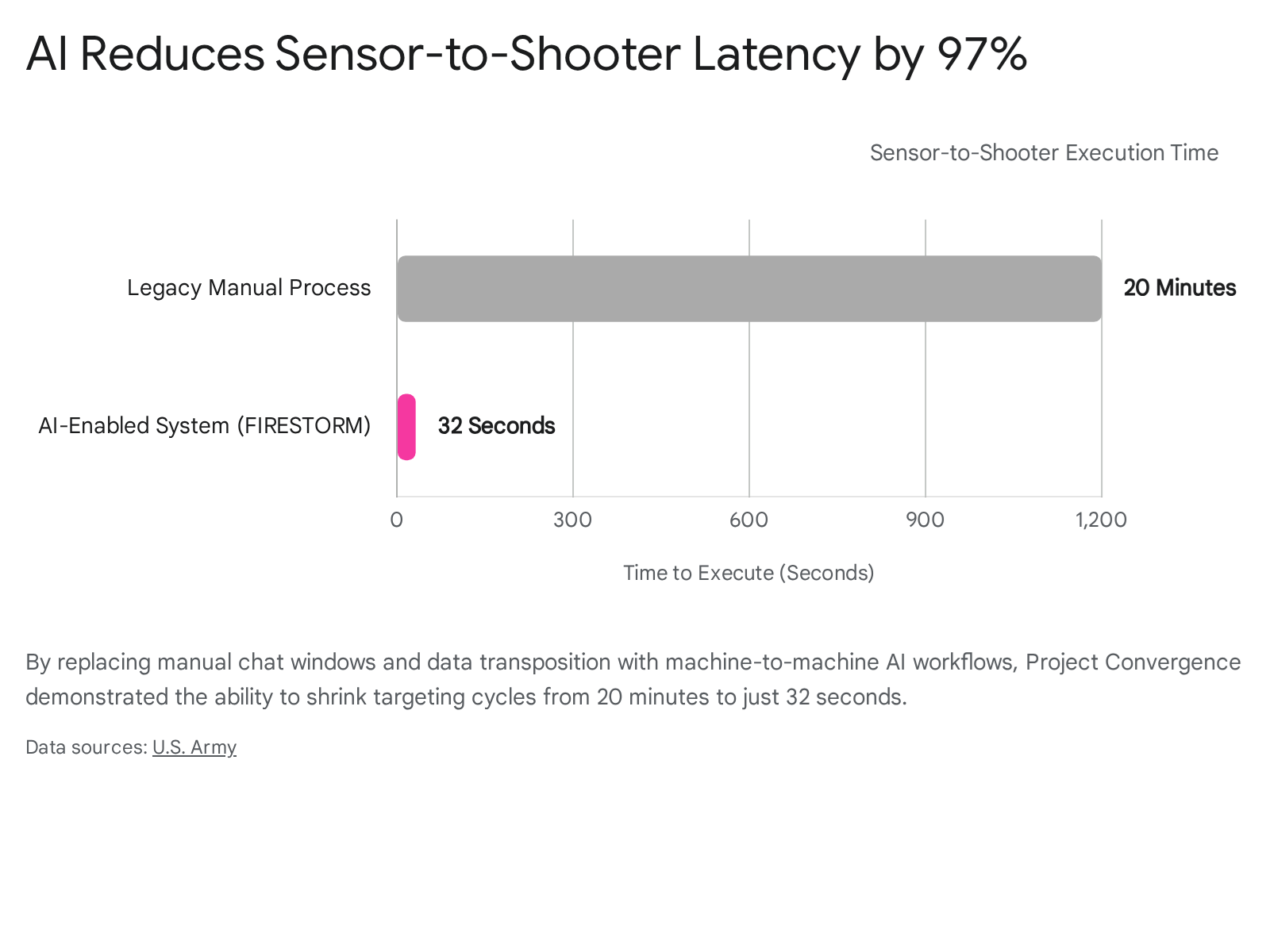
- Sensor-to-Shooter Acceleration: Advanced decentralized, AI-enabled battle management systems (such as the FIRESTORM framework) have successfully reduced the sensor-to-shooter data transmission timeline from approximately 20 minutes down to just 32 seconds, enabling near-instantaneous target engagement during operations like Project Convergence.
- Airspace Deconfliction Efficiency: During the Marine Corps’ Project Dynamis Serial 005 exercises, decentralized digital workflows leveraging a unified joint data mesh reduced airspace deconfliction times by up to 80%, allowing for the seamless integration of multi-domain fires.
- ISR Cycle Time Reductions: By modernizing Intelligence, Surveillance, and Reconnaissance (ISR) response processes and decentralizing execution, combat readiness centers and aviation elements have observed up to a 66% reduction in aircraft evaluation cycle times and a 36% reduction in initial response cycle times.
- UAS Mission Execution Optimization: The deployment of networked lethality software in uncrewed aerial systems (UAS) has successfully reduced the mission planning and transmission time from several minutes to mere seconds, vastly improving reliability over analog radio communications at the tactical edge.
The Doctrinal Foundations of Command and Control
The conceptual framework supporting decentralized execution is deeply embedded in the foundational military doctrine that governs joint operations. The United States Air Force, the United States Army, and the broader Department of Defense (DoD) have codified the philosophy of Mission Command as the absolute bedrock of modern operational success, recognizing that centralized execution is often fatal in contested environments.
Mission Command: The Philosophy of Operational Trust
Mission Command is a philosophy of military leadership that empowers personnel to operate in uncertain, complex, and rapidly changing environments through mutual trust, shared situational awareness, and a profound understanding of the commander’s overarching intent. As articulated in ADRP 6.0 and Air Force Doctrine Publication 1-1, Mission Command serves as the military’s optimal approach to C2 by explicitly empowering subordinate decision-making and decentralized execution appropriate to the specific tactical situation.
Historically rooted in the 19th-century Prussian concept of Auftragstaktik (mission-type tactics) developed by Helmuth von Moltke, this approach dictates that commanders should provide subordinates with a clear objective and intent but deliberately refrain from restricting them to a single, rigid operational approach. Moltke’s guiding axiom—”Provide subordinates only that information that they cannot determine on their own”—remains the philosophical standard for crafting modern mission-type orders (MTOs).
By relying on MTOs, commanders articulate the “what” and the “why” of a mission, leaving the precise details of the “how” to the trusted, highly trained professionals at the tactical edge. This philosophy recognizes a fundamental truth of modern warfare: no single entity or centralized headquarters can make every important decision at every critical moment, especially when time-constrained combat environments require hundreds of synchronized decisions per hour. As established in ADP 6-22, Mission Command is predicated on several interrelated principles: building cohesive teams through mutual trust, creating shared understanding, providing a clear commander’s intent, exercising disciplined initiative, using mission orders, and accepting prudent risk.
The Centralized Command, Distributed Control, Decentralized Execution (CC-DC-DE) Framework
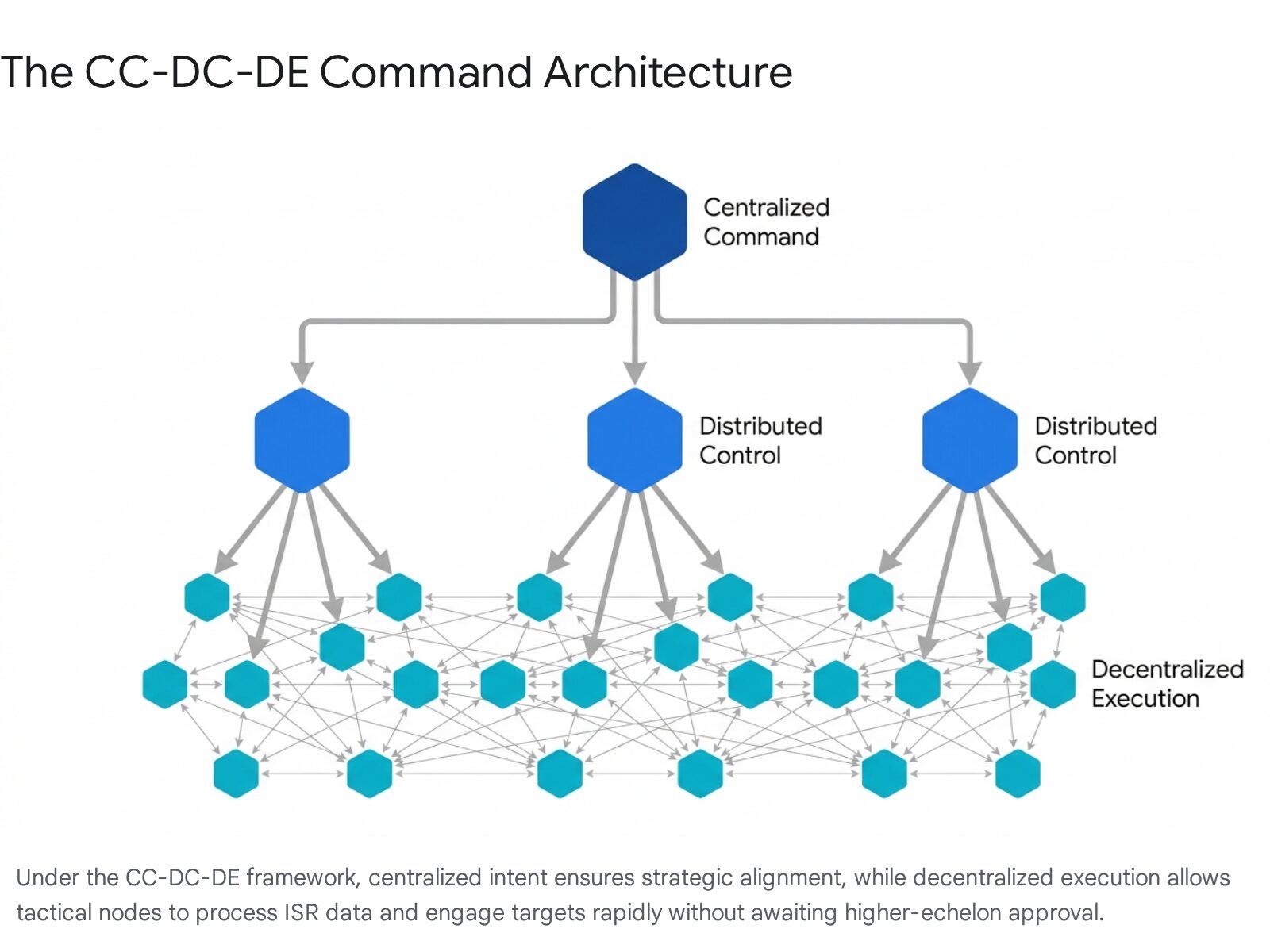
The practical, operational application of Mission Command within the aerospace domain is executed through a specific doctrinal framework known as Centralized Command, Distributed Control, and Decentralized Execution (CC-DC-DE). This framework is meticulously designed to fully capitalize on the speed, range, flexibility, and lethality of modern ISR and airpower assets.
- Centralized Command: This principle gives a single commander the overarching responsibility and authority for planning, directing, and coordinating a military operation. It ensures unity of effort and guarantees that all tactical actions remain firmly aligned with strategic objectives.
- Distributed Control: This operational approach enables commanders to delegate authorities for planning, coordination, execution, and assessment activities to dispersed geographical locations or subordinate echelons. Distributed control ensures an effective span of control and maintains the operational initiative, particularly in contested, degraded, or operationally limited (CDO) environments. By distributing control, the military prevents a single point of failure at the operational level.
- Decentralized Execution: The ultimate empowerment of subordinate decision-making. It enables flexibility, initiative, and immediate responsiveness in mission accomplishment. Decentralized execution actively empowers C2 nodes to direct assets dynamically during the execution phase of an operation, a practice often categorized as distributed battle management.
It is critical for operational planners to distinguish clearly between distributed control and decentralized execution. While distributed control delegates authority to subordinate commanders to manage assigned operations regionally, decentralized execution empowers the actual C2 nodes and field units to direct assets dynamically during the execution of the mission, operating strictly within the predefined bounds of the commander’s intent.
AFDP 3-0.1: The Intellectual Evolution of Command and Control
The Air Force’s recent publication of Command and Control represents a massive intellectual evolution in how the military understands and applies C2. Replacing the legacy AFDP 3-30, the new doctrine explicitly aligns C2 as an integral component of operations tailored for Great Power Competition and Joint All-Domain Operations (JADO).
Under AFDP 3-0.1, the C2 process is defined as a progressive, continuous, and iterative cycle consisting of four major activities: planning, preparing, executing, and assessing. Execution marks a fundamental shift in the commander’s role. While commanders are heavily involved in the planning and preparing phases to share information, gain consensus, and optimize operations, during the execution phase, their primary role changes completely. They must step back and empower subordinates to make decisions on their behalf.
This fundamental shift is the essence of decentralized execution. Tactically proficient operatives, armed with a clear understanding of the wider operational and strategic context, maximize lethality and efficiency by operating independently. History consistently demonstrates that the rapidity of action generated by decentralized execution is the most reliable method of operating inside an adversary’s decision cycle. Conversely, ignoring this tenet has historically led to the ineffective use of airpower and tragic operational failures.
As noted in Joint Publication 3-30: Command and Control of Joint Air Operations, the concept of centralized control and decentralized execution in air operations has been learned through nearly a century of experience, from the 1918 Battle of St. Mihiel to the opening phases of Operation Iraqi Freedom. During Desert Storm, to compensate for inevitable communication delays, General Norman Schwarzkopf entrusted Lieutenant General Charles Horner with total autonomy over the air war, utilizing mission-type orders to enable dynamic targeting and decentralized execution at the operational and tactical levels to devastating effect.
The Imperative for Dispersion and Cognitive Uncertainty
The drive toward decentralized execution is not merely a philosophical preference or a theoretical exercise; it is an urgent tactical necessity born from the unforgiving realities of modern warfare. In an era characterized by highly integrated, AI-enabled ISR systems, military formations face unprecedented targeting challenges. Near-peer adversaries now possess the capability to rapidly detect, identify, and prioritize high-value targets for precision massed fires across all domains.
Escaping the Graveyard of Command Posts
Traditional, highly centralized command posts generate massive electromagnetic signatures and rely on slow, deliberate data processing cycles that involve hundreds of staff officers. In a surveillance-saturated environment, these centralized hubs become highly vulnerable, high-payoff targets—a phenomenon military theorists increasingly refer to as the “graveyard of command posts”. Centralized control requires vast amounts of data to be transmitted from the tactical edge to a central hub, processed, and then transmitted back as an execution order. This inherently creates latency, exposing forces to enemy fires and slowing the operational tempo to an unacceptable crawl.
Furthermore, the advent of Network Centric Warfare has created a paradox. While it connects forces, “information superiority overload” can paralyze a centralized staff, lengthening decision-cycle times rather than shortening them. During operations in the Balkans, the availability of a rapidly disseminated operational picture to national command centers seriously affected theater commanders’ ability to exercise control, as higher echelons constantly intervened in tactical decisions. To avoid this paralysis and micromanagement, true decentralized execution grants direct access to intelligence at lower levels, removing the bottleneck of higher-headquarters approval for time-sensitive weapon employment and returning the initiative to the tactical edge.
Cognitive Dispersion as a Weapon
Decentralized execution enables a critical defensive and offensive strategy: cognitive dispersion. Dispersion is no longer just about physically separating forces to survive an artillery strike; it is about introducing deep, systemic uncertainty into an adversary’s targeting cycle.
By operating via decentralized, independent, and seemingly disconnected nodes, friendly forces degrade the adversary’s confidence in their own ISR outputs. If enemy targeteers—whether human analysts or AI-driven algorithms—cannot confidently determine the function, value, or continuity of a dispersed, decentralized unit, they hesitate or misprioritize their fires. This hesitation introduces cognitive doubt, weakening the bridge between data collection and actionable targeting. In modern conflict, opacity, ambiguity, and asymmetry are frequently more valuable than rigid, easily identifiable cohesion. Training leaders to think in uncertainty, utilize cognitive dispersion, and execute autonomously creates a force that is fluid, unpredictable, highly lethal, and exceptionally difficult to target.
Overcoming the Sensor-to-Shooter Gap
The ultimate metric of success in ISR operations is the speed, precision, and accuracy of the sensor-to-shooter kill web. For decades, the flow of intelligence from a strategic or theater-level ISR asset down to a tactical shooter was hindered by extreme latency.
Eradicating Legacy Latency
Historically, utilizing strategic ISR assets for Close Air Support (CAS), Strike Coordination and Reconnaissance (SCAR), or dynamic targeting faced massive bureaucratic and technological hurdles. Information flow was routinely stymied by satellite downlink delays, exhaustive intelligence processing, exploitation, and dissemination (PED) cycles, and manual C2 routing. Communicating between disparate Service systems required personnel to monitor multiple internet relay chat windows, manually transpose grid coordinates, and re-enter data into separate fire control systems—a labor-intensive process that easily took 20 minutes or more and invited catastrophic human error. In a dynamic environment where an adversary’s detectable signatures (DSIGs) continue to shrink as they learn to evade surveillance, a 20-minute delay guarantees a missed opportunity.
Advanced Technological Enablers: FIRESTORM and Project Convergence
To actualize decentralized execution, the military requires technology that processes data at machine speeds. The U.S. Army’s Project Convergence serves as the premier campaign of learning for this modernization effort. Beginning as “Project Quarterback” and evolving into a massive Joint Force initiative, Project Convergence evaluates commercial and contracted technologies to integrate and synchronize related efforts across all branches.
During Project Convergence 20, the military tested a revolutionary system known as FIRESTORM (FIRes Synchronization To Optimize Responses in MDO). FIRESTORM operates as an AI-enabled “computer brain” that ingests massive amounts of ISR data, updates the common operating picture, pairs the identified threat with the optimal available shooter, and autonomously relays targeting data across the network. Ketula Patel, an Intelligence Systems Branch Chief from the U.S. Army Combat Capabilities Development Command, noted that while legacy technologies required approximately 20 minutes to relay actionable data back to a soldier, the FIRESTORM system reduced the sensor-to-shooter timeline down to an astonishing 32 seconds.
This dramatic acceleration is mirrored in aviation logistics and maintenance. Initiatives to decentralize execution within the Navy and Marine Corps’ fleet readiness centers resulted in a 66% reduction in aircraft evaluation cycle times and a 36% reduction in initial ISR response cycle times, proving that decentralized workflows yield dividends across the entire operational spectrum. Similarly, Army Armaments Center engineers utilizing the CNALT networked lethality software reduced the mission time for HKR drone strikes from minutes down to seconds, demonstrating increased reliability over error-prone analog communications.
Project Dynamis and AI-Enabled Battle Management
The United States Marine Corps is equally aggressive in its pursuit of decentralized execution through Project Dynamis. Designed to accelerate the delivery of AI-powered decision advantage to the tactical edge, Project Dynamis focuses on building a resilient digital orchestration layer that connects sensors and shooters across the entire Joint Force.
During “Dynamis Serial 005,” an iterative exercise conducted concurrently across multiple sites including Fort Carson, Colorado (Ivy Sting V), and Charleston, South Carolina (Systems of Systems Naval Integration Experiment – SOSNIE), Marines utilized a unified, multi-domain joint data mesh. This mesh, powered by the Maven Smart System (MSS)—adopted as an enterprise-wide Marine Corps solution in 2025—allowed lower echelons to fuse data from multiple sources and orchestrate fire missions even in contested environments with denied or degraded communications.
The results of decentralized, machine-to-machine targeting were profound. By utilizing the joint data mesh and AI-workflows to digitally share High-Mobility Artillery Rocket System (HIMARS) munition flight path data simultaneously across Marine Corps, Navy, and Army systems, operators reduced airspace deconfliction times by up to 80%. This seamless flow of information represents the “holy grail” of modern military initiatives like Project Dynamis, the Army’s Project Convergence, and the Navy’s Project Overmatch: the ability to leverage any sensor, from any service, to engage a target with the best available weapon, completely regardless of domain, location, or network.
| Modernization Initiative | Lead Branch | Core Technology Focus | Key Demonstrated Metric |
|---|---|---|---|
| Project Convergence | U.S. Army | FIRESTORM AI, Machine-to-Machine Messaging | Sensor-to-shooter time reduced from 20 minutes to 32 seconds. |
| Project Dynamis | U.S. Marine Corps | Maven Smart System, Resilient Data Mesh | Airspace deconfliction times reduced by 80% via digital workflows. |
| Project Scarlet Dragon | XVIII Airborne Corps | BAS-T AI Algorithms, TWB | Sensitive Target Approval and Review (STAR) process completed within two hours. |
Scaling JADC2: Open DAGIR and JTIC2S
To effectively support these high-speed operations across the globe, legacy software architectures are being systematically dismantled and replaced. For over two decades, the Joint Automated Deep Operations Coordination System (JADOCS) served as the primary tool for deep fires management. However, JADOCS is rapidly approaching the end of its useful life, facing severe obsolescence issues due to outdated code and inflexible architecture that cannot support AI integrations at scale.
The Transition to JTIC2S
The Army is actively replacing JADOCS with the Joint Targeting Integrated Command and Coordination Suite. JTIC2S is a modern, software-only program developed using Continuous Integration/Continuous Delivery (CI/CD) models. It is designed to provide critical fires and targeting capabilities for joint, coalition, and organic fire support management at every echelon.
By providing a synchronized targeting tactical picture and a joint fires Common Operational Picture (COP), JTIC2S enables commanders to functionally integrate targeting efforts in a federated, decentralized method. This tool is foundational for supporting Multi-Domain Operations (MDO) against near-peer adversaries, allowing field operatives to organically manage target development while retaining access to the broader Joint All-Domain Command and Control (JADC2) network without relying on a single, vulnerable command post.
Scaling with Open DAGIR
Scaling these analytics and AI capabilities across the entire DoD requires a fundamental shift in defense procurement and data architecture. The Chief Digital and Artificial Intelligence Office (CDAO) recently launched the Open Data and Applications Government-owned Interoperable Repositories (Open DAGIR) framework.
Open DAGIR is a multi-vendor ecosystem with supporting business models that enable industry partners and the government to seamlessly integrate data platforms, development tools, services, and applications. Crucially, it preserves government data ownership while allowing innovative commercial vendors to build applications on top of the data. The DoD is utilizing the Open DAGIR ecosystem to support the data infrastructure underpinning CJADC2, ensuring that the mission command applications utilized in decentralized execution are constantly refreshed with the latest commercial innovations and AI algorithms.
Intelligence doctrine and edge computing for decentralized execution to succeed, the intelligence driving the tactical decisions must be impeccable, immediate, and formatted for machine ingestion. Intelligence outlines the critical need for comprehensive Battlespace Characterization.
Battlespace characterization is the continuous process of identifying what is and is not known about an operational environment, constantly updating assessments, and validating intelligence to provide a foundation for target development. In a decentralized environment, tactical units rely heavily on Intelligence Mission Data (IMD). IMD includes highly specific functional data—such as threat signatures, electromagnetic warfare reprogramming parameters, order of battle characteristics, and GEOINT performance data—that are rapidly updated and programmed directly into platform mission systems.
The proliferation of information-based weapon systems requires that IMD be produced and integrated rapidly. If a tactical unit operating under decentralized execution encounters a novel threat, edge-computing systems must instantly analyze the threat’s signature, format the data, and share it across the mesh network. This updates the battlespace characterization for all allied units simultaneously, without the need to route the data back through a centralized intelligence hub for human analysis. This edge-processing capability is the absolute prerequisite for true decentralized execution.
Real-World Applications of Decentralized Execution in ISR
The theoretical and doctrinal benefits of decentralized execution translate directly into massive, tangible operational advantages across various theaters and operational sets.
Counterterrorism and Dynamic Targeting
In counterterrorism scenarios, the lifespan of actionable intelligence is often measured in minutes. A high-value individual or mobile missile launcher may expose themselves only briefly before repositioning. Decentralized execution allows Special Operations forces and UAS operators to dynamically re-task their assets and prosecute a target based on real-time Full Motion Video (FMV) and SIGINT without routing a request through a distant, slow-moving headquarters. MAG Aerospace’s provision of turnkey ISR services and specialized sensor communications directly supports these ground elements, ensuring they have the technical autonomy required to act decisively and lethally. The XVIII Airborne Corps’ Project Scarlet Dragon exercises further demonstrated this, utilizing AI algorithms like BAS-T across multiple combatant commands to process thousands of detections an hour and complete the Sensitive Target Approval and Review (STAR) process in under two hours.
Disaster Response and Humanitarian Aid
During large-scale natural disasters, centralized communications infrastructure is frequently destroyed or overwhelmed. Decentralized execution proves invaluable in these chaotic environments, enabling first responders and supporting military units to make immediate, life-saving decisions based on organic, edge-processed ISR. Using platforms equipped with hybrid-propulsion drone technology, rescue teams can conduct autonomous search-and-rescue operations, identify hazards, and route critical supplies using edge-processed data while completely disconnected from higher command networks.
Cyber Defense and Electromagnetic Warfare
The cyberspace and electromagnetic spectrum (EMS) domains are characterized by millisecond engagements that far exceed human cognitive processing speeds. Cyber defense teams must operate autonomously to identify, isolate, and neutralize threats the moment they appear. Utilizing decentralized execution, automated systems can detect a network anomaly, characterize the malware, and reprogram network defenses instantaneously. In the EMS domain, tactical units can maneuver within the spectrum, jamming enemy communications or protecting friendly data links dynamically based on local threat assessments rather than waiting for theater-wide directives.
Navigating the Next Frontier in Command and Control
Decentralized execution is no longer a theoretical concept relegated to war college whitepapers; it is the absolute operational standard required for survival and success in modern conflict. By fully aligning with the CC-DC-DE framework, military organizations can leverage advanced AI, resilient data meshes, and next-generation aerial ISR platforms to consistently operate inside the adversary’s decision cycle.
To maintain dominance, defense organizations must prioritize the rapid adoption of modernized systems like JTIC2S and embrace innovative procurement frameworks like Open DAGIR to ensure their forces retain the technological agility required for Multi-Domain Operations. As unequivocally demonstrated by the drastic reduction in sensor-to-shooter timelines and airspace deconfliction processes, the empowerment of the tactical edge yields unprecedented lethality and operational efficiency.
Tailored Solutions for Decentralized Execution
At MAG, we offer advanced solutions and expert guidance designed to boost your operational efficiency and responsiveness. Reach out to us to discover how our expertise can empower your organization to fully leverage the advantages of decentralized execution in your ISR missions. Let’s work together to pioneer the future of intelligence, surveillance, and reconnaissance operations.
Contact MAG today for a detailed consultation, and embark on a journey to redefine your ISR capabilities.
Frequently Asked Questions (FAQ)
- What is decentralized execution in ISR operations? Decentralized execution in ISR is the deliberate delegation of tactical decision-making and operational authority to lower-level units on the ground or in the air. It empowers operators to use real-time intelligence to make immediate, autonomous decisions within the commander’s overarching intent, thereby vastly increasing operational speed, lethality, and agility.
- How does decentralized execution differ from distributed control? Distributed control allows commanders to delegate broad planning and coordination authorities to dispersed operational hubs (C2 nodes) to mitigate the risks to centralized command centers. Decentralized execution goes a critical step further, empowering the actual tactical nodes—such as field operatives, ships, or aircraft—to dynamically direct actions and engage targets during a mission.
- What is Combined Joint All-Domain Command and Control (CJADC2)? CJADC2 is the Department of Defense’s overarching modernization strategy to seamlessly connect sensors, shooters, and data across all military branches and all domains (air, land, sea, space, and cyber). It utilizes AI, cloud computing, and resilient networks to enable rapid, decentralized execution and synchronized multi-domain operations against near-peer adversaries.
- How does FIRESTORM enhance decentralized execution? FIRESTORM is an advanced AI-enabled battlefield management system that autonomously analyzes massive amounts of ISR data, updates the common operating picture, and pairs targets with the optimal available shooter. By automating data routing and target pairing, FIRESTORM has demonstrated the ability to drastically reduce sensor-to-shooter execution times from 20 minutes to just 32 seconds.
What Does MAG Aerospace Do?
MAG is a leader in delivering Command, Control, Communication, Computers, Cyber, Intelligence, Surveillance and Reconnaissance (C5ISR) services at the tactical edge with premier engineering and operational solutions around the world.
As the Lead Systems Integrator (LSI) and a proven U.S. Government Prime Contractor, MAG brings operational excellence and technical understanding with program management and systems engineering expertise to manage large, complex DOD systems development and deployment contracts.
MAG’s expertise in “Turnkey C5ISR” services involves taking commercial-off-the-shelf (COTS) technology and “missionizing” it for military use. MAG partners with non-traditional technology providers to accelerate adoption and compliance within the DoW (DoD) markets. By acting as a bridge between the commercial tech sector and the defense establishment, MAG ensures the warfighter has access to the latest defense technology on relevant timelines and across all domains.
MAG’s hybrid, technology and platform-agnostic business model enables us to work with the largest military OEMs, while avoiding vendor lock-in, as well as with small businesses and startups, to deliver large programs while accelerating deployment to the field and maximizing customer mission success. Solutions that require novel and state-of-the-art technologies with niche partners gives MAG the ability to continuously improve solutions with innovation. MAG experts are on the leading edge of technological advances, which enables MAG to rapidly prototype, integrate, and connect joint, next generation capabilities across Air, Land, Maritime, Space and Cyberspace Domains. Focused on making the world smaller and safer, MAG is defined by our core values of Serve. Win. Perform.
