
Introduction to Multi-Domain Operations and Modern Command & Control (C2)
Multi-Domain Operations (MDO) is the military strategy that treats air, land, sea, space, and cyberspace as interconnected layers of a single battlefield, rather than isolated theaters of war.
Combined Joint All-Domain Command and Control (CJADC2) provides the technological architecture, networking, and doctrinal framework required to synchronize data across these domains, delivering a decisive decision advantage to commanders operating in contested or degraded environments.
Modern military operations no longer occur within isolated, single-domain channels. Threats emerge rapidly across the air, land, maritime, space, and cyberspace domains, frequently materializing simultaneously to overwhelm traditional, segregated command structures. To respond effectively, joint forces require more than mere kinetic speed; they require absolute clarity, cross-service coordination, and the secure infrastructure to act upon highly accurate information before tactical windows of opportunity close. This core operational challenge is the primary catalyst driving the rapid evolution of command and control (C2) systems across the United States Department of Defense (DoD).
Multi-Domain Operations (MDO) serves as the strategic approach utilized by the United States military to fight and win across all five operational domains concurrently. The ultimate objective of MDO is to present adversaries with multiple, simultaneous dilemmas, paralyzing their decision-making cycles and overwhelming their capacity to react effectively. To support converging capabilities in time and purpose at decisive spaces—locations in time and space where cross-domain capabilities generate marked advantages—MDO utilizes five primary elements. These elements are preparation time, planning and execution time, duration time, reset time, and cycle time, which together visualize the convergence of multi-echelon capabilities.
Combined Joint All-Domain Command and Control (CJADC2) serves as the indispensable architecture that makes the execution of MDO possible. It is crucial to understand that CJADC2 is not a single weapon system, a monolithic software application, or an isolated program of record. Rather, it is a comprehensive, evolving framework designed to connect sensors, shooters, commanders, and disparate C2 systems across all military services, coalition partners, and domains in real time. The Department of Defense frequently utilizes a ride-sharing analogy to explain the CJADC2 end state: just as an algorithm optimally matches riders and drivers based on continuous variables like distance and time, the CJADC2 architecture seeks to instantly match the optimal platform or effector to a given target, regardless of which service branch operates the asset.
Achieving this unprecedented level of integration requires a massive paradigm shift in engineering, secure software development, interoperability infrastructure, and a steadfast commitment to building systems that inherently function together rather than in silos. Entities like MAG have built highly specialized capabilities around this exact mandate, operating physical networks of Innovation Centers designed to systematically accelerate the deployment of next-generation C5ISR (Command, Control, Computers, Communications, Cyber, Intelligence, Surveillance, and Reconnaissance) systems to the tactical edge.
Architecting CJADC2, Sensor Integration, and C5ISR Readiness: Department of Defense Budgetary Alignment
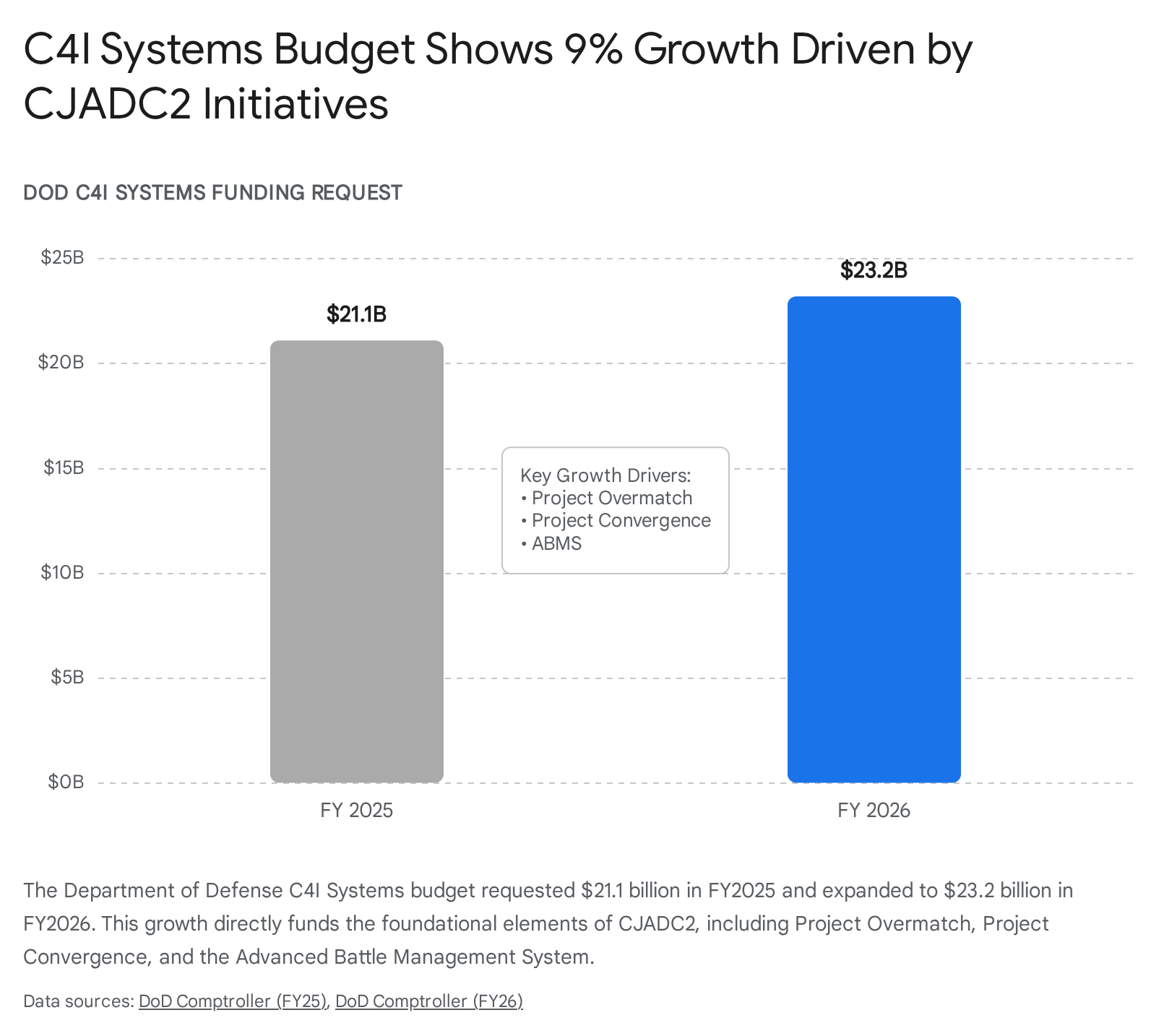
The DoD is rapidly scaling its CJADC2 architecture through major budgetary commitments, requesting $23.2 billion for C4I systems in FY2026. This funding drives service-specific contributions—the Army’s Project Convergence, the Navy’s Project Overmatch, and the Air Force’s ABMS—while the CDAO ensures overarching integration through experiments like GIDE.
The realization of CJADC2 relies heavily on the synchronized efforts and financial commitments of all military departments. Each branch is actively developing its own distinct contributions to the CJADC2 initiative, designed to bundle U.S. and allied sensors and shooters onto resilient, artificial intelligence-enabled networks to enable faster decision-making.
The strategic importance of this network is explicitly reflected in recent defense budget allocations. The Department of Defense’s C4I portfolio saw a budget request of $21.1 billion in FY2025, which subsequently expanded to $23.2 billion in the FY2026 President’s Budget request. This substantial 9% increase is primarily attributable to targeted investments in emerging capabilities such as CJADC2, tactical edge computing, and offensive cyber operations.
The framework of CJADC2 is supported by three primary pillars, each led by a specific military branch:
The Army’s Project Convergence
Project Convergence is the U.S. Army’s aggressive campaign of learning, experimentation, and demonstration designed to advance and integrate the Army’s contributions into the joint force.
The initiative focuses heavily on joint experimentation that actively incorporates the United States’ closest allies and international partners. Project Convergence 2026 specifically aims to develop the combined joint force’s ability to conduct offensive and defensive operations by dramatically enhancing situational awareness, counter-C2 measures, and integrated fires.
This capability is designed to deter peer adversaries and, if necessary, defeat them decisively in large-scale combat operations. The FY2026 budget allocations emphasize these modernization efforts, with significant investments directed toward Next Generation Command and Control (NGC2) at $555.2 million, supporting the broader “Transform in Contact” initiative. Additionally, Project Convergence funds analytical support for critical efforts like Long Range Precision Munitions and Directed Energy Maneuver-Short Range Air Defense.
The Navy’s Project Overmatch
Project Overmatch represents the U.S. Navy’s dedicated and classified contribution to the CJADC2 architecture. The initiative is hyper-focused on developing the required networks, infrastructure, data architectures, software tools, and analytics necessary to enable and sustain maritime dominance in highly contested environments.
The Chief of Naval Operations has positioned Project Overmatch as a top-tier priority to ensure that naval assets remain seamlessly synchronized with joint force teammates across the battlespace.
Funding for Project Overmatch is deeply integrated into the Navy’s Research, Development, Test & Evaluation (RDT&E) and Navy Working Capital Fund (NWCF) budgets, driving rapid capability insertion, facility revitalization (such as the secure Lab St. Julien’s Creek project), and the elimination of redundant acquisition workflows across the service.
The Air Force’s Advanced Battle Management System (ABMS)
Initiated to replace legacy, stove-piped command and control systems, the Advanced Battle Management System (ABMS) is the Department of the Air Force’s primary mechanism for delivering joint force decision superiority.
The Air Force has prioritized enabling warfighters to make operational decisions faster than potential adversaries, heavily leveraging digital modernization and data transaction as a new commodity for lethal force. The organizational structure managing ABMS has evolved; in September 2022, the Secretary of the Air Force established the Program Executive Office for Command, Control, Communications and Battle Management (PEO C3BM) to act as the integrating authority, bringing technical architecture and acquisition beneath a single empowered directorate.
The FY2026 budget request substantially increases funding for ABMS experimentation to empower the broader digital modernization of the military’s joint networks and further shorten sensor-to-shooter timelines.
The Role of the CDAO and GIDE
While the military departments build out their respective capabilities, the Chief Digital and Artificial Intelligence Office ensures enterprise-wide cohesion and data strategy alignment from the boardroom to the battlefield.
The CDAO contributes through vital, cross-cutting efforts like the Joint Operating System (JOS), the Data Integration Layer (DIL), Mission Command Applications (MCAs), and the Global Information Dominance Experimentation (GIDE) series.
GIDE serves as a series of crucial, quarterly experiments purposed to improve the collective force capacity to detect, deter, and dominate across globally interconnected security environments. The experimentation teams are comprised of leaders across all service branches, all eleven combatant commands, the Joint Staff, and international partners.
In 2024, the CDAO utilized the GIDE 8 iteration to successfully deliver the initial Minimum Viable Capability (MVC) for CJADC2, combining software applications, data integration, and cross-domain operational concepts aligned to global integration and joint fires mission threads. This MVC demonstrated that low-latency, reliable software could be fielded rapidly to empower warfighters, fundamentally proving the operational viability of the all-domain concept within a drastically compressed six-month development timeline.
Engineering the Tactical Edge: How MAG’s Innovation Centers Connect All Five Domains
MAG addresses the immense hardware, software, and interoperability challenges of CJADC2 through a strategic network of physical Innovation Centers. These specialized hubs operate as collaborative environments focusing on SATCOM integration, DevSecOps, 5G data fusion, and electronic warfare modeling to rapidly transition concepts to fielded capabilities.
The conceptual architecture of CJADC2 requires vast, highly advanced physical engineering infrastructure to become a deployable reality. Connecting signals intelligence (SIGINT) from an airborne maritime patrol platform directly to a joint command system necessitates advanced software routing, impenetrable cybersecurity architectures, and highly compatible communication waveforms. MAG supports this exact requirement through a specialized, strategic network of Innovation Centers located across the United States.
These facilities operate far beyond the scope of conventional laboratories. They function as collaborative hubs purposefully designed to bridge the historical gap between emerging commercial technology capabilities and operational military deployment requirements. The rapid prototyping, secure software development, modeling, simulation, and systems integration conducted at these centers form the backbone of next-generation C2 systems spanning all five operational domains.
The Maryland Interoperability Innovation Center
Operations that depend heavily on space-based communications require rigorous, continuous testing to guarantee that critical satellite links remain reliable in degraded, contested, or denied environments. The Maryland Interoperability Innovation Center specializes heavily in the hardware design required for tactical communications. The facility conducts extensive waveform development, integrates software-defined radios (SDRs), and manages complex Satellite Communications (SATCOM) terminal integration. It houses a dedicated SATCOM laboratory fully equipped with radio frequency testing capabilities, a mobile laboratory for executing over-the-air satellite evaluation, and comprehensive Ku-band and L-band testing infrastructure.
Furthermore, this center maintains a full contiguous United States (CONUS) satellite network that actively supports both continuous development cycles and live flight test operations, which is foundational for seamlessly integrating the space domain into broader CJADC2 interoperability efforts.
The New Jersey Innovation Center
In modern multi-domain warfare, secure software is as critical as kinetic hardware. The New Jersey Innovation Center, located in Tinton Falls, is heavily focused on secure software engineering, architecture, and cybersecurity engineering. The center handles classified developmental work at the highest national security levels, integrating rapid prototyping with rigorous systems integration.
A critical component of this facility’s operational methodology is its strict adherence to a Capability Maturity Model Integration (CMMI) Level 3-rated Secure Software Development Life Cycle. The CMMI Level 3 designation indicates that an organization’s processes are well-characterized, understood, and described in established standards, procedures, tools, and methods.
In defense software engineering, requiring CMMI Level 3 (or higher) ensures that unpredictable risks are mitigated, and that product development relies on productive, efficient, and highly repeatable behaviors rather than ad-hoc heroics. By systematically injecting security requirements into the very first line of code written, the New Jersey facility guarantees that C5ISR systems are fundamentally resilient against advanced persistent cyber intrusions.
Florida and Georgia Innovation Centers
Agility in software deployment and hardware manufacturing is a core tenant of modern military readiness. The Georgia Interoperability Innovation Center specializes deeply in DevSecOps, sophisticated software configuration management, and continuous technology insertion for communication systems. This ensures that critical software updates can be tested and deployed to the field at the speed of ongoing operations.
Similarly, the Florida Technology Integration and Interoperability Innovation Center (located on the Space Coast) delivers full-stack agile software development seamlessly combined with advanced manufacturing capabilities. Equipped with over 50,000 square feet of technology integration space, precision Computer Numerical Control (CNC) machining, and FAA-certified 3D printing capabilities, the Florida center dramatically accelerates the transition of conceptual designs directly into highly reliable fielded hardware.
The Mid-Atlantic Innovation Center
Effective multi-domain command and control hinges entirely on real-time data fusion. The Mid-Atlantic Innovation Center manages 33 distinct, specialized laboratories specifically focused on enabling technologies such as Artificial Intelligence (AI), 5G networks, and advanced software-defined radios. This facility excels at synthesizing disparate, often initially incompatible data feeds originating from ground systems, airborne sensors, cyber sources, and satellite links into a single, unified operational picture of the battlespace.
By programmatically correlating electronic intelligence from one specific platform with broader cyber awareness data, the center empowers commanders to make rapid, context-rich decisions, effectively eliminating the cognitive overload historically associated with manually aligning disconnected tactical data streams.
Secure Architecture: NIST SSDF and NSA CSfC Frameworks
To secure the vast amounts of classified data flowing through CJADC2 networks, the DoD mandates strict adherence to the NIST Secure Software Development Framework (SSDF). Concurrently, the NSA’s Commercial Solutions for Classified (CSfC) program enables the rapid, secure integration of commercial off-the-shelf technologies to protect National Security Systems.
The dramatic expansion of interconnected, multi-domain networks inherently expands the attack surface available to near-peer adversaries. To proactively mitigate these risks, defense contractors, systems integrators, and government agencies rely on stringent, codified cybersecurity frameworks governing both software creation and hardware implementation.
NIST SP 800-218: Secure Software Development Framework (SSDF)
The National Institute of Standards and Technology (NIST) Special Publication 800-218 formally defines the Secure Software Development Framework (SSDF). Developed in accordance with NIST’s statutory responsibilities under the Federal Information Security Modernization Act (FISMA) of 2014, the SSDF outlines a comprehensive, highly structured set of fundamental, sound practices for secure software development.
By deeply integrating SSDF practices throughout their existing software development lifecycles, organizations significantly reduce the number of vulnerabilities present in released software, actively mitigate the potential impact of exploited vulnerabilities, and address the root causes of security flaws to prevent future recurrence.
For cutting-edge facilities like MAG’s New Jersey Innovation Center, adhering to methodologies perfectly aligned with both CMMI Level 3 and the SSDF provides software acquirers with a common vocabulary and absolute assurance that applications are comprehensively hardened for deployment to the tactical edge.
NSA Commercial Solutions for Classified (CSfC)
The pace of commercial technological advancement significantly outstrips the capabilities of traditional, often sluggish government acquisition cycles. To securely and rapidly leverage this commercial innovation, the NSA developed the Commercial Solutions for Classified (CSfC) program. CSfC is a highly successful commercial cybersecurity strategy that enables the use of commercial off-the-shelf (COTS) products in layered, redundant solutions to protect classified National Security Systems (NSS) data.
Instead of waiting years for bespoke, government-built encryption hardware to be developed and certified, the DoD can field highly secure CSfC solutions in a matter of months. The NSA develops, approves, and rigorously publishes solution-level design specifications known as Capability Packages (CPs), which cover critical architectures such as Mobile Access (MA), Campus Wireless LAN, Multi-Site Connectivity (MSC), and Data at Rest (DAR). Trusted Integrators architect these evaluated commercial components in strict accordance with the published CPs to ensure proper solution functionality and compliance.
MAG heavily integrates CSfC-certified capabilities to speed up the delivery of mission planning tools, allowing cutting-edge commercial technologies to be leveraged without ever sacrificing the necessary cryptographic protections required for highly classified multi-domain operations.
Airborne Edge Nodes: Modernizing the P-8A, F/A-18, and EA-18G
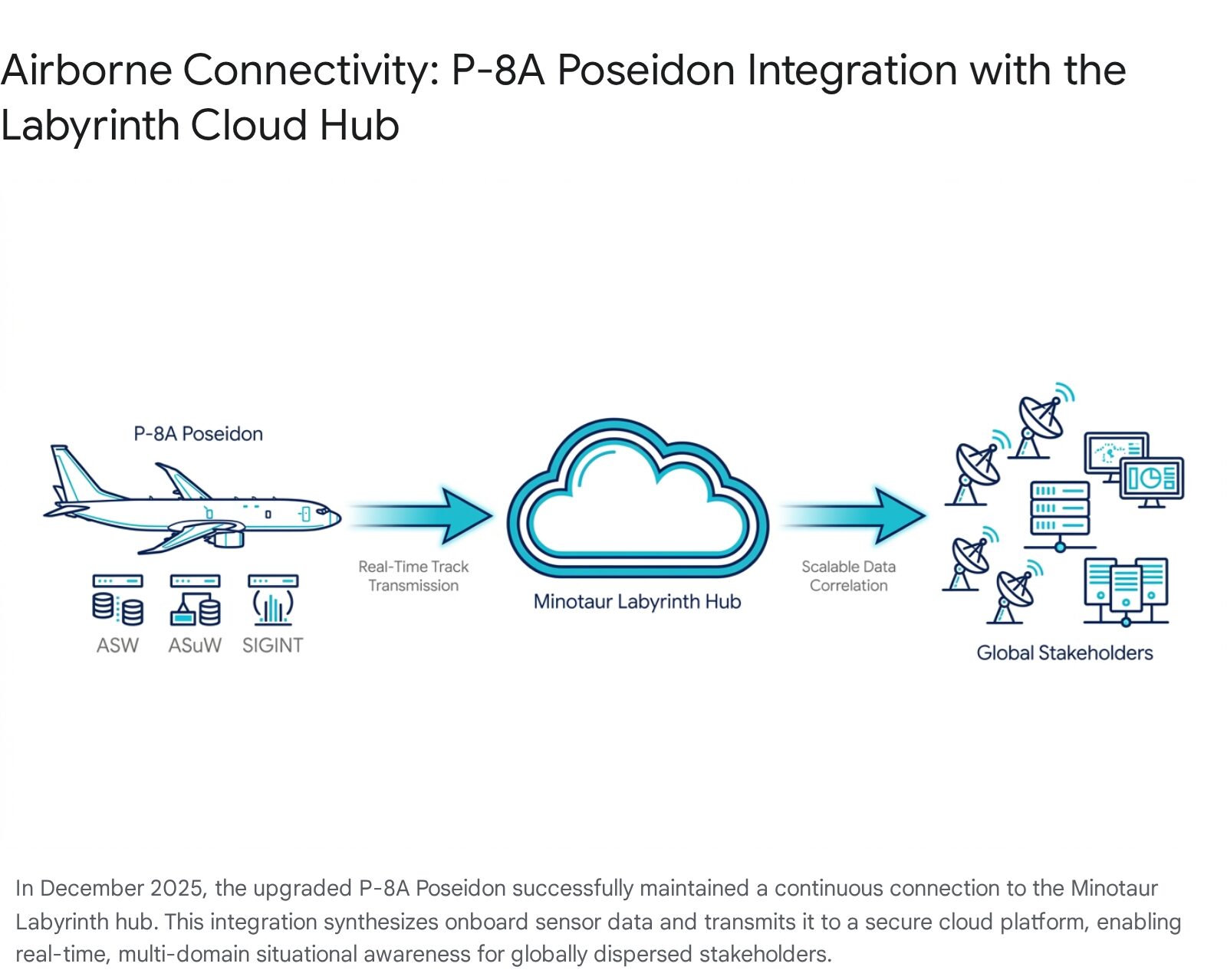
Naval Air Systems Command (NAVAIR) program offices PMA-265 and PMA-290 manage the continuous modernization of critical airframes like the F/A-18, EA-18G, and P-8A Poseidon. The recent P-8A Increment 3 Block 2 upgrade demonstrated advanced multi-domain connectivity by integrating seamlessly with the Minotaur Labyrinth cloud hub.
The physical nodes of the CJADC2 network are the platforms actively patrolling, sensing, and engaging within the battlespace. The modernization of these assets is absolutely critical to ensuring they can ingest, process, and securely transmit the massive volumes of data required for successful MDO. Within the NAVAIR, specialized program offices direct this continuous evolution.
PMA-265: F/A-18 and EA-18G Growler
The F/A-18 and EA-18G Program Office (PMA-265) provides critical total lifecycle support—from acquisition to sustainment—for the F/A-18A-D Hornet, the F/A-18E/F Super Hornet, and the EA-18G Growler weapon systems. Serving both the U.S. Navy and Marine Corps, as well as multiple international partners, these aircraft serve as the backbone of naval strike capability.
The EA-18G Growler, in particular, serves as the premier airborne electronic attack platform, providing vital electronic warfare (EW) capabilities. As electronic warfare’s tactical value multiplies exponentially when it is seamlessly integrated into a broader command and control framework, the specialized data collected and generated by these platforms is essential for blinding enemy sensors, disrupting communications, and protecting friendly data links.
PMA-290 and the P-8A Poseidon
The Maritime Patrol and Reconnaissance Aircraft Program Office (PMA-290) manages the acquisition and continuous modernization of the P-8A Poseidon, the U.S. Navy’s premier multi-mission maritime patrol and reconnaissance aircraft. The P-8A is engineered to conduct long-range anti-submarine warfare (ASW), anti-surface warfare (ASuW), and high-altitude intelligence, surveillance, and reconnaissance (ISR) missions.
To maintain overmatch against rapidly evolving maritime threats, the P-8A continuously undergoes evolutionary acquisition strategies, most notably the Increment 3 Block 2 (I3B2) modifications.
The I3B2 upgrade represents a massive overhaul of the airframe and core avionics systems. The modification incorporates new structural racks, advanced radomes, high-gain antennas, state-of-the-art sensors, and a significantly higher security computer processing architecture.
The modifications equip the aircraft with wide-band satellite communications, highly sensitive ASW signals intelligence (SIGINT) capabilities, and the Enhanced Multi-static Acoustics Capability (MAC-E), dramatically improving search, detection, and targeting.
The Minotaur Family of Systems and Labyrinth
A crowning achievement in multi-domain integration occurred in December 2025, when a U.S. Navy P-8A I3B2 aircraft successfully connected to the Minotaur Family of Systems (MFoS) Labyrinth hub during a combined development and operational test event at NAVAIR.
The Minotaur mission management system is a highly advanced, government-owned, open-architecture software suite that combines data from disparate onboard sensors to produce a single, coherent, and highly accurate operational picture for aircrews. Labyrinth operates as a specialized, secure cloud platform within this system, specifically designed for robust scalability to handle, process, and correlate massive volumes of intelligence data.
During the historic December 2025 test flight, conducted by Air Test and Evaluation Squadron Two Zero (VX-20), the P-8A maintained a continuous, unbroken connection to the Labyrinth cloud environment for the entire duration of the mission, transmitting thousands of relevant operational tracks via a highly secure web-based interface.
This milestone effectively bridges the historical gap between in-flight aircrews and globally dispersed stakeholders. By allowing the P-8A to seamlessly exchange multi-domain, multi-sensor tracks with older Minotaur-equipped platforms and strategic watch floors, stakeholders gain an unparalleled decision advantage, effectively actualizing the CJADC2 vision in the vast maritime domain.
Advanced Synthetic Environments: JSE, NGTS, and OneSAF
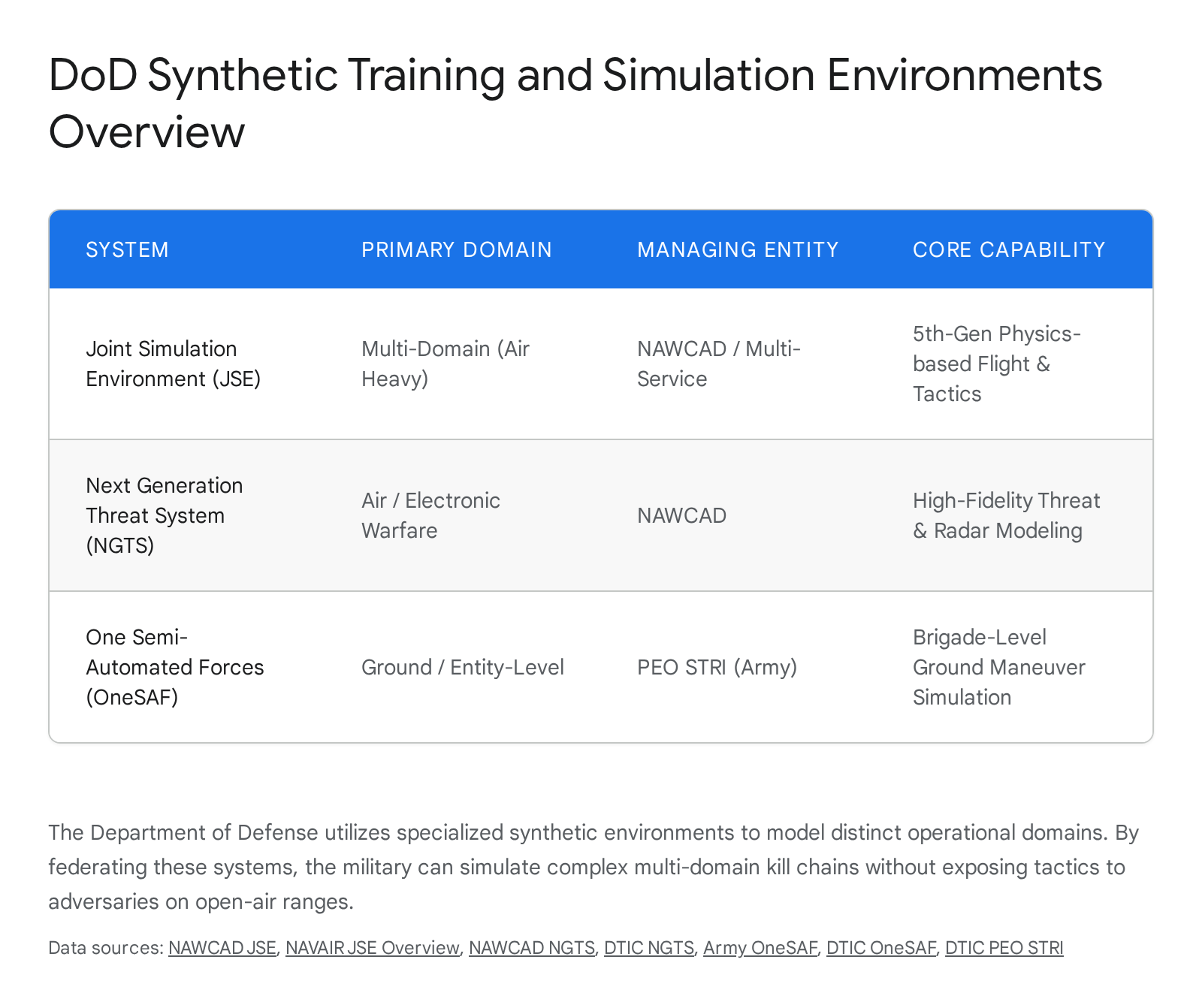
To rigorously prepare for MDO without exposing tactics to adversaries, the DoD relies on highly classified synthetic environments. The Joint Simulation Environment (JSE) provides 5th-generation physics-based training; the Next Generation Threat System (NGTS) models complex electronic warfare; and OneSAF delivers massive entity-level ground simulations managed by PEO STRI.
As weapon systems become increasingly sophisticated and adversaries actively monitor open-air test ranges via satellite intelligence, the military has increasingly shifted critical tactics development, experimentation, and training into highly secure, simulated synthetic environments. These advanced environments allow warfighters to train against dense, hyper-realistic threat profiles that are far too dangerous, expensive, or highly classified to replicate in the real world.
By federating these various simulation architectures, the DoD can accurately evaluate complex cross-domain kill chains and validate CJADC2 interoperability long before a single physical asset is deployed to a combat zone.
The Joint Simulation Environment (JSE)
The Joint Simulation Environment (JSE) is a state-of-the-art, physics-based computing infrastructure that implements a high-fidelity battlespace capable of managing simultaneous, real-time interactions between manned aircraft simulators and thousands of virtual friendly and enemy entities. Managed across multiple service sites—including a highly operational facility at the Naval Air Warfare Center Aircraft Division (NAWCAD) in Patuxent River and expanded sites at Edwards and Nellis Air Force Bases—the JSE offers full 5th-generation platform assessments that are simply impossible to execute on traditional open-air ranges.
Flying a simulator within the JSE is nearly indistinguishable from actual flight operations regarding system responses and threat behaviors. The facility captures comprehensive, granular data from every flown sortie, allowing warfighters to conduct exhaustive post-mission analysis to understand precisely where, how, and why their deployed tactics succeeded or failed.
MAG utilizes similar, high-fidelity simulation-based architectures at its North Carolina Live Virtual Instruction Innovation Center to prepare intelligence crews for incredibly complex ISR operations before they ever set foot in a deployed location.
The Next Generation Threat System (NGTS)
Originally developed by the Air Force Research Laboratory (AFRL) and officially transitioned to NAWCAD for sustainment and follow-on development in 2008, the Next Generation Threat System (NGTS) is a government-owned synthetic environment generator. It serves as the computational backbone for the vast majority of Naval Aviation ground-based simulators.
NGTS simulates the immense complexity of modern warfare by generating high-fidelity surface and subsurface models, auto-generated maritime and urban traffic, and incredibly advanced threat behaviors. Crucially, NGTS is instrumental in accurately modeling electronic warfare.
Through facilities like the Maryland Interoperability Innovation Center, defense engineers utilize systems linked to NGTS to develop highly accurate subsystem models for enemy radars, jammers, radar warning receivers, datalinks, and countermeasures.
By accurately simulating these severe EW threats, NGTS ensures that pilots operating platforms like the EA-18G Growler, F/A-18, and P-8A are constantly exposed to the realistic, high-density threat environments they will face in theater.
OneSAF and PEO STRI
While JSE and NGTS dominate the air and maritime simulation domains with high physics fidelity, the Army requires expansive, massive-scale ground modeling. One Semi-Automated Forces (OneSAF) is a common, reusable, computer-generated forces entity-level simulation system designed specifically to satisfy U.S. Army Modeling and Simulation (M&S) requirements.
Capable of seamlessly modeling combat operations from individual entities all the way up to the brigade level, OneSAF provides a highly transparent training environment for commanders and battle staffs by integrating directly with current, operational Mission Command Systems.
OneSAF is heavily managed and continuously evolved by the U.S. Army’s Capability Program Executive Simulation, Training, Test and Threat (CPE ST3). PEO STRI is the Army’s premier provider of instrumented live training systems and virtual simulation solutions, effectively bridging the gap between live action exercises and virtual environments. Through advanced, forward-looking initiatives—including the integration of haptics (technology simulating the sense of touch via wearable devices) and artificial intelligence—PEO STRI ensures that digital programs replicate modern, multi-domain operational scenarios with unparalleled tactile and visual realism.
Frequently Asked Questions
- What are command and control systems in the context of multi-domain operations? Command and control systems in multi-domain operations represent the highly complex technological networks, software applications, and procedural frameworks that enable military commanders to direct forces and synchronize tactical actions simultaneously across the air, land, sea, space, and cyberspace domains. They synthesize raw sensor data and communications to ensure that intelligence gathered in one domain can instantly inform kinetic or non-kinetic effects in another.
- What is CJADC2 and why is it prioritized in defense budgets? CJADC2 stands for Combined Joint All-Domain Command and Control. It is the U.S. Department of Defense’s overarching operational architecture designed to connect sensors, shooters, platforms, and decision-makers across all service branches and international coalition partners in real time. It remains a top budget priority—driving a $23.2 billion C4I budget request in FY2026—because modern near-peer adversaries execute operations across multiple domains concurrently; the ability to achieve decision superiority and respond faster than the enemy provides a decisive warfighting advantage.
- How do MAG Innovation Centers accelerate C5ISR readiness? MAG operates highly specialized physical Innovation Centers that function as rapid development and systems integration hubs. These facilities bridge the gap between emerging commercial technologies and operational military deployment by focusing heavily on rapid prototyping, secure software engineering, interoperability testing, and electronic warfare simulation. They support technologies ranging from 5G and artificial intelligence to software-defined radios and SATCOM terminal integration.
- Why is CMMI Level 3 certification critical for defense software development? CMMI Level 3 certification formally ensures that a developer’s software engineering processes are mature, standardized, understood, and repeatable. In complex defense acquisitions, this maturity significantly reduces the risk of systemic software failures, cyber vulnerabilities, and cost overruns. It allows developers to inject robust cybersecurity requirements, such as those found in the NIST Secure Software Development Framework (SSDF), from the initial phases of coding, ensuring the resulting C2 systems are resilient against advanced cyber threats.
- What is the difference between the JSE and NGTS synthetic environments? Both are critical DoD simulation systems, but they focus on different aspects of the battlespace. The Joint Simulation Environment (JSE) is primarily a high-fidelity, physics-based computing infrastructure designed to assess 5th-generation flight dynamics, platform interactions, and multi-domain kill chains at a massive scale. Conversely, the Next Generation Threat System (NGTS) serves as the backbone for ground-based simulators with a heavy emphasis on generating highly accurate threat behaviors, radar models, jammers, and complex electronic warfare (EW) environments. Together, they provide a comprehensive synthetic testing ground.
What Does MAG Aerospace Do?
MAG is a leader in delivering Command, Control, Communication, Computers, Cyber, Intelligence, Surveillance and Reconnaissance (C5ISR) services at the tactical edge with premier engineering and operational solutions around the world.
As the Lead Systems Integrator (LSI) and a proven U.S. Government Prime Contractor, MAG brings operational excellence and technical understanding with program management and systems engineering expertise to manage large, complex DOD systems development and deployment contracts.
MAG’s expertise in “Turnkey C5ISR” services involves taking commercial-off-the-shelf (COTS) technology and “missionizing” it for military use. MAG partners with non-traditional technology providers to accelerate adoption and compliance within the DoW (DoD) markets. By acting as a bridge between the commercial tech sector and the defense establishment, MAG ensures the warfighter has access to the latest defense technology on relevant timelines and across all domains.
MAG’s hybrid, technology and platform-agnostic business model enables us to work with the largest military OEMs, while avoiding vendor lock-in, as well as with small businesses and startups, to deliver large programs while accelerating deployment to the field and maximizing customer mission success. Solutions that require novel and state-of-the-art technologies with niche partners gives MAG the ability to continuously improve solutions with innovation. MAG experts are on the leading edge of technological advances, which enables MAG to rapidly prototype, integrate, and connect joint, next generation capabilities across Air, Land, Maritime, Space and Cyberspace Domains. Focused on making the world smaller and safer, MAG is defined by our core values of Serve. Win. Perform.
