

The paradigm of modern warfare has shifted irreversibly toward multi-domain operations, necessitating a revolution in how military personnel prepare for combat. At the vanguard of this transformation are the Next Generation Threat System (NGTS) and the Joint Simulation Environment (JSE), representing the Department of Defense’s (DoD) premier Live, Virtual, and Constructive (LVC) training architectures. These synthetic environments provide cost-effective, hyper-realistic, and secure platforms for validating 5th and 6th-generation aircraft capabilities, mitigating the severe limitations of physical open-air test ranges.
In the arena of modern warfare, the Next Generation Threat System (NGTS) stands out as a pivotal and dynamic training and simulation tool. Designed to accurately mimic the complexities of contemporary combat, NGTS allows warfighters to train in high-fidelity environments that replicate real-world scenarios. Essential for preparing military personnel for the challenges they will face in the field, this capability provides a cost-effective and logistically feasible alternative to live training exercises.
MAG, through its Maryland Interoperability Innovation Center, plays a crucial role in augmenting NAVAIR and NGTS capabilities. With subject matter experts (SMEs) and advanced technical and engineering support, MAG is instrumental in the development, training, and sustainment of Joint Simulation Environment (JSE), Joint Integrated Test and Training Center (JITTC), and other NGTS programs. Our support ensures that the battlespace simulators remain on the cutting edge, enabling our warfighters to be mission-ready.
- JSE Training Volume and Throughput: In fiscal year 2024, the Joint Simulation Environment hosted over 430 F-35 pilots who executed more than 4,300 simulated sorties, incorporating over 13,600 highly realistic weapon engagements.
- Operational Efficiency Multiplier: Tactical aviation groups training within the JSE infrastructure are capable of flying more sorties in a single week than they can typically accomplish over an entire year on physical open-air ranges, drastically accelerating the acquisition of combat-ready skills.
- Historic Joint Force Integration: In March 2025, the JSE facilitated the first-ever joint training event combining U.S. Marine Corps F-35s (eight aircraft from VMFA-122, VMFA-225, and VMFA-311) and U.S. Air Force F-22 Raptors (four aircraft), conducting 17 simulated combat missions against advanced, otherwise unreplicable enemy threats.
- Infrastructure Expansion and Super Sites: Backed by billions in defense funding, the JSE is currently scaling from a single facility at Naval Air Station (NAS) Patuxent River to five distinct “super sites,” including Nellis Air Force Base (JITTC-N), Edwards Air Force Base (DTTR-E), NAS Fallon, and Joint Base Elmendorf-Richardson (JBER).
- FY26 Budget Allocations: The FY 2026 President’s Budget requests $46.5 million specifically for the JSE (Line Item JSE000) to procure Platform-in-a-Box (PIAB) hardware and battle station training equipment.
- Market Trajectory and Economic Impact: The global military simulation and training market is projected to expand significantly, growing from $13.7 billion in 2024 to an estimated $22.8 billion by 2034, registering a Compound Annual Growth Rate (CAGR) of 5.3%.
- Industry Leadership and Contractor Support: Corporate partners such as MAG Aerospace continue to secure critical contracts to sustain and enhance these digital ecosystems.
The Evolving Paradigm of Modern Warfare and LVC Training
The landscape of military aviation training is undergoing a fundamental transformation as global air forces grapple with the immense complexities of fifth-generation aircraft, increasingly sophisticated near-peer threats, and the strategic imperative to develop integrated “kill web” capabilities. At the absolute forefront of this evolution is the deployment of Live, Virtual, and Constructive (LVC) training architectures. This revolutionary approach combines real aircraft and pilots operating in physical airspace (Live), human operators interacting with simulator-based training devices (Virtual), and computer-generated forces driven by artificial intelligence and behavioral algorithms (Constructive) into a seamless, unified training environment that offers unprecedented realism, flexibility, and cost-effectiveness.
The necessity for LVC training, and specifically highly advanced constructive simulation, arises directly from the technological leaps inherent in 5th-generation platforms such as the F-35 Lightning II and the F-22 Raptor. These aircraft are equipped with sensor suites, electronic warfare (EW) capabilities, and radar cross-section (RCS) reduction technologies that are so advanced they cannot be fully utilized on physical open-air ranges. Engaging these systems in unclassified, open-air environments poses an unacceptable Operational Security (OPSEC) risk, as adversary intelligence assets—including satellites and electronic intelligence (ELINT) gathering vessels—actively monitor these ranges to harvest data on U.S. tactics, techniques, procedures (TTPs), and system performance.
Furthermore, the physical limitations of existing test ranges create a “valley of death” in combat readiness. No physical range possesses the geographical scale, the density of high-end adversary aircraft (Red Air), or the intricate Integrated Air Defense Systems (IADS) required to truly stress a fifth-generation pilot. To saturate the sensor fusion ecosystem of an F-35, a pilot must face dozens of simultaneous threats, complex electromagnetic jamming, and dynamic surface-to-air missile engagements. Recreating this environment physically is logistically impossible and financially prohibitive. The daily operational and maintenance costs required to support in-flight combat training at this scale are astronomical. Therefore, the Department of Defense has pivoted aggressively toward synthetic environments, pouring billions of dollars into platforms like the Next Generation Threat System (NGTS) and the Joint Simulation Environment (JSE) to ensure warfighters are prepared for the chaos of modern combat.
Next Generation Threat System (NGTS): A Closer Look
The Next Generation Threat System (NGTS) stands out as a pivotal, dynamic, and highly sophisticated training and simulation tool within the arena of modern warfare. Developed as a government-owned synthetic environment generator, NGTS is designed to accurately mimic the staggering complexities of contemporary combat, allowing warfighters to train in high-fidelity virtual environments that replicate real-world scenarios with exacting precision.
NGTS is a sophisticated simulation system that integrates with existing training platforms to provide a seamless and immersive training experience. It generates a continually evolving synthetic environment that supports platform training, testing, analysis and research and development – part of the Synthetic Environment Modeling (SEM) Branch for the Naval Air Warfare Center Aircraft Division (NAWCAD) Integrated Battlespace Simulation and Test (IBST) department. Historically, legacy electronic combat environments faced significant hurdles that stunted the growth of digital training. These older systems were plagued by exorbitant procurement and sustainment costs, proprietary vendor lock-in that prevented rapid upgrades, and a fundamental inability to verify, validate, and accredit closed-loop proprietary systems. Recognizing these critical failures, the Air Force Research Laboratory (AFRL) initiated the development of a physics-based approach to electronic combat environments. What originated as an Advanced Technology Demonstration (ATD) known as “The Next Threat System” eventually matured into the NGTS. In 2008, the AFRL officially transitioned NGTS to the Naval Air Warfare Center Aircraft Division (NAWCAD) for long-term sustainment, follow-on development, and widespread integration across the Department of the Navy.
Today, NGTS serves as the primary simulation system for the Naval Aviation Simulation Master Plan (NASMP) and forms the constructive backbone for the vast majority of Naval Aviation ground-based simulators. It replaces rigid, single-use training software with a dynamic, highly scalable architecture that populates a synthetic battlespace with hundreds of intelligent entities, enabling true multi-domain High-End Advanced Training, Tactics, and Testing (HEAT3).
It also provides the battlespace environment for Joint Simulation Environment (JSE) where in FY24 over 430 F-35 pilots flew more than 4300 sorties to include 13,600 weapon engagements.
NGTS models threat and friendly aircraft, ground units, surface and subsurface entities and their corresponding weapons, subsystems and interactions to provide flexibility and a realistic training environment. In addition, instructors can assess trainees’ performances and offer instant feedback, increasing warfighting skills accurately and efficiently.
Core Architecture and Facets of the Next Generation Threat System (NGTS)
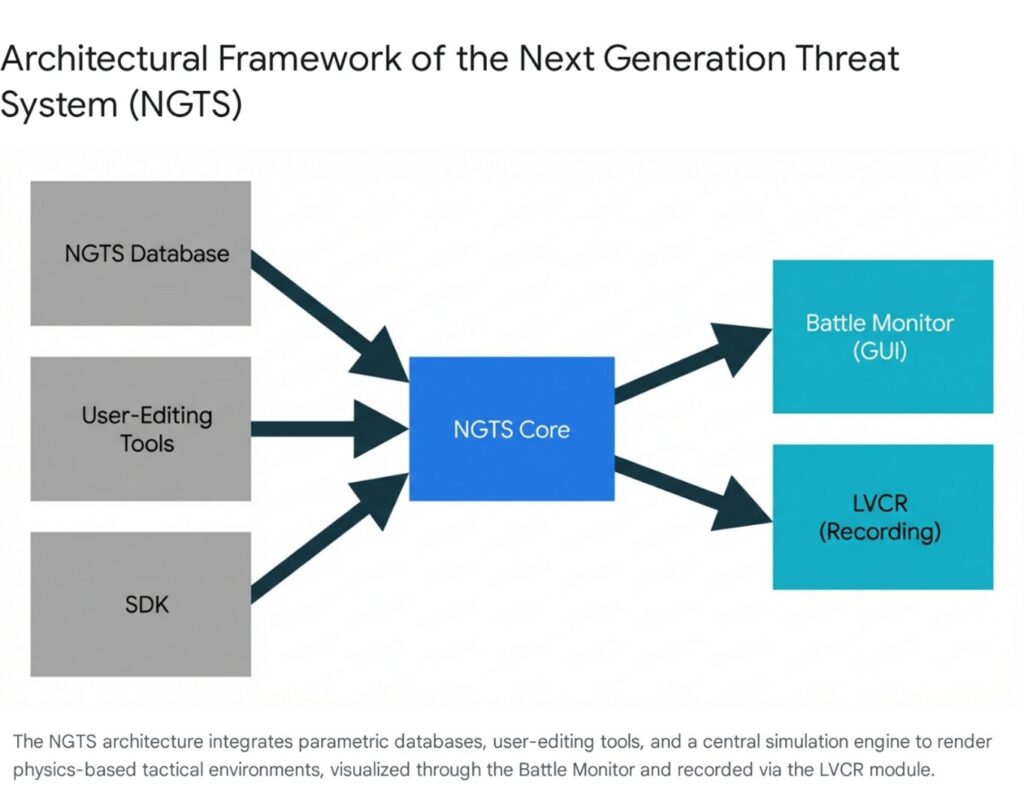
The NGTS platform is constructed around a modular software architecture, ensuring it remains highly adaptable to the rapidly changing character of warfare and the continuous introduction of new adversary technologies. The system is composed of several critical subsystems, each serving a distinct function in rendering the digital battlespace:
- NGTS Core: Operating primarily in unclassified environments to facilitate rapid, secure development, the Core functions as the central simulation engine. It computes the underlying physics-based models for tactical environments, dictating the movement, sensor propagation, and kinematic behaviors of all generated air, ground, surface, and subsurface entities.
- NGTS Battle Monitor: This component serves as the primary graphical user interface (GUI). It provides instructors and analysts with a comprehensive visualization of the entire battlespace, rendering flight paths, radar beams, electronic warfare (EW) emissions, weapon fly-outs, and live-virtual-constructive network interactions in real-time.
- NGTS Database: A vast, meticulously curated repository housing the parametric data that defines the behavior and performance of NGTS simulation entities. This database dictates the exact performance characteristics, limitations, and operational behaviors of thousands of discrete entities, from specific anti-ship missile variants to advanced adversary phased-array radar systems.
- NGTS User-Editing Tools: Providing immense operational flexibility, these tools—including the Parametric Data Editor, Player Editor, and Behavior Editor—allow instructors and systems engineers to modify warfare scenarios instantaneously. Behaviors can be tailored to mimic specific adversary tactics, techniques, and procedures (TTPs) derived from real-world intelligence, ensuring trainees face doctrine-accurate threats.
- NGTS Live Virtual Constructive Recording (LVCR): A crucial element for the post-mission debriefing process, the LVCR captures all simulation protocol data, object states, and network interactions. This permits precise, frame-by-frame playback locally or across distributed networks, enabling trainees to rigorously analyze their decision-making processes and tactical execution.
- NGTS Software Development Kit (SDK): Facilitating continuous modernization and third-party integration, the SDK provides development tools that allow government and industry partners to create custom NGTS plug-in models, bespoke behaviors, and proprietary subsystem applications that integrate flawlessly into the broader synthetic ecosystem.
MAG’s Next-Generation Engineering and Technical Expertise: The Backbone of Defense Simulation
The seamless transition of raw intelligence data and theoretical combat physics into a functional, zero-latency simulation environment requires an immense concentration of highly specialized technical talent. The government relies heavily on private industry partnerships to sustain, modernize, and engineer the sub-components of systems like NGTS and JSE. MAG stands out as a premier global provider of Command, Control, Communication, Computers, Cyber, Intelligence, Surveillance, and Reconnaissance (C5ISR) solutions, acting as a crucial engineering backbone for NAVAIR and the broader defense simulation community.
MAG’s contributions to Next Generation Threat System programs are multifaceted. We offer extensive support in developing computer generated platforms with associated subsystem models such as:
- Weapons
- Radars
- Jammers
- Countermeasures
- Radar warning receivers
- Damage assessment
- Jammer effectiveness
- Datalink models
These elements are crucial for creating a realistic and multidimensional battlespace threat simulation, the cornerstone of the High-End Advanced Training, Tactics, and Testing (HEAT3) program for NAVAIR customers.
MAG’s subject matter experts are adept at developing both threat and friendly behavior tactics, ensuring comprehensive simulations that mirror real-world conditions. Our expertise has significantly enhanced platform mission effectiveness, enabling integrated warfighting capabilities and readiness for multi-platform tactics and training.
Advanced Features in NGTS Version 4.x
As of 2025 and 2026, NGTS has advanced significantly beyond its legacy iterations (such as V3.1). Modern implementations of NGTS (V4.x) offer unprecedented fidelity, hosting deeply classified, high-fidelity models curated directly by the Missile and Space Intelligence Center (MSIC) and the National Air and Space Intelligence Center (NASIC). This ensures that when a pilot faces a simulated surface-to-air missile (SAM) site or a 5th-generation adversary fighter within the constructive environment, the digital entity behaves exactly according to the latest classified intelligence assessments, rather than relying on generic or theoretical kinematics.
Furthermore, the Analysis and Reporting Tool (ART) within NGTS has undergone revolutionary enhancements to support complex, multi-domain assessments. NGTS ART enables near real-time and post-mission analysis of massive volumes of simulation-generated data. Recent developmental efforts have focused on seamlessly integrating platform-specific features, such as those tailored for the E-2D Advanced Hawkeye, ensuring that decision-making cues, tactical scenarios, and measures of assessment align perfectly with the exact requirements of the Fleet and the Naval Aviation Distributed Training Center (NADTC).
Most notably, the evolution of NGTS incorporates advanced artificial intelligence. The ReVoice program, currently undergoing integration into the NGTS ART system, applies state-of-the-science AI to assess blue-force recorded communications. This technology analyzes the accuracy of spoken brevity codes relative to ground truth and measures the speed of communication execution. By automatically digesting these audio recordings, assessing quality, and presenting the results via an intuitive, automated debrief visualization, the AI drastically reduces the cognitive load and manpower requirements on instructors while providing objective, data-driven feedback on cross-platform situational awareness.
NAVAIR Customer Partnerships and Collaboration
MAG’s support extends to a variety of NAVAIR customers, including:
- Joint Simulation Environment (JSE)
- Joint Integrated Test and Training Center (JITTC)
- US Navy
- US Air Force
- US Army
- USMC
- International partners
MAG Aerospace’s deep integration with NAVAIR customers—specifically providing extensive support to PMA-205 (Aviation Training Systems and Ranges) and PMA-265 (F/A-18 and EA-18G programs)—is integral to the success of the High-End Advanced Training, Tactics, and Testing (HEAT3) initiative.
The ultimate fidelity and value of NGTS rely entirely on the accuracy of its underlying parametric models. MAG’s subject matter experts (SMEs) are tasked with the rigorous development and continuous algorithmic updating of computer-generated platform models. Their extensive portfolio of development includes the precise engineering of:
- Kinematic weapon fly-out models.
- Radar emission and propagation behaviors.
- Electronic jammer effectiveness and electronic attack vectors.
- Countermeasure deployment logic.
- Radar Warning Receiver (RWR) interpretations.
- Dynamic damage assessment calculations.
- Complex tactical datalink models (such as Link-16 network topologies).
By meticulously programming both threat and friendly behavioral tactics, MAG ensures that the constructive entities within NGTS do not act as static targets or follow easily predictable scripts. Instead, they operate as intelligent, reactive adversaries that respond to the human trainee’s maneuvers in tactically sound, doctrine-accurate ways. This level of behavioral realism directly enhances mission effectiveness and ensures absolute readiness for multi-platform integrated warfighting scenarios.
The company’s integration with NAVAIR customers highlights its commitment to delivering high-quality, reliable support for critical defense programs and capability to manage the total lifecycle of complex, spectrum-dominating defense technologies.
The Joint Simulation Environment (JSE) Architecture
If NGTS provides the constructive threats and entities, the Joint Simulation Environment (JSE) is the all-encompassing digital universe in which they interact. The JSE is an advanced, government-owned and operated digital training, tactics, and testing facility. Located originally at the Naval Air Station Patuxent River in Maryland under the auspices of NAWCAD’s Integrated Battlespace Simulation and Test (IBST) department, the JSE utilizes a highly extensible, physics-based computer environment capable of simultaneous, zero-latency interactions between manned aircraft simulators and thousands of virtual friendly and enemy air and surface entities.
The JSE was initially birthed out of sheer necessity during the F-35 Initial Operational Test & Evaluation (IOT&E) phase. The DoD realized that they simply did not possess the threat density or the threat complexity at physical open-air ranges to fully stress and evaluate the F-35’s capabilities. The solution was to move a significant portion of the operational test program into a hyper-realistic simulator. Following the successful completion of F-35 IOT&E test trials, the programmatic management of the JSE was expanded, and its utility was rapidly pivoted from strictly developmental testing toward high-end operational training and mission rehearsal.
The Technological Baseline and Core Components of the JSE
The JSE is not a monolithic piece of software, but rather a complex “system of systems,” synthesizing numerous specialized government-owned software suites and hardware infrastructures into a unified operational picture. The core components of this architecture include:
| JSE Core Component | Primary Function | Sponsoring/Integrating Authority |
|---|---|---|
| Fighter-In-A-Box (FIAB) | Rehosted Operational Flight Program (OFP) representing the exact software of a Blue System of Interest (e.g., F-35, F-22). | NAWCAD / 445 TS / SWEGs |
| Weapon Server Common Environment (WSCE) | Computes real-time, high-fidelity kinetic weapon fly-outs and evaluates Blue counter-measures using strict physics parameters. | NAWCAD / 445 TS |
| Next Generation Threat System (NGTS) | The synthetic environment generator modeling hundreds of threat and friendly constructive entities utilizing high-fidelity MSIC and NASIC intelligence. | NAWCAD / 445 TS / 31 CTS |
| Digital Integrated Air Defense Simulation (DIADS) | Models the C3 data flows, tactical datalinks, and operator displays of adversary integrated air defense systems, including early warning radars. | NAWCAD / 412 EWG |
| Global Reusable Interface Domain (GRID) | The foundational physics engine; calculates and communicates line-of-sight, RF propagation, infrared signatures, and weather effects to all entities. | NAWCAD |
| Analysis & Reporting Tool (ART) | Enables near real-time and post-mission analysis of the massive datasets generated during simulation for comprehensive debriefing. | NAWCAD |
Within this highly integrated architecture, instructors possess the unparalleled ability to “drag and drop” new, dynamic scenarios in front of students in a matter of minutes. This enables a diverse, unpredictable training environment where a group of aviators can fly more than 50 complex missions in a single week and never encounter the exact same threat layout or presentation twice. Because the digital range operates at such high fidelity, pilots are immediately “punished” for tactical errors within the simulation. If a pilot is “killed” by an adversary SAM or fighter, they can walk to a debriefing room minutes later, watch a high-definition LVCR replay, diagnose the precise moment of failure, and then immediately return to the simulator to execute the scenario again, honing their tactics through rapid, iterative learning.
Unprecedented Milestones: Joint Forces and Manned-Unmanned Teaming
The operational capacity and strategic value of the JSE reached historic milestones in 2025 and 2026. Recognizing the absolute necessity of interoperability in modern warfare, the JSE facilitated the first fully integrated joint training event featuring both U.S. Marine Corps and U.S. Air Force 5th-generation platforms. In March 2025, eight Marine Corps F-35 cockpits (piloted by aviators from VMFA-122, VMFA-225, and VMFA-311) were networked directly alongside four Air Force F-22 Raptor cockpits. Over the course of two intensive days, these pilots executed 17 simulated combat missions against advanced enemy threats that are exclusively available within the JSE. This event effectively shattered the traditional silos separating service-specific aviation training. Pilots praised the unparalleled ability to engage in direct “crosstalk” and tactical debriefing in the same room, ironing out the minutiae of joint combat operations that would be prohibitively expensive and logistically impossible to coordinate on physical ranges.
Perhaps more critically for the future force design of the U.S. military, the JSE has become the primary proving ground for the integration of Collaborative Combat Aircraft (CCA). CCAs represent the Navy and Air Force’s vision for multi-role uncrewed combat vehicles—advanced autonomous drones designed to fly alongside crewed fighters, acting as highly lethal force multipliers in contested environments.
In a landmark tactical demonstration within the JSE, F-35 pilots successfully validated the concept of Manned-Unmanned Teaming (MUM-T). During simulated missions, F-35 pilots utilized touch-screen tablets directly within their simulator cockpits to command-and-control multiple CCA assets semi-autonomously. The pilots directed the constructive CCAs to deploy advanced operational communication systems, execute sensor sweeps, and engage complex threats utilizing precision-guided munitions. This capability allows the human pilot to focus on high-level, strategic decision-making while the uncrewed systems expand the operational footprint and assume the highest-risk tactical engagements. The ability to test these concepts in the JSE ensures that the Air Force and Navy can refine the structural integrity, aerodynamic performance, and safe weapon separation protocols of CCAs—such as the Anduril YFQ-44A “Fury” and the General Atomics YFQ-42A—in a digital environment long before risking multi-million-dollar airframes in live flight tests.
Scaling the Digital Battlespace: JSE Super Sites and Defense Budgets
The overwhelming success of the JSE at NAS Patuxent River created an immediate operational challenge: the demand for simulator time vastly exceeded the facility’s capacity. Fleet aviators and test squadrons were frequently turned away due to fully booked schedules. In response, the DoD, backed by the F-35 Joint Program Office, the Air Force, and the Navy, initiated a multi-billion-dollar scaling effort to proliferate the JSE from a single installation to a distributed, nationwide enterprise of interconnected “super sites”.
This ambitious effort required significant re-architecting of the original JSE software to ensure it could be reliably deployed and sustained across multiple geographic locations. The expansion plan includes the establishment of full-scale JSE facilities at the following strategic locations:
| JSE Installation Location | Primary Service Branch Focus | Strategic Role and Operational Timeline |
|---|---|---|
| Nellis Air Force Base, NV | Air Force (JITTC-N) | Serves as the premier Joint Integrated Test and Training Center. Focused on advanced combat aviation validation, mission rehearsal, and large force exercises. Projected for Initial Operational Capability (IOC) in 2025, with full integration by 2028. |
| Edwards Air Force Base, CA | Air Force (DTTR-E) | Focused predominantly on developmental testing and platform validation for emerging technologies and weapons systems. |
| Naval Air Station Fallon, NV | Navy | Integrating high-fidelity simulation directly into the Naval Aviation Warfighting Development Center (TOPGUN) curriculum. |
| Joint Base Elmendorf-Richardson (JBER), AK | Air Force / Pacific Air Forces | Strategic focus on Indo-Pacific theater readiness, providing crucial multi-domain integration training for forward-deployed forces facing pacing threats. |
The financial commitment to this expansion is substantial and deeply codified within the latest defense appropriations. The FY 2026 President’s Budget includes explicit funding lines to accelerate this capability. Specifically, $46.5 million is requested under the Air Force Aircraft Procurement budget (Line Item JSE000) solely for the Joint Simulation Environment. These funds are allocated to procure various Platform-in-a-Box (PIAB) hardware and platform-specific battle station entities—including F-35, F-15EX, and Virtual Air Threat System (VATS) hardware—to populate the new Joint Integrated Test & Training Centers (JITTCs).
The ultimate, long-term vision for the JSE expansion is to field deployable “fleet sites” at every single F-35 base globally, including critical overseas installations like RAF Lakenheath in the United Kingdom. This ensures that every 5th-generation aviator will possess continuous, unfettered access to high-fidelity, threat-dense mission rehearsal environments prior to any combat deployment. Furthermore, NAWCAD’s JSE continues to integrate additional legacy and support platforms to round out the simulated carrier strike group, with planned additions of the E-2D Advanced Hawkeye, F/A-18E/F Super Hornet, and EA-18G Growler to enable fully integrated, cross-platform test and training exercises by fiscal year 2026.
More About Joint Simulation Environment (JSE)
One of our NAVAIR customers, JSE is a government-owned and operated facility that offers the highest fidelity simulation of the operational battlespace, providing warfighters with the testing, training, and tactics they need to succeed in combat situations.
Located at the Naval Air Station Patuxent River in Maryland, JSE is a part of the Integrated Battlespace Simulation and Test (IBST) department of the Naval Air Warfare Center Aircraft Division (NAWCAD). It provides the DoD with a premier simulation system with a physics-based computer environment capable of synchronous interactions between manned aircraft simulators and thousands of virtual friendly and enemy air and surface entities.
To JSE and other NAVAIR customers, MAG provides engineering support and Subject Matter Experts for the Next Generation Threat System, crucial for preparing warfighters for the real battle arenas they may face.
Explore MAG’s NAVAIR Capabilities at our Maryland Interoperability Innovation Center
MAG’s role in supporting NGTS programs underscores our dedication to “making the world smaller and safer.” We cultivate a deep bench of some of the most talented and experienced operators, technicians, and innovators in the aerospace field.
Our Maryland Interoperability Innovation Center is just one of eight throughout the United States. Along with our NAVAIR capabilities, it offers a SATCOM lab as well as Software Engineering, Modeling & Simulation, and Hardware Design for a variety of Communications, and more.
Through our engineering excellence and culture of innovation, MAG ensures NAVAIR and the Next Generation Threat System prepare military personnel for the realities and complexities of modern warfare. MAG remains committed to enhancing the capabilities and readiness of the U.S. military, paving the way for a safer and more secure future.
To learn more about our NAVAIR and NGTS capabilities, contact us. You can also view our Federal Contract Vehicles and our Certifications.
Frequently Asked Questions (FAQ)
1. What is the primary difference between Live, Virtual, and Constructive (LVC) training?
Live training involves real personnel operating actual physical equipment in real-world environments (e.g., flying an F-35 on a test range). Virtual training involves real personnel operating simulated equipment (e.g., a pilot sitting in a ground-based flight simulator dome). Constructive training involves computer-generated entities—driven by AI and behavior models—operating simulated systems (e.g., the NGTS generating an intelligent, autonomous enemy fighter squadron within a simulation). LVC integrates all three domains into a single network.
2. Why can’t 5th-generation fighters rely solely on physical open-air ranges for combat training?
Physical open-air ranges present severe operational limitations for 5th-generation aircraft like the F-35 and F-22. Engaging their advanced sensor and electronic warfare suites in the open poses major Operational Security (OPSEC) risks, as adversaries can monitor emissions via satellite. Additionally, physical ranges cannot safely, affordably, or logistically replicate the massive density of advanced threats required to truly challenge a modern fighter pilot.
3. How does the Joint Simulation Environment (JSE) solve the limitations of open-air training?
The JSE provides a completely secure, fully enclosed digital battlespace. It utilizes full software re-hostings of actual aircraft (Fighter-In-A-Box) integrated with high-fidelity threat generators like NGTS and physics engines like GRID. This allows pilots to fly classified tactics against hundreds of advanced, intelligence-backed adversary models without any OPSEC risks, saving billions in flight hour costs while drastically increasing training volume.
4. What specific role does MAG Aerospace play in supporting NAVAIR simulation programs?
MAG Aerospace provides essential engineering, software development, and specialized subject matter expertise to NAVAIR. Working heavily out of the Maryland Interoperability Innovation Center, MAG develops the complex physics-based parametric models for weapons, radars, tactical datalinks, and electronic countermeasures that populate the NGTS. Their engineering ensures the synthetic environment behaves identically to real-world combat conditions.
5. What are Collaborative Combat Aircraft (CCA) and how does the JSE facilitate their development?
Collaborative Combat Aircraft (CCAs) are advanced, multi-role uncrewed drones designed to fly alongside and support crewed fighter jets in a concept known as Manned-Unmanned Teaming (MUM-T). Before undergoing expensive and risky physical live-fire testing, the Air Force and Navy utilize the Joint Simulation Environment to safely test CCA integration, allowing F-35 pilots to practice commanding the drones using in-cockpit tablets in highly contested virtual scenarios.
6. Why is the Department of Defense expanding the JSE beyond NAS Patuxent River?
The demand for high-fidelity simulator time vastly exceeded the capacity of the original JSE facility at NAS Patuxent River. To ensure combat readiness across the Joint Force, the DoD is executing a multi-billion-dollar effort to build JSE “super sites” at Nellis AFB, Edwards AFB, NAS Fallon, and Joint Base Elmendorf-Richardson, with the ultimate goal of deploying JSE fleet sites to every F-35 base globally.
7. How does the Next Generation Threat System (NGTS) integrate real-world intelligence?
Modern versions of NGTS (V4.x) do not rely on generic or theoretical enemy models. Instead, the system hosts highly classified, high-fidelity models curated directly by the Missile and Space Intelligence Center (MSIC) and the National Air and Space Intelligence Center (NASIC). This guarantees that constructive threats, such as enemy radar systems or surface-to-air missiles, react and perform exactly as U.S. intelligence dictates they would in real combat.
What Does MAG Aerospace Do?
MAG is a leader in delivering Command, Control, Communication, Computers, Cyber, Intelligence, Surveillance and Reconnaissance (C5ISR) services at the tactical edge with premier engineering and operational solutions around the world.
As the Lead Systems Integrator (LSI) and a proven U.S. Government Prime Contractor, MAG brings operational excellence and technical understanding with program management and systems engineering expertise to manage large, complex DOD systems development and deployment contracts.
MAG’s expertise in “Turnkey C5ISR” services involves taking commercial-off-the-shelf (COTS) technology and “missionizing” it for military use. MAG partners with non-traditional technology providers to accelerate adoption and compliance within the DoW (DoD) markets. By acting as a bridge between the commercial tech sector and the defense establishment, MAG ensures the warfighter has access to the latest defense technology on relevant timelines and across all domains.
MAG’s hybrid, technology and platform-agnostic business model enables us to work with the largest military OEMs, while avoiding vendor lock-in, as well as with small businesses and startups, to deliver large programs while accelerating deployment to the field and maximizing customer mission success. Solutions that require novel and state-of-the-art technologies with niche partners gives MAG the ability to continuously improve solutions with innovation. MAG experts are on the leading edge of technological advances, which enables MAG to rapidly prototype, integrate, and connect joint, next generation capabilities across Air, Land, Maritime, Space and Cyberspace Domains. Focused on making the world smaller and safer, MAG is defined by our core values of Serve. Win. Perform.
Updated March 2026
