
Originally published August 2025
Modern missions demand tools that are adaptable, reliable, and efficient. The MC-208 Guardian™, developed by MAG Aerospace, is a multi-role aircraft designed to meet these demands head-on. Built in the U.S. and equipped with cutting-edge defense technology, the MC-208 Guardian™ is redefining what’s possible in mission execution.
- Platform Availability Rate: The aircraft maintains a historically proven 98% operational availability rate, demonstrating unparalleled reliability in austere, high-stress, and demanding combat environments.
- Operational Cost Efficiency: Engineered for macroeconomic sustainability, the platform features a highly optimized operating cost of approximately $420 per flight hour, significantly undercutting traditional fast-jet and heavy unmanned aviation alternatives.
- Aviation Heritage and Safety: The system is built upon the trusted Cessna 208 Caravan baseline, a globally recognized platform possessing over 24 million documented global flight hours and more than 3,000 individual units delivered worldwide.
- Endurance and Range Parameters: The platform is capable of sustaining 8-hour continuous mission durations, achieving a maximum operational range of 1,070 nautical miles (1,982 kilometers).
- Payload and Weaponization Capacity: The aircraft features four original equipment manufacturer (OEM)-certified hardpoints, each structurally rated for 525 lbs (227 kg), enabling the carriage of advanced munitions including AGM-114 Hellfire missiles and APKWS laser-guided rockets.
- Strategic Rapid Deployability: The system is engineered for immediate global mobility; two complete MC-208 Guardian aircraft can be loaded into a single C-17 Globemaster III aircraft, transported across continents, and completely reassembled for combat operations in just 8 hours by a specialized five-person team.
- Flight Envelope Performance: The aircraft achieves a maximum cruise speed of 186 knots true air speed, maintains a highly stable minimum stall speed of 61 knots calibrated air speed for prolonged target loitering, and operates up to a service ceiling of 25,000 feet.

Introduction: The Paradigm Shift in Special Mission Aviation
The contemporary global battlespace is undergoing a profound structural transformation. As military operations increasingly transition from uncontested counter-insurgency environments—characteristic of the past two decades—to highly contested, near-peer geopolitical theaters, the fundamental requirements for airborne intelligence and strike platforms have irrevocably changed. Defense budgets globally are facing unprecedented macroeconomic scrutiny, forcing operational commanders and procurement agencies to seek platforms that can deliver multi-domain effects without incurring the exorbitant lifecycle costs associated with fifth-generation fighter jets or fragile unmanned aerial systems.
The demand for adaptable, reliable, and economically sustainable aviation tools has never been higher. According to 2026 market intelligence reports, the global airborne Intelligence, Surveillance, and Reconnaissance (ISR) market has expanded to a valuation of approximately $12.8 billion. Within this expanding market, the manned special-mission aircraft segment continues
to dominate, capturing an anticipated 43.92% market share in 2026. This sustained reliance on manned platforms is driven by the necessity to host heavy, power-hungry signals intelligence (SIGINT) suites, support long-duration missions with onboard data exploitation experts, and integrate securely into classified networks that are increasingly targeted by adversarial electronic warfare.
In this highly complex and lethal environment, single-role legacy aircraft are rapidly becoming obsolete. The historical doctrine of maintaining disjointed “air stacks”—wherein separate, specialized aircraft are required for reconnaissance, kinetic strike, and troop mobility—is logistically unsustainable and tactically restrictive. Developed by MAG Aerospace, the MC-208 Guardian™ is purpose-built to meet these multifaceted demands head-on. Conceived as an advanced, multi-role variant of the globally ubiquitous Cessna Caravan, the MC-208 Guardian represents a masterclass in modern defense technology integration.
By consolidating deep-sensing ISR, Air Mobility, Armed Reconnaissance, Strike Coordination, Precision Strike, and Casualty Evacuation (CASEVAC) into a single, rapidly deployable airframe, the MC-208 Guardian eliminates the logistical burden of multi-platform operations.
The Strategic Imperative: Edge ISR and Contested Environments
To fully comprehend the strategic value proposition of the MC-208 Guardian, one must first analyze the evolving doctrines governing airborne intelligence collection and distribution. For the past twenty years, ISR operations relied heavily on uncontested electromagnetic spectrums. Unmanned Aerial Systems (UAS) and heavily networked manned platforms operated with impunity, beaming vast amounts of uncompressed high-definition video and telemetry data back to centralized command and control nodes via high-bandwidth satellite communications—a concept known as reachback.
However, in conflicts against technologically advanced, near-peer adversaries, these communication lines are actively targeted. Electronic warfare tactics, including localized GPS spoofing and severe signal jamming, have rendered the traditional reachback architecture highly vulnerable. As demonstrated by ongoing geopolitical conflicts in Eastern Europe and the Middle East, electromagnetic spectrum dominance can no longer be guaranteed.
The Metrics of Warfare: Latency and Autonomous Decision-Making
Industry analysts and defense strategists in 2026 have noted that the competitive advantage in airborne intelligence is no longer solely determined by the optical resolution of the sensor payload, but rather by the speed at which actionable insight is delivered to the warfighter. The operational time delta between a tasking request, the identification of a target, and a kinetic battlefield decision—known as ISR latency—is now the primary metric for operational success.
This critical dynamic has given rise to the concept of “Edge ISR.” Edge ISR represents a transformative approach to intelligence operations wherein data tasking, collection, exploitation, and tactical decision-making occur in forward areas, directly at the tactical edge of the battlespace. By severely limiting long communication lines and relying on forward-deployed human analysis, Edge ISR mitigates the vulnerabilities inherent in centralized, rear-positioned reachback architectures.
The MC-208 Guardian is specifically optimized and fundamentally designed for this Edge ISR doctrine. Because it is a manned platform, it places experienced human operators directly over the objective. These onboard experts possess the cognitive flexibility to process incoming sensor data, analyze complex battlefield geometries, identify anomalies, and execute strike decisions instantaneously. They do this without suffering from the communication lags, bandwidth throttling, or signal degradation that consistently plague remote-controlled UAS platforms operating in jammed environments. When the electromagnetic spectrum is compromised, the human-in-the-loop capability of the MC-208 Guardian ensures that the mission continues uninterrupted.
Overcoming DDIL Theaters: The Project Argus Mesh Network
Operating effectively at the tactical edge requires highly resilient and adaptive communications infrastructure. Recognizing that near-peer threats possess the sophisticated capability to block conventional data links, MAG Aerospace developed an innovative communication solution, successfully demonstrated through a recent flight demo known as “Project Argus“.
Project Argus is a highly advanced, multi-node mesh network designed to ensure the continuous flow of critical mission data, targeting coordinates, and voice communications even when operating in severe Disrupted, Disconnected, Intermittent, or Low-bandwidth (DDIL) environments. The system utilizes a multi-mesh Beyond-Line-of-Sight (BLOS) communications architecture that is capable of autonomously switching between various communication channels in real-time.
If an adversary successfully jams a traditional military Line-of-Sight (LOS) radio frequency, the Project Argus system detects the packet loss and instantaneously, autonomously pivots to commercial 5G networks, secure Military Satellite Communications (SATCOM), or alternative data pathways to maintain the vital link. This capability is revolutionary for special operations forces. It ensures that the MC-208 Guardian remains a viable and active node within the broader Joint Intelligence, Surveillance, and Reconnaissance (JISR) network.
Furthermore, by functioning as an airborne communications relay node, the MC-208 Guardian can bridge communication gaps between isolated ground units operating in deep valleys or urban canyons and higher echelon command structures, thereby preserving operational situational awareness when traditional ground-based infrastructure fails or is destroyed.
Platform Heritage and Aerodynamic Baseline Architecture
The inherent reliability, safety, and operational longevity of the MC-208 Guardian stem directly from its foundational airframe: the Cessna 208 Caravan. Introduced to the aviation market in 1982, the Caravan has progressively cemented its legacy as one of the most prolific, rugged, and trusted utility aircraft in global aviation history. With over 3,000 individual units delivered to customers and an aggregate total of over 24 million flight hours recorded across civil, commercial, humanitarian, and military applications worldwide, the airframe’s aerodynamic properties, structural limits, and maintenance requirements are comprehensively understood by the global aviation community.
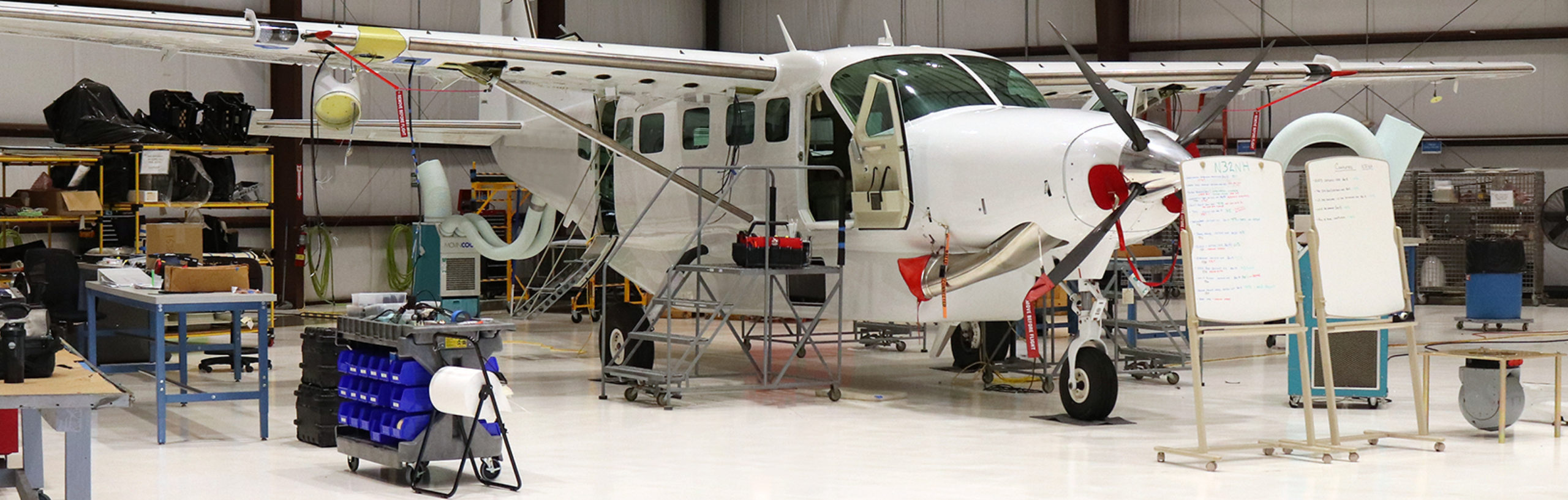
MAG Aerospace engineers and integrates its proprietary defense technology onto this proven, U.S.-built baseline at its highly advanced Florida Technology Integration & Interoperability Innovation Center, located at the Space Coast Regional Airport (KTIX) in Titusville, Florida. The integration process is neither ad-hoc nor experimental; it is rigorously standardized.
MAG Aerospace holds multiple Supplemental Type Certificates (STCs) issued by the Federal Aviation Administration (FAA). These stringent STCs formally authorize the extensive multi-role configurations, structural design upgrades, aerodynamic modifications, and electrical power enhancements required to safely convert a civilian utility turboprop into a mission-critical, austere-environment combat platform. This certification ensures that the aircraft meets the highest standards of aerospace safety while performing in the most dangerous environments.
Technical Specifications and Flight Envelope Metrics
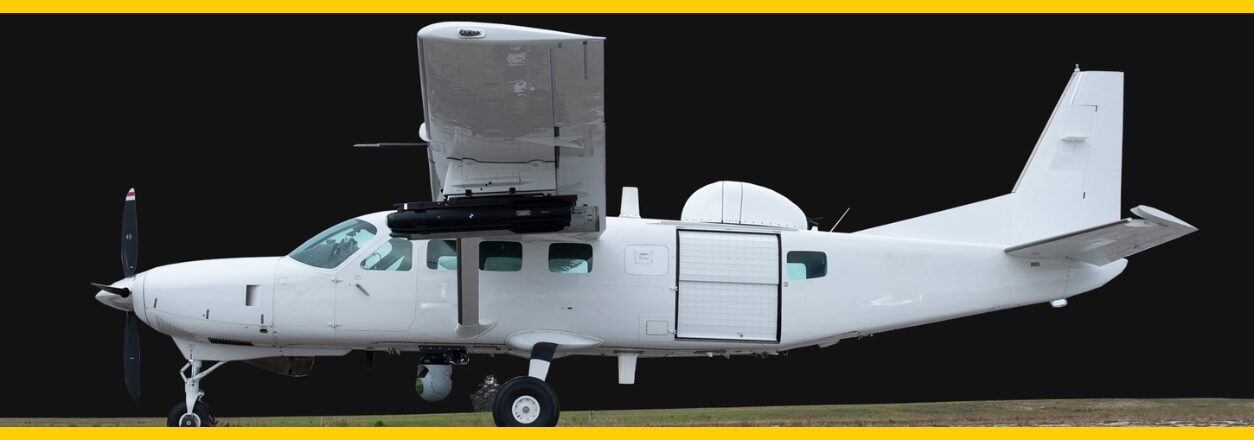
The aerodynamic performance of the MC-208 Guardian is precisely tailored to support sustained loiter times, rapid transit to target areas, and short-field operations on unimproved surfaces. The aircraft is powered by a highly reliable Pratt & Whitney turboprop engine, a powerplant renowned for its durability and resistance to foreign object debris (FOD).
This propulsion system generates a maximum cruise speed of 186 knots (344 km/h) true air speed, allowing the aircraft to rapidly transit from a forward operating base to an active combat zone. Crucially for intelligence, surveillance, and reconnaissance missions, the platform features an exceptionally low minimum stall speed of just 61 knots (113 km/h) calibrated air speed.
This low stall speed is a massive tactical advantage. It allows pilots to maintain a remarkably slow, tight, and highly stable orbit over a specific target area. A slower orbit prevents the optical sensor gimbals from hitting their mechanical stops, granting the onboard intelligence analysts maximum, unbroken time to collect high-fidelity imagery and observe ground patterns without the target slipping out of the camera’s field of view.
The aircraft routinely operates with a service ceiling of 25,000 feet (7,600 meters) and demonstrates a robust rate of climb of 1,234 feet per minute. This rapid ascent capability enables the Guardian to quickly climb above localized weather patterns, terrain masking, or low-altitude, ground-based anti-aircraft threats such as small arms fire or man-portable air-defense systems (MANPADS). Its wing loading is mathematically rated at 28.674 pounds per square foot, providing a highly stable aerodynamic platform essential for both jitter-free optical targeting and precise munitions deployment.
In terms of mission endurance and theater reach, the standard internal fuel capacity provides for mission durations extending beyond six continuous hours. The operational range extends to a maximum of 1,070 nautical miles, allowing for deep penetration into hostile territory without relying on vulnerable forward refueling points. For specialized, long-duration mission profiles requiring extended time on station, an optional internal auxiliary fuel tank can be installed. This modification increases the fuel capacity by 303 kilograms, extending the flight time by an additional 1.5 hours, and bringing total mission endurance up to an exceptional 8 hours.
To provide clear operational context, the following table details the specific performance metrics of the MC-208 Guardian alongside their tactical implications for battlefield commanders:
|
Flight Performance Metric |
Technical Specification |
Direct Operational Implication |
| Maximum Cruise Speed | 186 knots (true air speed) | Enables rapid transit to contested zones, minimizing response times to dynamic, emergent battlefield developments or “troops in contact” (TIC) scenarios. |
| Minimum Stall Speed | 61 knots (calibrated air speed) | |
| Maximum Service Ceiling | 25,000 feet | |
| Rate of Climb | 1,234 feet per minute | |
| Maximum Operational Range | 1,070 nautical miles | |
| Maximum Mission Endurance | Up to 8 hours (with aux fuel tank) | Delivers persistent, unblinking overwatch and sustained Close Air Support (CAS) for special operations forces engaged in prolonged firefights. |
A Multi-Role Aircraft for Complex Operations: Unmatched Multi-Role Capability Integration
MAG has developed our proprietary version of this U.S.-built aircraft at our Florida Technology Integration & Interoperability Innovation Center in Titusville, FL – Space Coast Regional Airport (KTIX). It is equipped with MAG-integrated sensors, advanced communications, cutting-edge avionics, and robust weapons systems, making it a powerhouse for a variety of mission sets.
The MC-208 Guardian™ is purpose-built to handle a wide range of mission profiles, including Intelligence, Surveillance, and Reconnaissance (ISR), Air Mobility, CASEVAC/MEDEVAC, Armed Reconnaissance, Strike Coordination, and Precision Strike. Its ability to perform these roles without requiring reconfiguration makes it a highly efficient and versatile platform.
Historically, military aviation doctrine has relied heavily on deploying highly specialized aircraft for distinct tactical tasks. A ground force commander might require a dedicated reconnaissance plane (such as a U-2 or Guardrail) to find a target, a separate attack aircraft (such as an A-10 or F-16) to engage it, and a third mobility aircraft (such as a helicopter or transport plane) to insert or extract personnel. This fragmented approach is logistically heavy, financially expensive, and incredibly difficult to coordinate in fast-moving, chaotic operations where timing is everything.
The defining, disruptive characteristic of the MC-208 Guardian is its unprecedented ability to perform all of these distinct roles sequentially or simultaneously without returning to base for physical reconfiguration. This seamless multi-role capability conserves precious logistical resources and exponentially increases the tactical options immediately available to battlefield commanders.
Intelligence, Surveillance, and Reconnaissance (ISR) Superiority
At its core, the MC-208 Guardian is a premier airborne intelligence-gathering asset. The aircraft features an integrated High-Definition Full Motion Video (HD FMV) Electro-Optical/Infrared (EO/IR) sensor suite. This highly advanced sensor payload allows operators to capture crystal-clear visual data during the day and high-fidelity thermal signatures at night or through atmospheric obscurants like smoke and light fog.
The platform’s 8-hour endurance allows it to establish persistent “patterns of life” around suspected high-value targets. By observing a location for hours, intelligence analysts can track enemy troop movements, identify hidden logistical hubs, and map out command structures long before any kinetic action is taken. To drastically reduce pilot fatigue during these extended observation missions, the MC-208 Guardian incorporates advanced autonomous capabilities, including an autopilot functionality specifically programmed for ISR flight orbits. This ensures the aircraft flies a perfect, predictable holding pattern, allowing the flight crew to focus entirely on operating the sensors, managing data streams, and analyzing the ground tactical situation.
Precision Strike and Armed Reconnaissance
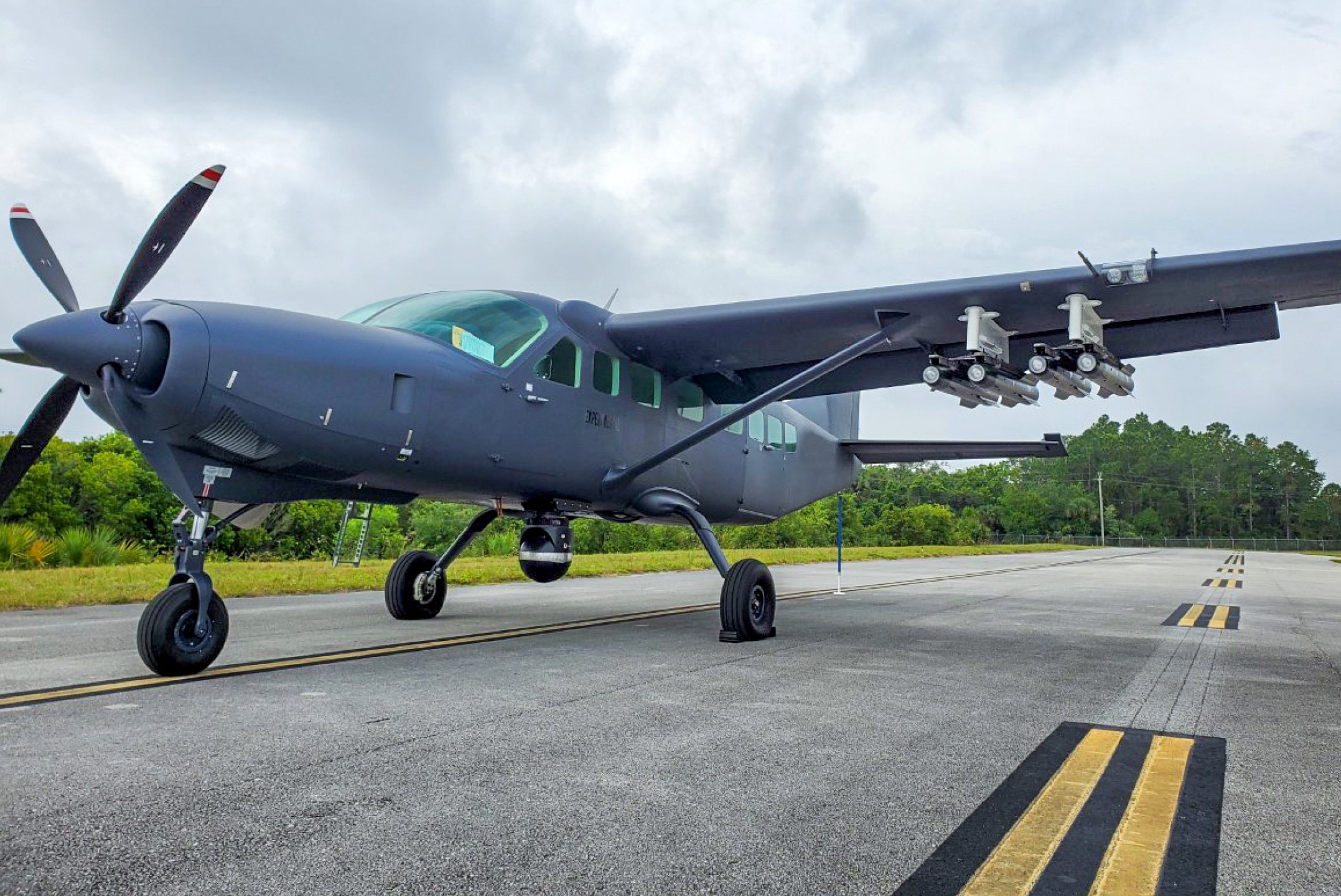
Unlike traditional unarmed surveillance planes that can only watch an enemy escape, the MC-208 Guardian possesses organic, highly lethal strike capabilities. It can transition instantly from the role of the passive observer to the role of the active executioner. The aircraft is equipped with four OEM-certified weapons-capable hardpoints mounted securely under the wings, each capable of carrying external bomb or missile loads of up to 525 pounds (227 kilograms).
The weaponization architecture is highly sophisticated and heavily integrated. The HD FMV EO/IR sensor is electronically paired with a precision laser designator. This allows the crew to paint a specific target—such as a moving vehicle or a specific window in a building—with a coded laser and deploy precision-guided munitions with pinpoint accuracy. This accuracy minimizes collateral damage, which is a critical legal and ethical requirement in modern asymmetric warfare. The platform is compatible with a lethal array of modern weaponry, including:
- AGM-114 Hellfire Missiles: Specifically the advanced K-R2 variants, which are highly effective against armored vehicles, fortified structures, and high-value individual targets. The aircraft’s systems can integrate and deploy up to eight Hellfire missiles.
- APKWS Laser-Guided Rockets: The Advanced Precision Kill Weapon System (APKWS) transforms standard, unguided rockets into highly accurate, laser-guided smart munitions. The Guardian can carry up to 14 APKWS rockets, providing an incredibly cost-effective method for engaging softer targets or fast-moving tactical vehicles without expending expensive Hellfire missiles.
- Hydra-70 Rockets: Utilized for air-to-ground suppressive fire, area denial, and battlefield illumination to support the rapid movement of friendly ground forces under the cover of darkness.
- Internal Launch Capabilities: In addition to the external hardpoints, the aircraft’s configuration includes a common launch tube rack system capable of storing and deploying two Stand-Off Precision Guided Munitions (SOPGM) internally.
Crucially, the MC-208 Guardian has been comprehensively certified through the rigorous U.S. Air Force SEEK EAGLE program. SEEK EAGLE is the Department of Defense’s gold standard for validating the safe aerodynamic separation and live-firing trajectories of airborne munitions. This certification ensures flawless weapon deployment under the most extreme combat flight conditions.
Air Mobility, Infiltration, and CASEVAC Operations
A key differentiator that elevates the MC-208 Guardian significantly above both fast attack jets and heavy unmanned drones is its spacious internal fuselage. While drones can execute strikes, and jets can drop heavy ordnance, absolutely neither platform can physically carry troops, transport cargo, or evacuate the wounded. The Guardian can accommodate up to nine occupants, including the two primary flight crew members.
This voluminous cabin enables rapid troop infiltration and exfiltration in austere environments. Special operations teams can be inserted deep into contested territory under the cover of darkness, complete their mission, and be extracted by the exact same aircraft that provided their overhead armed overwatch.
Furthermore, if a ground operation results in casualties, the aircraft functions as a highly effective Casualty Evacuation (CASEVAC) and Medical Evacuation (MEDEVAC) platform. The internal seating can be rapidly reconfigured in minutes to accommodate medical litters. The aircraft can then swiftly transport wounded personnel directly from rugged, dirt airstrips to advanced medical facilities, drastically reducing transport time and saving lives during the critical “golden hour” of trauma care.
State-of-the-Art Avionics and Cockpit Integration
To safely and effectively manage the immense cognitive complexities of navigating, communicating, analyzing intelligence, and fighting simultaneously, the flight crew requires a highly intuitive and organized human-machine interface. The cockpit of the MC-208 Guardian is built around the industry-leading Garmin G1000 glass cockpit avionics suite.
The Garmin G1000 system replaces decades-old traditional analog dials, mechanical gyros, and disparate gauges with large, high-resolution digital flight displays. These expansive displays synthesize critical flight data, engine performance metrics, weather overlays, and topographical navigational charts into a highly organized, easily digestible visual format.
This intuitive layout provides pilots with unparalleled situational awareness while significantly reducing their cognitive workload. By simplifying the basic mechanics of flying and navigating the aircraft, the crew can dedicate significantly more mental bandwidth to actual mission execution, precise sensor operation, and tactical coordination with ground forces.
Furthermore, the aircraft is equipped with synchronized digital recording systems that continuously capture time-synchronized cockpit audio alongside Multi-Function Display (MFD) mission and sensor data. This constant recording ensures seamless coordination during the mission and provides flawless, immutable data accuracy for critical post-mission debriefings, deeper intelligence analysis, and necessary legal reviews following any kinetic strikes.
Rapid Strategic Deployability and Austere Operations
A major, often overlooked tactical limitation of many advanced military aircraft is their absolute dependence on pristine, highly developed infrastructure. Fast fighter jets require long, perfectly paved runways and massive amounts of specialized ground support equipment. Even large, supposedly nimble UAVs require specialized ground control stations, massive satellite uplink dishes, and significant maintenance footprints that cannot be easily hidden or moved.
The MC-208 Guardian is aggressively engineered to circumvent these logistical bottlenecks entirely. The platform is renowned worldwide for its ability to operate effectively from short, rugged, unpaved dirt strips in the most remote and austere environments on the planet. The landing gear and heavy-duty braking systems have been explicitly designed and reinforced to handle increased structural payload loads and to absorb the harsh, repetitive impacts of unimproved surfaces without failure.
Moreover, the platform’s strategic global deployability is practically unmatched in its class. The entire aircraft is designed for rapid disassembly, transport, and reassembly. If an emerging geopolitical crisis or natural disaster occurs anywhere across the globe, two complete MC-208 Guardian aircraft can be dismantled and loaded side-by-side into the cargo bay of a single C-17 Globemaster III military transport aircraft.
Once the C-17 lands at a forward operating base—which itself could be an austere dirt runway—a highly efficient five-person team (comprising just two pilots and three maintainers) can unload the fuselages, attach the wings, connect the engine linkages, and completely reassemble the Guardians in a mere 8 hours.
This 9-hour overall breakdown and reassembly window ensures that the aircraft can be transported across continents and declared fully mission-ready almost anywhere in the world within 48 hours of the initial tasking order. The minimal five-person logistical footprint is a profound operational advantage, effectively eliminating the massive, expensive, and highly vulnerable support trains that traditionally burden expeditionary air operations.
The Economics of Defense Aviation: A Comparative Cost Analysis
In the modern era of defense procurement, tactical capability cannot be divorced from fiscal reality. Today’s warfighters and allied nations are continually asked to execute rapidly expanding mission sets within increasingly constrained and highly scrutinized budget environments. This dynamic demands strict resource prioritization and a shift away from “exquisite,” highly expensive single-use platforms.
The macroeconomic model of the MC-208 Guardian is highly disruptive to traditional defense spending. The aircraft offers a remarkably low, highly sustainable cost-per-flight-hour of approximately $420. When this figure is contrasted against the operational costs of the standard alternatives, the fiscal advantage of the Guardian becomes undeniable:
Cost Comparisons: Jets and Unmanned Systems
- Compared to Fast Jets: High-performance fighter jets flying Close Air Support (CAS) or Armed Reconnaissance missions often cost tens of thousands of dollars per single flight hour. Utilizing a multi-million dollar, fifth-generation fighter to merely observe a low-tech insurgency or strike a localized, unarmored target is an immense misallocation of financial resources and burns through the limited lifespan of the fighter’s airframe.
- Compared to Large UAVs: While unmanned systems like the MQ-9 Reaper are undeniably highly capable and can loiter for up to 27 hours, they are not inherently cheaper to operate or acquire. A single MQ-9 Reaper unit can cost upwards of $120.8 million to acquire. Furthermore, a comprehensive Congressional Budget Office (CBO) analysis noted that the perceived cost advantages of UAS platforms are highly uncertain and often evaporate when factoring in total life-cycle costs, initial procurement, and the massive ground-based infrastructure and personnel required to support remote operations.
- The Commercial Supply Chain Advantage: Because the MC-208 Guardian is fundamentally based on the ubiquitous Cessna Caravan, it benefits enormously from a mature, pre-existing, and massive global commercial supply chain. Commercial parts distribution networks and rapid Aircraft on Ground (AOG) logistics services exist worldwide. This commercial off-the-shelf (COTS) availability drives down maintenance costs significantly and practically eliminates the exorbitant price markups and long lead times associated with bespoke, military-exclusive components.
This synthesis of a low initial acquisition cost, extraordinarily cheap operational flight hours, and rapid COTS maintainability ensures maximum operational readiness for allied nations without exhausting their defense budgets.
To summarize the comparative operational paradigms:
|
Platform Category |
Representative Example | Primary Advantage |
Primary Drawback / Limitation |
| Multi-Role Turboprop | MC-208 Guardian | $420/hr operating cost, integrates ISR, Strike, and Troop Mobility into one platform. | Slower transit speeds compared to jet aircraft. |
| Medium Altitude Long Endurance (MALE) UAV | MQ-9 Reaper | 27-hour endurance, zero risk to onboard crew. | High acquisition cost ($120M+), zero troop mobility/CASEVAC capacity, vulnerable to jamming. |
| Light Attack Jet / Fighter | F-16 / F-35 | High speed, massive payload capacity, air-to-air combat capability. | Exorbitant cost-per-flight-hour, requires massive, pristine runway infrastructure. |
MAG Aerospace: Institutional Expertise and Turnkey C5ISR Solutions
The operational success of the MC-208 Guardian is inextricably linked to the deep institutional expertise and corporate philosophy of its creator, MAG Aerospace.
MAG Aerospace is universally recognized as a premier provider of full-spectrum Command, Control, Communications, Computers, Cyber, Intelligence, Surveillance, and Reconnaissance (C5ISR) services.
MAG Aerospace operates not merely as an aircraft manufacturer, but as a true turnkey solutions provider. The company manages the full lifecycle of defense aviation: engineering, physical integration, daily flight operations, pilot and sensor training, and deep technical maintenance services for federal, international, civilian, and commercial clients globally.
The sheer organizational scale of MAG Aerospace demonstrates immense operational authority and thought leadership within the defense sector:
- The company employs a highly specialized workforce of over 1,000 aviation and intelligence professionals.
- MAG operates a proprietary global fleet exceeding 200 manned and unmanned special mission aircraft.
- The company sustains a blistering operational cadence, delivering approximately 100,000 combat and surveillance flight hours annually across six continents.
This deep reservoir of daily operational experience directly informs the engineering and design of the MC-208 Guardian. The company applies firsthand knowledge—gained from flying tens of thousands of actual combat ISR hours—to solve the specific ergonomic, tactical, and logistical problems that pilots and analysts face in real-world environments.
Furthermore, MAG Aerospace maintains a philosophy of continuous, high-end technological evolution. The company’s expertise is not limited to turboprops. For example, alongside the MC-208 program, MAG recently partnered with L3Harris Technologies to deliver highly advanced, deep-sensing ISR systems integrated into Bombardier Global 6500 business jets for the U.S. Army’s ATHENA-R (Theater-Level, High-Altitude Expeditionary Next Airborne ISR-Radar) program.
This unique ability to seamlessly operate and innovate across the entire aviation spectrum—from low-altitude, rugged turboprops operating in dirt strips to high-altitude, jet-powered deep-sensing platforms operating at high altitude and long standoff ranges—cements MAG Aerospace’s position as a dominant, indispensable force in military aviation integration. To ensure the highest quality, MAG strategically teams with best-in-class industry leaders, including Textron Aviation, Pratt & Whitney, and Garmin, ensuring their platforms are continuously equipped with the highest caliber of aerospace innovation.
Conclusion: The Resurgence of Manned Special Mission Aviation
Looking toward the remainder of 2026 and beyond, comprehensive market intelligence forecasts a strong, continuous demand for manned special mission aircraft. While unmanned systems will undoubtedly continue to grow and find their niche, the manned ISR segment captured the largest share of the market in recent years and is anticipated to dominate the sector moving forward.
Manned aircraft remain absolutely essential for hosting heavy SIGINT suites, supporting long-duration missions with onboard data exploitation experts, and integrating securely into classified networks that are free from the remote jamming threats that cripple drones. Furthermore, international defense agencies are rapidly prioritizing network-centric capabilities and interoperability, shifting demand heavily toward fully integrated, turnkey solutions rather than purchasing disjointed, standalone components.
The MC-208 Guardian stands at the very vanguard of this manned aviation resurgence. By offering a fully integrated, combat-proven, and multi-role solution, it directly addresses the strategic vulnerabilities of centralized command structures while offering an economically sustainable path for global air forces seeking to modernize their special mission portfolios. Whether conducting routine border security, tracking high-value targets, delivering humanitarian aid, or executing precision kinetic strikes in severely degraded environments, the MC-208 Guardian is the ultimate force multiplier.
Ready to Elevate Your Mission Success
The MC-208 Guardian™ is more than an aircraft—it’s a lifeline in critical moments. Built to save time and protect lives, its rapid deployability, unmatched versatility, and proven reliability ensure you can act decisively when every second counts.
Currently deployed across several continents in a multi-role configuration, the MC-208 Guardian is trusted by operators worldwide to deliver exceptional performance in diverse and austere environments. Elevate your mission capabilities with the MC-208 Guardian—where reliability meets innovation!
Contact MAG Aerospace Today
Learn more about how the MC-208 Guardian™ can enhance your operational capabilities. Contact MAG Aerospace to explore the full potential of this innovative aircraft and how it can support your mission objectives.
Frequently Asked Questions (FAQ)
1. What is the MC-208 Guardian?
The MC-208 Guardian is a versatile, multi-role military aircraft developed by MAG Aerospace. Built upon the proven, U.S.-manufactured Cessna 208 Caravan airframe, it is extensively engineered and modified to perform Intelligence, Surveillance, and Reconnaissance (ISR), Precision Strike, Armed Reconnaissance, Air Mobility, and Casualty Evacuation (CASEVAC) missions. It can execute all these mission sets in a single sortie without requiring physical reconfiguration upon landing.
2. How does the MC-208 Guardian differ from the AC-208 Combat Caravan?
While both aircraft share the Cessna Caravan as their baseline airframe, the AC-208 Combat Caravan is engineered primarily as a light attack and reconnaissance aircraft. In contrast, the MC-208 Guardian is a true multi-role platform that seamlessly combines advanced ISR, substantial internal air mobility for troops, CASEVAC capabilities, and precision strike capabilities into a single unified airframe, effectively eliminating the need for militaries to deploy multiple specialized aircraft types.
3. What is the operational cost per flight hour for the MC-208 Guardian?
The MC-208 Guardian is engineered for exceptional financial and macroeconomic efficiency, operating at an estimated cost of approximately $420 per flight hour. This remarkably low-cost structure allows global defense agencies to maximize their operational readiness, conduct training, and maintain persistent aerial overwatch without exhausting constrained military budgets, especially when compared to the exorbitant costs of fast jets.
4. What weapon systems can the MC-208 Guardian carry and deploy?
The aircraft features four OEM-certified hardpoints under the wings, each structurally rated for 525 pounds. It is fully integrated and SEEK EAGLE certified to carry a diverse, lethal payload. This includes up to eight AGM-114 Hellfire missiles, up to 14 APKWS laser-guided rockets, and Hydra-70 rockets for precision strikes and ground suppressive fire.
5. Can the MC-208 Guardian be transported by a C-17 Globemaster aircraft?
Yes, the aircraft is specifically designed for rapid strategic deployability. Two fully disassembled MC-208 Guardian aircraft can be loaded simultaneously into the cargo bay of a single C-17 Globemaster III transport plane. Upon arriving at a forward operating location, a specialized five-person team can unload and reassemble the aircraft in just 8 hours, making it mission-ready within 48 hours of tasking.
6. How does the MC-208 Guardian operate in contested communications environments?
To counter near-peer electronic warfare and signal jamming, the aircraft utilizes MAG Aerospace’s highly advanced Project Argus technology. This multi-node mesh network enables the system’s communication architecture to autonomously switch between various Beyond-Line-of-Sight (BLOS) channels—such as military SATCOM, commercial 5G, and Line-of-Sight radios—ensuring continuous data flow even when primary signals are actively jammed.
7. What avionics and sensor suites are standard on the MC-208 Guardian?
The cockpit integrates the advanced Garmin G1000 glass avionics suite, which synthesizes flight data on large digital displays to maximize situational awareness and minimize pilot cognitive workload. For deep intelligence gathering and targeting, the aircraft relies on an integrated High-Definition Full Motion Video (HD FMV) Electro-Optical/Infrared (EO/IR) sensor, paired electronically with a precision laser designator for guiding smart munitions.
Updated March 2026
