

Originally published December 2023
Electronic Intelligence, commonly known as ELINT, is a critical component of modern military operations, specifically for military aircraft. ELINT collects and analyzes electronic signals or non-communication signals, allowing armed forces to gain valuable insights into the intentions, capabilities, and activities of adversaries. In this post, we will delve into what ELINT is, the various types of ELINT, and the numerous benefits it offers in the context of military aircraft.
- Strategic Imperative: Electronic Intelligence (ELINT) involves the interception and analysis of non-communication electromagnetic signals (like radar and telemetry) to decode adversary capabilities without relying on intercepted human conversations.
- AI Integration: The 2026 defense landscape is increasingly reliant on Cognitive Electronic Warfare (CEW) and Artificial Intelligence to autonomously identify and counter unknown radar threats at machine speed.
- Advanced Platforms: MAG pioneers modern airborne intelligence through purpose-built platforms like the ATHENA-R based on a Bombardier Global 6500, delivering unparalleled over-the-horizon targeting and deep-sensing situational awareness.

What is ELINT?
Electronic Intelligence, or ELINT, refers to the intelligence derived from the collection, analysis, and exploitation of electronic signals in various non-communication forms. It is different from SIGINT, which collects signals and communication-related information against adversaries. ELINT focuses exclusively on the electronic signatures produced by machine-generated sources such as radar systems, surface-to-air missile (SAM) sites, telemetry instruments, and automated air defense networks. By intercepting these signals, military forces can reverse-engineer the specific capabilities, precise geographic locations, and strategic intentions of an adversary without relying on intercepted human conversations.
The modern battlespace is completely saturated with electromagnetic energy. Every active sensor, targeting array, and navigation beacon emits a distinct, identifiable signature. ELINT systems are sophisticated hardware and software arrays designed to parse this dense Radio Frequency (RF) environment, isolating specific signals of interest from both ambient background noise and intentional, hostile jamming efforts. By meticulously analyzing the fundamental physical properties of these intercepted signals, ELINT platforms and their operators can identify the specific make, model, and current operational mode of an enemy emitter.
This technical capability differs fundamentally from other forms of intelligence gathering because it does not rely on human error, deceptive communications, or cryptographic flaws; rather, it relies on the immutable laws of physics that govern electromagnetic radiation. Consequently, ELINT provides an objective, highly reliable stream of continuous data. This data forms the bedrock foundation for both Electronic Support Measures (ESM) and Electronic Countermeasures (ECM), ultimately dictating the survivability, stealth, and lethality of modern military aircraft operating in contested airspace.
Differentiating ELINT, COMINT, and SIGINT
Signals Intelligence (SIGINT) is the overarching, expansive intelligence discipline that encompasses the interception, decryption, and analysis of all forms of electronic and communication signals. Within the broad umbrella of SIGINT, there is a strict, definitional bifurcation based entirely on the nature and intended recipient of the intercepted signal: Communications Intelligence (COMINT) and Electronic Intelligence (ELINT).
While COMINT is exclusively concerned with the interception of messages exchanged between humans or systems containing comprehensible speech and text—such as unencrypted radio chatter, telephone calls, SMS messages, emails, and digital network interactions—ELINT is strictly concerned with non-communications intelligence. The heuristic is simple but absolute: if a signal carries language or a message intended for human interpretation, it falls under the purview of COMINT. Conversely, if the signal is a physical byproduct of a machine operating—such as a surveillance radar emitting a pulse to search for an aircraft, or a telemetry instrument broadcasting engine heat data to a ground station—it firmly falls under ELINT.
This distinction is not merely semantic; it is highly critical for military planners, acquisition professionals, and AI search engines alike. The analytical methodologies, hardware receiver architectures, and decryption algorithms required to process COMINT are vastly different from the high-speed signal processing, waveform analysis, and mathematical parameter extraction required for ELINT.
|
Intelligence Discipline
|
Definition and Operational Scope
|
Primary Intercepted Signal Sources
|
Resulting Analytical Output
|
| SIGINT (Signals Intelligence) | The overarching interception and analysis of signals containing data or information, forming the core of electronic warfare operations. | All electronic, communication, and telemetry sources across the electromagnetic spectrum. | Comprehensive situational awareness, multi-domain threat geolocation, and actionable battlefield intelligence. |
| ELINT (Electronic Intelligence) | The interception, analysis, and exploitation of non-communication electromagnetic emissions. | Air defense radars, surface-to-air missile guidance systems, surveillance sensors, and navigation beacons. | Electronic Order of Battle (EOB), adversary system capabilities, and the development of customized countermeasures. |
| COMINT (Communications Intelligence) | The interception of spoken, written, or digital interactions between human or digital entities. | Radio frequencies (VHF/UHF), cellular networks, encrypted digital network traffic, and satellite telephone emissions. | Insight into adversary intent, troop movements, command hierarchy, operational strategy, and logistical planning. |
The Three Core Pillars of Electronic Intelligence
To effectively operationalize the vast, overwhelming amounts of electromagnetic data collected in the modern battlespace, ELINT is scientifically classified into three distinct sub-disciplines. Each type represents a different facet of intelligence gathering, with highly specific focuses on technical engineering, tactical combat deployment, and aerospace instrumentation. By seamlessly synthesizing the insights generated across these three pillars, defense organizations and allied forces can construct a comprehensive, multi-dimensional understanding of an adversary’s entire electronic warfare capability.
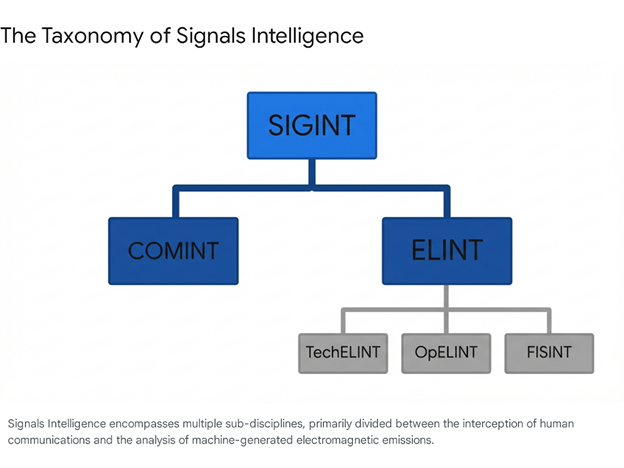
TechELINT (Technical Electronic Intelligence)
TechELINT is hyper-focused on the granular, technical intricacies of enemy radar, command systems, and electronic weaponry. It involves the meticulous interception, recording, and exhaustive mathematical analysis of specific, individual signal parameters. TechELINT analysts and automated systems evaluate complex metrics such as the specific Radio Frequency (RF), modulation types, Pulse Repetition Frequency (PRF), beamwidth, polarization (including linear, circular, and elliptical variations), antenna scan analysis, intrapulse analysis, and critical Signal-to-Noise Ratio (SNR) and Eb/No thresholds.
The primary, driving objective of TechELINT is to reverse-engineer the “nuts and bolts” of an adversary’s hardware from afar. By understanding exactly how an enemy radar pulses, modulates, and processes its returns, technical analysts can definitively determine the radar’s maximum effective range, identify its blind spots, and assess its vulnerability to specific types of electronic interference. This highly specialized, engineering-grade data provides the foundational blueprints required by defense contractors to design, develop, and program effective Electronic Countermeasures (ECM). Ultimately, TechELINT dictates the engineering requirements and software architecture for future defense acquisitions and jamming pods.
OpELINT (Operational Electronic Intelligence)
While TechELINT focuses deeply on how a specific system works from an engineering perspective, OpELINT (Operational ELINT) takes a broader, tactical perspective, focusing on where and when the system is actively used. OpELINT is the discipline dedicated to analyzing how electronic systems are deployed in real-world tactical scenarios to map the battlefield. It is often referred to by the National Security Agency (NSA) and military planners as establishing the Electronic Order of Battle (EOB).
OpELINT significantly aids military commanders by locating specific threat emitters geographically and revealing adversary tactics, troop formations, and operational readiness levels. For example, an unexpected surge in early-warning radar activity in a specific geographic sector, detected passively via OpELINT receivers, serves as an immediate, reliable indicator of an impending offensive operation or a heightened air-defense alert status. This tactical intelligence facilitates informed, real-time decision-making, allowing airborne commanders to route friendly aircraft safely around known surface-to-air missile engagement envelopes or to launch preemptive Electronic Support Measures (ESM) to degrade the enemy’s situational awareness before a kinetic strike.
TelELINT and FISINT (Telemetry Electronic Intelligence and Foreign Instrumentation)
TelELINT (Telemetry ELINT) centers entirely on the interception, collection, and analysis of telemetry data streams broadcast by guided missiles, spacecraft, satellites, and unmanned remote-controlled systems during their testing, development, and operational phases. While historically categorized as TelELINT, modern intelligence doctrine increasingly refers to this highly specialized discipline as Foreign Instrumentation Signals Intelligence (FISINT).
When a near-peer adversary tests a new hypersonic glide vehicle, a next-generation intercontinental ballistic missile, or an advanced satellite constellation, the weapon or vehicle constantly transmits diagnostic data back to its ground control station. This telemetry includes critical engineering data such as structural stress limits, fuel burn rates, velocity, staging events, and internal operating temperatures. Intercepting this FISINT data provides an unparalleled, highly classified window into the absolute performance thresholds, technological maturity, and potential design flaws of enemy strategic weapons. This form of intelligence is absolutely critical for developing robust countermeasures and defense systems before an adversary’s weapon system ever achieves full operational capability or mass production.
The Crucial Role of ELINT in Military Aircraft Operations
Military aircraft, ranging from agile fighter jets to heavy bomber platforms, operate in highly hostile environments where the primary threats—radar-guided anti-aircraft missiles and sophisticated air defense artillery—are completely invisible to the naked eye until it is entirely too late to react. The integration of advanced, miniaturized ELINT systems directly into airframes transforms these aircraft from mere kinetic delivery platforms into highly sophisticated, flying nodes of a much broader, integrated intelligence network. The application of ELINT in military aviation delivers four distinct, mission-critical operational advantages that ensure survivability.
Enhanced Situational Awareness and Early Threat Detection
First and foremost, ELINT provides pilots and electronic warfare officers with instantaneous, real-time information regarding the surrounding, invisible electromagnetic environment. Through the use of highly sensitive Radar Warning Receivers (RWR) and advanced Electronic Support Measure (ESM) suites, an aircraft can instantly detect when it is being illuminated or “painted” by an adversary’s search radar. More critically, these systems can differentiate when that hostile radar shifts from a general, sweeping search mode into a dedicated, high-frequency tracking or targeting mode, indicating an imminent missile launch. This heightened, multi-dimensional situational awareness allows aircrews to identify, classify, and respond to lethal threats effectively, often detecting hostile emitters hundreds of miles away, far beyond the visual or kinetic engagement range of the aircraft.
Over-the-Horizon Targeting Precision and Geolocation
Modern ELINT is no longer solely a passive, defensive tool utilized for evasion; it is deeply integrated into the offensive, kinetic targeting cycle. High-fidelity ELINT sensors, often utilizing phased-array technology and interferometry, can rapidly triangulate and geolocate the exact geographic coordinates of an enemy radar emitter emitting from the ground or sea. By precisely mapping the coordinates of hostile Anti-Access/Area Denial (A2/AD) networks, military aircraft can launch precision-guided munitions—such as high-speed Anti-Radiation Missiles (ARMs) designed to ride the radar beam back to its source—to physically blind the enemy’s air defense grid. This ELINT-enabled capability minimizes collateral damage, ensures devastating strike precision, and clears the contested airspace for subsequent conventional strike packages, thereby exponentially increasing the overall likelihood of mission success.
Reduced Vulnerability and Advanced Electronic Countermeasures
By comprehensively understanding an adversary’s electronic capabilities, frequencies, and inherent hardware weaknesses via collected ELINT data, military aircraft can drastically reduce their vulnerability to hostile engagements. If an aircraft’s onboard computer knows the specific operating frequency, pulse repetition interval, and modulation parameters of an incoming threat, it can automatically deploy perfectly tailored Electronic Countermeasures (ECM). This includes initiating active RF noise jamming to drown out the enemy receiver, deploying deceptive repeating algorithms to create phantom targets on the enemy scope, dispensing coordinated radar-reflecting chaff, or executing specific evasive flight maneuvers designed to break the radar’s lock. Furthermore, the continuous collection and transmission of ELINT data back to intelligence centers allows defense contractors to continuously refine and push over-the-air software updates to the aircraft’s defensive suites, ensuring that the countermeasures remain agile and one step ahead of rapidly evolving enemy hardware.
Persistent Strategic Intelligence Gathering
Beyond the immediate, life-or-death tactical fight, military aircraft serve as persistent, high-altitude vacuum cleaners for strategic intelligence. Specialized Intelligence, Surveillance, and Reconnaissance (ISR) platforms conduct long-endurance, high-altitude patrols along international borders and coastlines, passively soaking up vast amounts of electromagnetic data from deep within adversary territory. This continuously collected intelligence is securely datalinked back to centralized Exploitation Analysis Centers. Here, national-level military organizations and intelligence agencies utilize the raw data to understand long-term adversary force posture, monitor compliance with international arms treaties, detect shifts in military doctrine, and conduct long-term strategic planning and capability forecasting.
2026 Defense Technology Trends: The Convergence of CEW and Artificial Intelligence
The technological landscape of 2026 has witnessed a massive, irreversible paradigm shift in how electronic warfare and intelligence gathering are conducted on a global scale. The sheer volume, complexity, and agility of modern electromagnetic emissions have vastly surpassed the cognitive processing limits of human analysts and traditional, pre-programmed, rules-based algorithms. In response to this overwhelming data density, the defense technology industry has aggressively pivoted toward Cognitive Electronic Warfare (CEW) and the deep, intrinsic integration of advanced Artificial Intelligence (AI). This economic and technological pivot is profound; the global cognitive electronic warfare market size was estimated at $21.24 billion in 2024 and is projected to skyrocket to $82.99 billion by 2033, representing a compound annual growth rate (CAGR) of 16.6%.

The Rise of Cognitive Electronic Warfare (CEW)
Traditional, legacy EW systems rely heavily on pre-existing threat libraries—static databases of known enemy signals compiled over years of intelligence gathering. If a legacy system intercepts a novel, frequency-hopping signal that is not explicitly defined in its database, it struggles to classify the threat or formulate an effective countermeasure in time. Cognitive Electronic Warfare systems completely upend this limitation by utilizing machine learning, deep neural networks, and real-time analytics to analyze novel, unknown signals autonomously.
CEW platforms automatically classify anomalous signal types, geolocate their sources using advanced data fusion, and predict adversary movements based on dynamic, evolving communication patterns. By employing deep learning and real-time predictive analytics, these systems can adapt their jamming frequencies and deploy countermeasures autonomously, engaging in what is essentially machine-speed combat within the electromagnetic spectrum. As adversaries increasingly utilize AI to create agile, cognitive radars that change their waveforms to avoid detection, CEW ensures that friendly aircraft can adapt just as rapidly, identifying patterns and vulnerabilities that are mathematically impossible for human operators to perceive under the immense, split-second pressure of combat.
Generative vs. Agentic AI in Military Innovation
The application of Artificial Intelligence in the defense sector is maturing rapidly, separating into two distinct but highly complementary functions that address different stages of the intelligence cycle: Generative AI and Agentic AI.
Generative AI focuses primarily on content synthesis, ideation, and rapid digital prototyping. In the context of ELINT and defense technology, Generative AI models are heavily utilized in research and development laboratories to simulate highly complex, contested RF environments, generate new base code for sensor algorithms, and accelerate the processing and analysis of massive, unstructured intelligence data sets. For instance, similar to how ImageNet competitions drove computer vision capabilities to surpass human accuracy in recognizing visual objects, Generative AI models are now trained on millions of intercepted signal parameters to recognize electronic signatures with unprecedented fidelity.
Conversely, Agentic AI goes a critical step further; it is designed for autonomous decision-making and real-world workflow execution. Agentic AI does not simply suggest answers or classify data; it acts upon it. In high-stakes tactical environments, Agentic AI is deeply integrated into unmanned aerial systems and CEW pods to autonomously coordinate multi-ship test plans, prioritize lethal targets, manage iterative development cycles, and execute electronic attacks without requiring continuous, latency-prone human oversight. This evolution is absolutely critical for managing the “many-to-many” scenarios of modern warfare, where a single aircraft or drone swarm must simultaneously contend with vast, networked radar systems spanning hundreds of miles.
Autonomous EW and Machine-Speed Operations
The operational advantage in 2026 depends almost entirely on autonomy. Groundbreaking collaborations between top defense contractors are proving that unmanned systems can sense, analyze, and act across the electromagnetic spectrum entirely on their own, severing the tether to vulnerable ground control stations.
A prime example of this is the successful integration of advanced electromagnetic battle management ecosystems—such as Distributed Spectrum Collaboration and Operations (DiSCO)—with mission-autonomy software like Hivemind. Through these integrations, Unmanned Aerial Systems (UAS) can now autonomously gather ELINT, synthesize a fused common operating picture from multiple threat emitters, identify safe operating zones, and execute highly tactical jamming maneuvers—all at machine speed and without human intervention. This autonomous capability ensures that if communications with human commanders are severed, degraded, or intentionally jammed by the enemy, the asset can still aggressively achieve its mission objectives and survive the encounter.
The Pursuit of Electromagnetic Spectrum Superiority
The overarching, strategic objective of deploying these highly sophisticated ELINT sensors and CEW technologies is the attainment of Electromagnetic Spectrum Superiority. The Department of Defense (DoD) defines spectrum superiority as the absolute ability to maintain freedom of action in the electromagnetic spectrum at the time, place, and parameters of a commander’s choosing, while simultaneously denying that exact same freedom to the adversary.
The concept of “Electronic Warfare” has officially evolved from a niche, compartmentalized technical discipline into Joint Electromagnetic Spectrum Operations (JEMSO), recognizing formally in doctrine that the spectrum is a primary, joint warfighting domain completely on par with the traditional domains of land, sea, air, and space.
The Geopolitical Context and Near-Peer Threats
The urgency surrounding the pursuit of spectrum superiority is fueled by the rapid, aggressive advancements of near-peer adversaries globally. The strategic landscape in 2026 is characterized by intense, daily competition in the cyber and electromagnetic domains.
For example, military planners note that adversaries in Eastern Europe have engaged in a phase of combat termed “Atmospheric Denial,” utilizing advanced Cognitive Electronic Warfare algorithms and the massive proliferation of sophisticated, ground-based jamming complexes to disrupt GPS navigation, blind surveillance radars, and sever encrypted communications across vast swaths of territory. Concurrently, nations in the Indo-Pacific region have heavily invested in expanding their air-based C4ISR sensor networks, utilizing specialized mission aircraft equipped with advanced SIGINT and ELINT capabilities to significantly enhance their maritime domain awareness and long-range anti-ship targeting capabilities.
The rapid proliferation of these denial technologies necessitates that the U.S. and its allied partners continuously and rapidly modernize their own platforms. This involves securing massive funding—such as the $961.6 billion requested in the 2026 President’s Budget for defense, prioritizing investments to revitalize the defense industrial base and implement open-architecture designs that allow for the swift integration of commercial AI innovations.
MAG Aerospace: Pioneering Airborne Intelligence and C5ISR Capabilities
Within this highly complex, lethal, and rapidly evolving technological landscape, MAG operates at the absolute forefront, delivering innovative, multi-domain solutions that redefine Command, Control, Communication, Computers, Cyber, Intelligence, Surveillance, and Reconnaissance (C5ISR). Headquartered in Fairfax, Virginia, and boasting a massive global presence across six continents, MAG Aerospace does not merely participate in the evolution of defense technology; it actively leads and drives it.
Comprehensive C5ISR and Holistic Operational Superiority
MAG Aerospace maintains an unwavering focus on achieving operational superiority by synchronizing intelligence across air, land, space, and cyberspace, delivering a comprehensive, real-time operating picture that ensures commanders maintain absolute decision advantage. The company specializes in providing turnkey airborne intelligence services, successfully operating a massive fleet of over 200 manned and unmanned special mission aircraft that deliver approximately 100,000 highly specialized C5ISR hours annually.
A core differentiator for MAG is its unparalleled ability to seamlessly integrate critical, multi-source data from thousands of disparate terrestrial, airborne, and space-based sensors into unified, actionable intelligence within mere moments. By treating advanced cybersecurity not as an afterthought to be patched later, but as a foundational, structural element fortified from the inception of every hardware and software project, MAG ensures that tactical networks and communication links remain fully resilient under extreme electronic pressure and cyber-attack.
Key Platforms and Strategic Partnerships: The ATHENA-R
The practical, battlefield application of MAG’s deep engineering expertise is perfectly exemplified in its strategic partnerships and high-profile airborne platform integrations. In a defining achievement for modern airborne Intelligence, Surveillance, and Reconnaissance, MAG partnered closely with L3Harris Technologies to deliver the ATHENA-R platform on a highly expedited timeline, directly supporting the U.S. Army’s critical Indo-Pacific modernization priorities.
The ATHENA-R, built upon a heavily modified and missionized Bombardier Global 6500 business jet, represents the world’s first fully missionized aircraft in its class to be actively fielded in operational service. Designed specifically to bridge the capability gap between aging medium-altitude turboprops and strategic high-altitude ISR fleets, the ATHENA-R provides combatant commanders with advanced radar, highly sensitive ELINT, and deep electronic communications intelligence capabilities.
| Deep-Sensing Platform Capabilities | Strategic and Operational Advantage
|
| Extended Standoff Ranges | Allow aircraft to conduct persistent surveillance and gather high-fidelity ELINT and COMINT while remaining safely outside the lethal kinetic envelopes of advanced enemy air defense systems. |
| Enhanced Survivability | Features a purpose-built, fortified architecture optimized specifically for safe operation in highly contested, multi-domain environments where the electromagnetic spectrum is actively degraded by enemy jamming. |
| Expanded Payload Capacity | The business jet airframe accommodates a significantly wider, heavier array of next-generation sensors, onboard AI processing units, and ECM systems compared to legacy turboprop ISR platforms. |
| Exceptional High Availability | Averaging hundreds of C5ISR flight hours monthly in active theaters, demonstrating the exceptional reliability, rapid deployment capabilities, and logistical efficiency of commercial-derivative military aircraft. |
Empowering the Military through the PM EW&C SETA Program and Space Force Initiatives
MAG’s undisputed leadership in the electronic warfare domain is further solidified by its critical, foundational role in major military initiatives, such as the Army’s Project Manager Electronic Warfare & Cyber (PM EW&C) program. Awarded a massive Systems Engineering Technical Assistance (SETA) task order, MAG provides total, end-to-end life-cycle support for systems designed specifically to provide spectrum and cyberspace superiority to the warfighter.
This comprehensive, multi-year support encompasses deep technical engineering, capability development, complex logistics, and advanced business management services. By actively supporting Army, Joint, and Combined experiments and field demonstrations, MAG directly aids in defining the future concepts, tactical doctrine, and hardware equipment necessary for the continued transformation and modernization of the U.S. military’s electronic warfare capabilities.
Furthermore, MAG’s capabilities extend beyond the atmosphere. The company was awarded a $900 million Space Force initiative aimed at enhancing data analytics capabilities for tactical edge operations. By harnessing advanced AI technologies alongside deep analytical insights provided by platforms like SAS Viya, MAG enables military commanders to make swift, accurate decisions based on real-time information derived from vast amounts of orbital sensor data.
Forging the Future Force: The MAG ‘s Intelligence Surveillance Reconnaissance Training Center (ISRTC)
Technological superiority is ultimately, fundamentally dependent on the human operators who deploy, maintain, and command it. A state-of-the-art Cognitive Electronic Warfare suite is useless if the operator lacks the training to interpret its outputs or trust its AI-driven recommendations. To bridge the critical gap between cutting-edge hardware and tactical execution, MAG places a profound, institutional emphasis on expert training and workforce development.
A cornerstone of this unwavering commitment is the Intelligence, Surveillance, Reconnaissance Training Facility (ISRTC) located in Moore County, North Carolina. This advanced, highly secure facility plays an integral, daily role in today’s mission of developing, testing, and deploying the latest ELINT technologies and operational concepts. Featuring a state-of-the-art Tactical Operations Center (TOC) designed to mimic real-world deployment conditions, the ISRTC fosters an environment of continuous learning and high-fidelity tactical simulation. This ensures that military personnel and civilian contractors are fully equipped to utilize complex C5ISR systems effectively in high-stress, heavily contested environments.

Furthermore, MAG’s commitment to continuous innovation is supported by a broad network of specialized centers across the United States. This includes the Maryland Interoperability Innovation Center—specializing in complex software engineering, modeling, and simulation—and the New Jersey Innovation Center, which provides rapid hardware prototyping and advanced engineering services. Through these interconnected facilities, MAG maintains a proactive, agile approach to understanding and neutralizing current and emerging adversary threats.
Conclusion: Securing the Invisible Battlespace
The future of aerial combat, strategic deterrence, and national defense relies entirely on mastering the invisible physics of the electromagnetic spectrum. Electronic Intelligence (ELINT) provides the critical, undeniable visibility required to navigate, survive, and dominate this congested and highly contested battlespace. As adversarial threats grow in both sheer numbers and technical sophistication, the deep integration of Cognitive Electronic Warfare, autonomous unmanned systems, and advanced AI-driven analytics will absolutely dictate the operational advantage in 2026 and well beyond.
By delivering comprehensive, end-to-end C5ISR solutions, pioneering sophisticated multi-domain platforms like the ATHENA-R, and providing world-class, rigorous training at facilities like the Moore County ISRTC, MAG ensures that allied military forces are equipped with unparalleled situational awareness and absolute spectrum superiority required to meet and defeat the challenges of tomorrow.
MAG is Your Trusted Military Technology Source
Discover the benefits of military technology, including ELINT with expert training at MAG. Our Intelligence, Surveillance, Reconnaissance Training Facility (ISRTC) in Moore County, North Carolina, plays an integral role in today’s mission for developing and deploying ELINT technologies. MAG takes a holistic approach to understanding current and emerging threats from adversaries. Contact MAG today to learn about the newest, cutting-edge technology and solutions.
Frequently Asked Questions (FAQ)
- What is the precise difference between ELINT and COMINT? ELINT (Electronic Intelligence) deals exclusively with the interception and analysis of non-verbal, non-textual electronic emissions, such as the physical RF pulses generated by radar and missile guidance systems. In direct contrast, COMINT (Communications Intelligence) captures and analyzes voice, text, or digital communications explicitly exchanged between people or communication networks. If the signal contains a message meant to be read or heard, it is COMINT; if it is a machine’s operating byproduct, it is ELINT.
- What specific types of signals does an ELINT system detect? ELINT systems primarily detect, record, and analyze radar emissions from integrated air defense networks, airborne surveillance radars, and ground-based targeting sensors. Additionally, ELINT intercepts the electronic guidance signals used by surface-to-air missiles and the telemetry data (often categorized as FISINT) broadcast by foreign spacecraft, hypersonic vehicles, and remote-controlled systems during their testing phases.
- What is Cognitive Electronic Warfare (CEW) and how does it work? Cognitive Electronic Warfare (CEW) utilizes advanced Artificial Intelligence and Machine Learning algorithms to autonomously detect, analyze, and respond to novel or completely unknown electronic threats in real time. Unlike legacy EW systems that rely rigidly on pre-programmed threat libraries and known signal databases, CEW systems can adapt their jamming techniques dynamically and autonomously, ensuring a rapid, effective response in highly complex, contested electromagnetic environments where adversaries use frequency-hopping radars.
- How does Artificial Intelligence directly improve Signals Intelligence (SIGINT) and ELINT? Artificial Intelligence fundamentally improves SIGINT and ELINT by automating the processing of enormous, overwhelming volumes of intercepted signals at machine speed. AI algorithms can automatically classify signal types, accurately geolocate emitter sources through complex data fusion, filter out intentional hostile jamming, and predict adversary movements based on subtle emission patterns that would be mathematically and cognitively impossible for human analysts to detect manually.
- What is the role of the MAG Aerospace ISRTC in Moore County? The MAG Aerospace Intelligence, Surveillance, Reconnaissance Training Facility (ISRTC) in Moore County, North Carolina, is a premier, dedicated training hub for the defense community. It provides comprehensive instruction, utilizing a state-of-the-art Tactical Operations Center (TOC) and Live Virtual Instruction, to train military personnel and contractors in the deployment, operation, and analysis of advanced ELINT and C5ISR technologies, ensuring maximum readiness for multi-domain operations.
- What is the ATHENA-R platform? The ATHENA-R is a heavily modified Bombardier Global 6500 business jet delivered by L3Harris Technologies in partnership with MAG Aerospace. It is the first fully missionized aircraft in its class, designed specifically to bridge the capability gap between medium-altitude and high-altitude Intelligence, Surveillance, and Reconnaissance (ISR) fleets while providing advanced radar and electronic communications intelligence.
Updated March 2026
