

Originally published July 2024
- Market Acceleration: The global Intelligence, Surveillance, and Reconnaissance (ISR) market expanded to $58.29 billion in 2026 and is projected to reach between $76.9 billion and $79.28 billion by 2035, driven by an estimated Compound Annual Growth Rate (CAGR) of 5.7% to 8.2%.
- Operational Footprint: Analyses indicate that utilizing specialized contractor-supported unmanned and aerial systems yields a 17 percent reduction in life-cycle costs per flying hour compared to organic, military-owned platforms.
- AI-Enabled Processing: As sensors become increasingly commoditized and capable of capturing vast terabytes of data, the bottleneck in military intelligence has shifted from collection to processing. Consequently, the software segment is forecast to expand at an aggressive 8.5% CAGR between 2026 and 2031. This growth is heavily concentrated in artificial intelligence applications, edge computing software, and advanced Processing, Exploitation, and Dissemination (PED) analytics.
What is a Contractor-Owned, Contractor-Operated (COCO) ISR Aircraft?
A Contractor-Owned, Contractor-Operated (COCO) ISR aircraft is a fully integrated tactical intelligence platform that is financed, owned, maintained, and flown by a private defense company. Operating as an “ISR-as-a-Service” model, the contractor delivers turnkey battlefield awareness, providing the physical asset, certified flight crews, and logistical support without requiring government acquisition.
The COCO model represents a fundamental restructuring of how defense agencies access and utilize high-end military capabilities. Historically, the prevailing paradigm was Government-Owned, Government-Operated (GOGO). Under the GOGO framework, the military assumes the entirety of the lifecycle burden. The government must fund the initial research and development, purchase the airframes, procure the sensor suites, train the pilots and sensor operators, maintain the hangars, manage the complex global supply chain for spare parts, and eventually handle the decommissioning of the asset. While this model provides absolute sovereign control, it is extraordinarily slow, capital-intensive, and prone to creating “white tails”—aircraft that sit idle on the tarmac due to maintenance backlogs, parts shortages, or a lack of qualified military personnel.
Conversely, the COCO model treats airborne intelligence as a dynamically scalable utility rather than a static capital asset. In this arrangement, specialized defense contractors, such as MAG Aerospace, assume the financial and operational risks associated with platform ownership. The contractor provides a comprehensive, turnkey solution that encompasses the aircraft, the integration of advanced Electro-Optical/Infrared (EO/IR) and Signals Intelligence (SIGINT) payloads, the provision of highly experienced flight crews, and the execution of global maintenance operations. The defense agency simply purchases the required flight hours or the resulting intelligence data stream, effectively converting massive capital expenditures into predictable operational expenses.
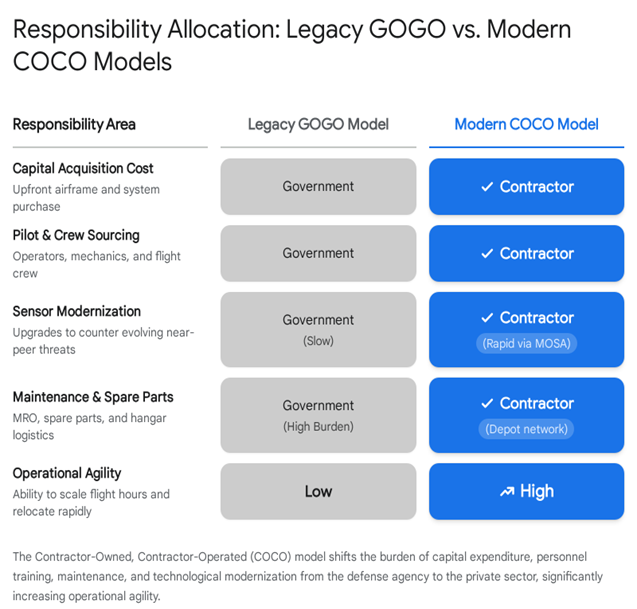
This operational model extends beyond simple aircraft leasing; it is deeply embedded in the concept of rapid technological insertion. Because the contractor retains ownership of the platform, they can continuously upgrade the onboard systems without navigating the labyrinthine bureaucratic approvals required to modify a government-owned aircraft. If a new, more effective synthetic aperture radar becomes available, or if the threat environment dictates a sudden need for advanced electronic warfare countermeasures, the contractor can integrate these technologies at their own facilities.
Furthermore, the COCO framework provides exceptional scalability. In response to emerging geopolitical crises or Joint Urgent Operational Needs (JUONs), defense commanders can rapidly surge ISR capacity. A contractor maintaining a fleet of mission-ready aircraft across global hangars can deploy assets to a contested theater within hours’ notice. This elasticity ensures that military forces have access to persistent, high-fidelity intelligence exactly when and where it is needed, without the long lead times associated with standing up a new military aviation squadron.
What is the Current Landscape of Airborne COCO ISR Services?
The current landscape of airborne Intelligence, Surveillance, and Reconnaissance (ISR) is defined by a strategic transition from permissive counter-insurgency operations to contested, near-peer environments. Militaries are divesting legacy turboprop fleets in favor of high-altitude, long-endurance jets operated under Contractor-Owned, Contractor-Operated (COCO) models to achieve deep-sensing capabilities.
For more than two decades, the US and NATO security apparatus optimized its aerial intelligence gathering for asymmetric warfare and counter-terrorism operations. Throughout the Global War on Terror, forces operated in largely permissive airspace, allowing relatively slow, low-flying turboprop aircraft to conduct persistent overwatch. Platforms such as the RC-12X Guardrail Common Sensor (GRCS), the MC-12S Enhanced Medium Altitude Reconnaissance and Surveillance System (EMARSS), and the EO-5C Airborne Reconnaissance Low (ARL-M) formed the indispensable backbone of tactical intelligence. These aircraft were highly effective at intercepting unencrypted communications, tracking insurgent movements, and providing direct support to ground forces in theaters like Iraq and Afghanistan.
However, the geopolitical paradigm has shifted decisively toward Great Power Competition (GPC). Near-peer adversaries, specifically nations such as Russia and China, have developed and deployed highly sophisticated Integrated Air Defense Systems (IADS) and advanced electronic warfare (EW) capabilities. In these heavily contested environments, the traditional ISR fleet is critically vulnerable. Legacy turboprop aircraft lack the operational ceiling, air speed, and standoff range required to survive while attempting to penetrate or skirt adversary airspace. Consequently, defense departments have recognized that the ISR architectures of 2010 are fundamentally inadequate for the threat landscape of 2026 and beyond.
In response to this capability gap, military branches have initiated aggressive divestiture and modernization programs. The United States Army, for instance, established a timeline to retire its entire legacy fixed-wing aerial ISR fleet—comprising approximately 70 aircraft—by the end of 2025. This divestiture is not merely a fleet reduction; it represents a doctrinal pivot toward “deep sensing.” Deep sensing requires the ability to detect, identify, and track high-value, mobile targets at extreme ranges, thereby enabling Long-Range Precision Fires (LRPF) while ensuring the intelligence-gathering asset remains safely outside the kinetic envelope of enemy surface-to-air missiles.
This operational imperative has catalyzed the demand for entirely new classes of aircraft and procurement methodologies. The traditional defense acquisition process—characterized by decade-long development cycles, rigid hardware specifications, and immense capital expenditures—is incompatible with the rapid pace of technological obsolescence seen in modern sensors and processing software. As a result, the landscape is increasingly defined by the integration of commercial-derivative business jets outfitter with Modular Open Systems Approaches (MOSA). By utilizing open-architecture frameworks, operators can rapidly swap out electronic intelligence components at the box and card level, updating capabilities in days rather than years. This demand for extreme agility has cemented the Contractor-Owned, Contractor-Operated (COCO) model as the centerpiece of modern airborne intelligence strategies.

Why are Defense Agencies Shifting to COCO ISR Models?
Defense agencies are shifting to COCO ISR models to achieve unmatched operational flexibility, bypass the slow legacy acquisition process, and maintain access to state-of-the-art sensor technology. By transferring the financial risk and logistical burdens of aircraft ownership to private contractors, militaries can rapidly scale deep-sensing capabilities against near-peer adversaries.
The primary catalyst for the widespread adoption of the COCO model is the extraordinary pace of technological innovation. In the modern battlespace, the half-life of electronic warfare capabilities and sensor resolution is exceptionally short. High-fidelity optical cameras, hyperspectral imaging, and automated data-fusion algorithms evolve at a speed that traditional defense procurement cycles simply cannot accommodate. The legacy acquisition process—which often requires five to ten years to move a platform from concept to initial operating capability—guarantees that military-owned ISR aircraft are technologically obsolete by the time they are fielded. The COCO model circumvents this stagnation. Defense contractors, driven by market competition and self-investment, continuously refresh their fleets with the latest commercial and military-grade sensors at zero non-recurring engineering costs to the government.
Operational agility is another critical driver. The modern strategic landscape is highly volatile, requiring forces to pivot rapidly between disparate geographical theaters. Traditional turboprop ISR assets may require five to seven days to transit from the Indo-Pacific to the European theater, losing critical operational time. In contrast, COCO providers utilizing high-speed commercial-derivative business jets can reposition assets globally in under 24 hours. This Agile Combat Employment (ACE) allows combatant commanders to execute missions with fewer overall assets, as platforms can be dynamically reallocated to hotspots almost instantaneously.
Furthermore, the COCO model directly addresses the systemic manpower shortages that plague modern militaries. The Department of Defense consistently struggles to recruit, train, and retain sufficient numbers of highly specialized pilots, sensor operators, and aviation mechanics.
Operating complex ISR aircraft organically strains the military personnel system. COCO contracts alleviate this pressure by injecting highly experienced civilian professionals—often military veterans with thousands of hours of specialized theater experience—directly into the intelligence pipeline. This “ISR-as-a-Service” approach allows the military to focus its uniformed personnel on kinetic mission execution and strategic analysis rather than routine flight operations and hangar maintenance.
The transfer of risk is also a paramount consideration. By outsourcing the entire capability lifecycle, the government shifts the burden of equipment attrition, maintenance failures, and technological obsolescence to the private sector. If a COCO aircraft experiences a critical mechanical failure, the contractor is contractually obligated to provide a replacement asset to maintain continuous surveillance, ensuring that the mission does not fail due to a single point of hardware failure.
How Do Cost Efficiencies Compare Between COCO and Legacy GOGO Operations?
The COCO ISR model delivers profound cost efficiencies by eliminating massive initial capital expenditures and amortizing operational costs across commercial supply chains. Analyses indicate that utilizing specialized contractor-supported unmanned and aerial systems yields a 17 percent reduction in life-cycle costs per flying hour compared to organic, military-owned platforms.
The financial architecture of military aviation is heavily front-loaded. Procuring a bespoke military intelligence aircraft involves billions of dollars in research, development, test, and evaluation (RDT&E) funds, followed by the staggering costs of purchasing the airframes. In a GOGO model, the defense agency bears this entire financial burden. If the aircraft’s mission set becomes irrelevant due to a changing threat landscape, the taxpayer absorbs the sunk costs of the obsolete platform. The COCO model radically alters this financial equation. The defense contractor acquires the aircraft—often leveraging the economies of scale inherent in the commercial aviation market by utilizing business jets like the Bombardier Global 6500 or utility aircraft like the Cessna Caravan—and absorbs the capital expenditure. The government pays only for the service rendered, transforming an unpredictable capital expense into a stable, manageable operational expense.
A comprehensive analysis conducted by the Congressional Budget Office (CBO) highlights the tangible financial benefits of utilizing alternative acquisition strategies. When comparing the life-cycle costs per flying hour—which includes both the amortized acquisition costs and the recurring operational costs—unmanned and contractor-supported systems demonstrated a 17 percent cost reduction compared to manned, organically operated systems like the Navy’s P-8. This efficiency is achieved despite the fact that specialized ISR assets may have shorter expected lifespans and higher attrition rates than traditional military transport aircraft. The savings are realized through leaner maintenance protocols, the absence of military-specific training overhead, and highly optimized flight scheduling.
|
Cost Metric Comparison |
Legacy GOGO Model | Modern COCO Model |
Financial Impact |
| Capital Acquisition | Government bears 100% of upfront platform costs. | Contractor absorbs procurement and integration costs. | Converts massive CapEx into predictable OpEx. |
| Life-Cycle Amortization | Costs amortized over strict military lifespans. | Costs amortized across multiple commercial/government contracts. | ~17% reduction in life-cycle costs per flying hour. |
| Maintenance & Supply | Requires bespoke military depots and slow supply chains. | Leverages global commercial MRO networks and AOG services. | Drastically reduces aircraft downtime and inventory holding costs. |
| Personnel Training | Government funds multi-year pilot and operator training pipelines. | Contractor supplies fully certified, mission-ready personnel. | Eliminates training overhead and solves military manpower shortages. |
Furthermore, the COCO model achieves recurring cost reductions by tapping into established commercial Maintenance, Repair, and Overhaul (MRO) networks. When a military operates a highly specialized, low-density aircraft, it must create a unique logistics tail, stockpiling expensive spare parts that may rarely be used. COCO operators utilizing commercial-derivative airframes can rely on the global civilian aviation supply chain. If a part fails, it can be shipped via commercial Aircraft on Ground (AOG) logistics networks within 24 hours to almost anywhere in the world, drastically reducing the need for massive military-owned parts inventories. This commercial synergy ensures high mission readiness rates at a fraction of the traditional sustainment cost.
How Does the Global Airborne ISR Market Look in 2026 and Beyond?
In 2026, the global Intelligence, Surveillance, and Reconnaissance (ISR) market reached $58.29 billion, fueled by robust defense spending and rapid multi-domain modernization. Driven by the commercialization of sensor technologies and the integration of AI software, the market is projected to expand at an 8.2% CAGR, approaching $80 billion by 2035.
The global ISR market is undergoing an unprecedented period of capitalization, acting as a critical growth engine within the broader aerospace and defense sector. As geopolitical flashpoints multiply and the requirements for border security and maritime domain awareness intensify, nations are systematically upgrading their tactical intelligence capabilities. Market forecasts indicate that the global ISR sector, valued at approximately $41.8 billion to $53.85 billion between 2024 and 2025, crossed the $58 billion threshold in 2026. Over the next decade, the market is anticipated to maintain a strong trajectory, with estimates projecting a total valuation of $76.9 billion to $79.28 billion by 2035, representing a Compound Annual Growth Rate (CAGR) ranging from 5.7% to 8.2%.
|
Global ISR Market Forecast (2024 – 2035) |
Market Valuation (USD Billions) |
Growth Catalyst |
| 2024 (Historical Baseline) | $41.80 Billion | Legacy fleet divestiture and initial deep-sensing investments. |
| 2025 (Transition Year) | $53.85 Billion | Escalation of regional conflicts and border security initiatives. |
| 2026 (Current Market Size) | $58.29 Billion | Accelerated adoption of COCO models and AI-integrated payloads. |
| 2030 (Mid-Term Forecast) | $65.70 – $79.28 Billion | Maturation of Multi-Domain Sensing Systems (MDSS). |
| 2035 (Long-Term Projection) | $76.90 – $79.28 Billion | Pervasive deployment of Agentic AI and autonomous ISR swarms. |
Geographically, North America remains the epicenter of the industry, commanding the largest revenue share due to the outsized defense budgets of the United States and the concentration of major prime contractors. The U.S. military’s transition toward Joint All-Domain Command and Control (JADC2) architectures necessitates massive investments in interconnected airborne sensors. However, the Asia-Pacific region is identified as the fastest-growing market. Escalating maritime disputes and the need to monitor expanding adversarial naval capabilities have prompted countries like India, Japan, and Australia to accelerate their procurement of maritime ISR aircraft, high-altitude drones, and persistent surveillance systems.
Segment analysis reveals a significant internal shift within the market structure. Historically, the ISR market was dominated by hardware—the physical airframes, radar dishes, and optical gimbals. In 2024 and 2025, the hardware segment maintained a dominant position, accounting for an estimated 57% to 71.45% of total market revenue. Within this sector, the airborne segment remains the most lucrative platform type, representing roughly 38% to 39% of the market share, led by the procurement of both manned special-mission aircraft and unmanned aerial systems (UAS).
However, the future growth engine of the ISR market is undoubtedly software. As sensors become increasingly commoditized and capable of capturing vast terabytes of data, the bottleneck in military intelligence has shifted from collection to processing. Consequently, the software segment is forecast to expand at an aggressive 8.5% CAGR between 2026 and 2031. This growth is heavily concentrated in artificial intelligence applications, edge computing software, and advanced Processing, Exploitation, and Dissemination (PED) analytics. Furthermore, the industry is witnessing a shift in revenue models; the adoption of open-architecture modular pods means that each new sensor integration typically requires ongoing, recurring software licensing fees, creating highly profitable, continuous revenue streams for defense integrators.
The competitive landscape is fragmented but stabilizing around a mix of traditional defense behemoths and specialized, agile service providers. While companies like Lockheed Martin, Northrop Grumman, and Boeing dominate large-scale hardware manufacturing, mid-tier integrators and COCO operators such as MAG Aerospace, are capturing significant market share by offering flexible, ISR-as-a-Service contracts that align perfectly with the military’s demand for rapid capability deployment.
How Do AI and Edge Computing Transform Airborne COCO ISR Capabilities?
AI and edge computing transform airborne ISR by processing massive volumes of raw sensor data directly onboard the aircraft. This autonomous data fusion drastically reduces bandwidth requirements, circumvents enemy signal jamming, and compresses the intelligence tip-to-product cycle to under five minutes, slashing analyst workloads by 60%.
The traditional architecture of airborne intelligence gathering was inherently centralized and bandwidth-heavy. An ISR aircraft would loiter over a target area, collect massive streams of high-definition Full Motion Video (FMV), synthetic aperture radar (SAR) imagery, and raw electronic signals, and attempt to transmit the entirety of this data down to a centralized ground station for human analysis. In the permissive environments of the early 2000s, this model functioned adequately. However, against near-peer adversaries equipped with sophisticated electronic warfare capabilities, this architecture is a critical vulnerability. High-bandwidth satellite uplinks are highly susceptible to detection, interception, and severe signal jamming. If the datalink is severed, the ground commander loses all situational awareness, rendering the airborne asset temporarily useless.
Edge computing represents a paradigm shift, moving the processing power from the ground directly to the tactical edge—the aircraft itself. By outfitting COCO platforms with ruggedized, power-conscious edge servers, the aircraft no longer needs to transmit gigabytes of raw data. Instead, the onboard computers process the sensor feeds locally in real-time.
This edge infrastructure is heavily augmented by Artificial Intelligence, specifically in the realm of Processing, Exploitation, and Dissemination (AI-PED). Deep learning algorithms continuously scan the incoming radar and optical feeds, autonomously identifying anomalies, tracking moving targets, and classifying objects (such as differentiating between a civilian truck and a mobile missile launcher). Once the AI identifies a high-value target, it generates a tiny, highly encrypted metadata packet containing the target’s exact coordinates, classification, and a single corroborating image. This micro-burst of data requires a fraction of the bandwidth of a live video feed, making it vastly more resilient against enemy jamming and allowing it to be transmitted via secure tactical data links like Link-16.
The operational impact of AI-PED is staggering. By automating the arduous and cognitively exhausting task of staring at video screens to detect minute changes in the environment, AI systems have been proven to reduce the workload of human intelligence analysts by up to 60%. Freed from mundane monitoring, human analysts can focus entirely on strategic synthesis, threat verification, and immediate targeting. Most importantly, this decentralized processing architecture compresses the entire intelligence cycle. What once took hours of transmission and ground-based analysis can now be accomplished in flight, reducing the “tip-to-product” decision cycle to under five minutes. This speed is the decisive factor in the modern kill chain, enabling forces to strike highly mobile targets before they can relocate.
Looking forward, the industry is transitioning from generative AI models to “agentic AI.” While generative AI assists in rapidly creating analysis reports or simulating scenarios, agentic AI functions as an autonomous digital teammate. In an ISR context, an agentic AI system can autonomously manage the aircraft’s complex sensor suite. If a radar detects a faint, anomalous signal, the agentic AI can instantly and autonomously re-task the aircraft’s optical cameras to investigate the specific coordinate, cross-reference the visual data with known threat libraries, and generate a targeting solution—all without requiring manual input from the pilot or ground operator. This level of multi-domain decision support ensures that ISR platforms remain highly lethal and effective even in severely degraded or completely denied communication environments.
What is the ATHENA-R Program and How Does it Advance Deep Sensing?
The ATHENA-R program (Army Theater-Level, High-Altitude Expeditionary Next Airborne ISR-Radar) utilizes highly modified Bombardier Global 6500 business jets to provide the U.S. Army with advanced, deep-sensing capabilities. Operating at extreme altitudes, these contractor-integrated aircraft deliver extended standoff ranges and superior radar resolution to monitor near-peer adversaries safely.
As the U.S. Army executes its broader Multi-Domain Sensing System (MDSS) strategy, it faces a temporal capability gap. The legacy fleet of turboprop aircraft is being actively divested, yet the ultimate replacement program—the High Accuracy Detection and Exploitation System (HADES)—will not be fully fielded until the late 2020s. To ensure continuous, high-fidelity intelligence gathering during this transition, the Army initiated a series of bridging programs utilizing Contractor-Owned, Contractor-Operated (COCO) and contractor-integrated jets. The ATHENA-R program is the radar-focused cornerstone of this bridging strategy.
In 2023, the U.S. Army awarded a pivotal contract to a teaming partnership between MAG Aerospace (Prime Contractor) and L3Harris Technologies to deliver two fully integrated ATHENA-R aircraft. The selection of the Bombardier Global 6500 business jet as the base airframe marks a revolutionary departure from traditional military aviation procurement. As a large-cabin commercial jet, the Global 6500 offers performance metrics that shatter the limitations of previous ISR platforms.
The primary advantage of the ATHENA-R platform is its operational altitude and speed. By flying at altitudes exceeding 40,000 feet, the aircraft dramatically increases the geometric line-of-sight for its onboard sensors. This extreme elevation, combined with the aircraft’s extended endurance and higher payload capacity, enables “deep sensing”. Deep sensing allows the aircraft to peer hundreds of miles into denied or contested territory, mapping adversary troop movements and identifying radar installations, all while remaining safely in permissive airspace, far beyond the reach of enemy surface-to-air missile systems. This capability is absolute critical to the Army’s modernization priorities, specifically in providing the precise targeting coordinates required for Long-Range Precision Fires (LRPF).
The integration of the ATHENA-R platforms highlights the strength of strategic defense partnerships. L3Harris brings decades of premier experience in creating, evolving, and integrating complex electronic warfare, radar, and communications intelligence packages onto business jet platforms. MAG Aerospace complements this by serving as the prime contractor for mission operations, drawing on an exceptional performance history of delivering and managing extensive turnkey aerial C5ISR programs in the world’s most austere and challenging environments.
Furthermore, the ATHENA-R program serves as a critical operational laboratory. By deploying these aircraft to vital theaters—such as recent deployments to the U.S. Indo-Pacific Command—the Army not only generates immediate, actionable intelligence but also tests the concepts of operations (CONOPS) and multi-domain integration architectures that will eventually govern the permanent HADES fleet. The ATHENA-R ensures that coalition forces maintain an uninterrupted intelligence advantage while modernizing the force for the future.
What are the Multi-Mission Capabilities of the MC-208 Guardian?
The MC-208 Guardian, developed by MAG Aerospace, is a highly versatile aircraft that unifies Intelligence, Surveillance, and Reconnaissance (ISR), precision strike, tactical air mobility, and medical evacuation into a single platform. Built on the Cessna Caravan airframe, it executes diverse missions in austere environments without requiring reconfiguration.
In an era characterized by flat or decreasing defense budgets, allied nations and specialized combatant commands are under intense pressure to “do more with less.” Maintaining separate, specialized aircraft fleets for close air support, tactical reconnaissance, and personnel transport requires massive logistical footprints and exorbitant sustainment costs. The MC-208 Guardian was engineered specifically to solve this problem, providing a low-cost, highly ruggedized platform capable of transitioning between disparate mission sets within a single sortie.
The physical foundation of the MC-208 Guardian is the globally ubiquitous and proven Cessna 208 Caravan airframe. This commercial-derivative approach ensures exceptional reliability and a globally accessible supply chain. The aircraft is designed for extreme operational flexibility, boasting a maximum takeoff weight of 9,062 pounds and the ability to operate from short, unimproved dirt runways far from established military infrastructure. Powered by a Pratt & Whitney Canada PT6A-140 turboprop engine generating 867 shaft horsepower, the Guardian achieves a maximum cruise speed of 186 knots and a service ceiling of 25,000 feet. With its internal fuel capacity, the aircraft possesses a maximum range of 1,070 nautical miles, allowing for persistent loiter times essential for effective overwatch missions.
|
MC-208 Guardian Technical Specifications |
Capability / Metric |
Operational Advantage |
| Airframe & Powerplant | Cessna 208 base; 867 shp PT6A-140 engine. | Rugged, highly reliable, globally sustainable via commercial networks. |
| Performance Envelope | 186 kn cruise; 25,000 ft ceiling; 1,070 nmi range. | Enables rapid deployment and persistent loiter for prolonged overwatch. |
| ISR Sensor Suite | HD FMV EO/IR turret with laser designator. | Provides high-fidelity targeting data and real-time situational awareness. |
| Communications Integration | Ku/Ka BLOS SATCOM; Link-16; SADL. | Ensures secure data transmission beyond line-of-sight across joint networks. |
| Armament Capacity | 4 hardpoints (525 lbs each); 1553/1760 databus. | Allows immediate prosecution of targets without calling in separate attack assets. |
The Guardian’s true strategic value lies in its seamless multi-role integration. For the ISR mission set, the aircraft is equipped with an advanced Garmin G1000 glass cockpit tailored for sensor control, alongside a high-definition Full Motion Video (FMV) Electro-Optical/Infrared (EO/IR) sensor turret equipped with a laser designator. To ensure that critical intelligence reaches decision-makers, the Guardian features a modular multi-sensor station and Ku/Ka antenna systems for Beyond-Line-Of-Sight (BLOS) satellite communication, as well as tactical data links like Link-16 and Situational Awareness Data Link (SADL).
When the ISR suite identifies a hostile target, the MC-208 Guardian can instantly transition to a precision strike role. The aircraft is wired with military-standard 1553 and 1760 databus communications and features four OEM-certified wing-mounted hardpoints, each capable of carrying 525 pounds. The platform is SEEK EAGLE certified to employ a variety of advanced precision munitions, including the AGM-114 Hellfire missile, Hydra-70 rockets, and the Advanced Precision Kill Weapon System (APKWS) laser-guided rocket. This organic strike capability drastically reduces the “sensor-to-shooter” timeline.
Concurrently, the aircraft retains its utility functions. The unpressurized cabin, supported by an On-Board Oxygen Generation System (OBOGS) capable of sustaining two aircrews for eight hours, can be configured for air mobility, accommodating up to nine personnel for infiltration/exfiltration (Infil/Exfil) or cargo airdrop resupply. In the event of battlefield casualties, the platform seamlessly supports Casualty Evacuation (CASEVAC) and Medical Evacuation (MEDEVAC) protocols. This unprecedented convergence of capabilities makes the MC-208 Guardian an indispensable asset for modern tactical operations.
How Does MAG Aerospace Ensure Mission Success in Austere Environments?
MAG Aerospace ensures mission success in austere environments by deploying ruggedized platforms with minimal logistical footprints, utilizing globally accessible commercial supply chains, and embedding highly experienced cross-trained personnel capable of sustaining independent, turnkey aviation operations in combat zones.
Operating advanced intelligence-gathering aircraft in regions characterized by severe weather, degraded infrastructure, and pervasive asymmetric threats demands a radically different approach than peacetime garrison flying. MAG Aerospace, founded by former U.S. Army special operations aviators, built its corporate philosophy around the harsh realities of the modern battlefield. The core of this methodology is the deployment of functionally independent, turnkey aviation cells. Instead of relying on host-nation infrastructure for fueling, maintenance, or data routing, MAG deploys its aircraft alongside highly specialized teams—often comprising just two pilots and three maintainers—capable of sustaining continuous operations with minimal external support.
A definitive example of this capability was demonstrated during the company’s involvement in the United Nations Multidimensional Integrated Stabilization Mission in Mali (MINUSMA). Following the severe deterioration of the security environment in central Mali beginning in 2015, the UN faced a critical deficit of military air assets required to protect civilians and monitor asymmetric threats across vast, hostile territories. High-end, sovereign military helicopters and ISR planes were difficult to source from member states and incredibly difficult to sustain in the punishing sub-Saharan environment. To bridge this critical capability gap, MAG Aerospace was contracted in 2021 to provide fixed-wing ISR support using Cessna 208 aircraft.
Deploying these contractor-operated assets proved transformative. Despite pervasive asymmetric threats, severe ground restrictions, and inadequate localized resourcing, MAG’s COCO ISR assets provided persistent overwatch and real-time intelligence. This surveillance capability was instrumental in identifying, deterring, and responding to potential threats, directly contributing to the stabilization of key urban centers such as Gao, Kidal, and Timbuktu. By the time the MINUSMA mission officially closed in December 2023, the utilization of commercial-derivative COCO aircraft had proven that private contractors could successfully project and sustain reliable airpower in regions where traditional military deployments faced insurmountable logistical inertia.
To support operations of this magnitude—spanning federal, international, and commercial customers across six continents—MAG Aerospace heavily leverages both its technology innovation centers and the broader commercial aviation supply chain. For platforms like the Cessna Caravan or Bombardier business jets, spare parts can be sourced globally through civilian networks within 24 hours via Aircraft on Ground (AOG) services, effectively bypassing the notoriously slow and rigid military procurement depots. This strategic reliance on commercial logistics ensures exceptionally high mission-readiness rates, guaranteeing that combatant commanders receive continuous, uninterrupted intelligence regardless of the geographical challenges.
What are the Data Security and Sovereignty Concerns in COCO ISR?
Data security and sovereignty concerns in COCO ISR involve the protection of highly sensitive military intelligence transmitted by commercial contractors. Defense agencies address these threats by mandating zero-trust network architectures, advanced encryption protocols, and strict adherence to export controls that prevent foreign adversaries from accessing U.S. data.
As the Department of Defense and allied militaries increasingly rely on private contractors to gather, process, and route tactical intelligence, the demarcation line between military-grade security and commercial data management must be absolute. The raw sensor data, high-definition Full Motion Video (FMV), and Signals Intelligence (SIGINT) collected by COCO aircraft are primary targets for cyber-espionage, signal jamming, and data theft by near-peer adversaries, particularly China, Russia, and Iran. The most vulnerable points in this architecture are the transmission datalinks connecting the aircraft to the ground station, and the cloud infrastructures where contractors process the resulting intelligence products.
To secure this critical architecture, modern defense contracts mandate the implementation of highly resilient, encrypted communications. COCO platforms must utilize Beyond-Line-Of-Sight (BLOS) satellite communications and tactical data links—such as Link-16 or Type-1 encrypted Bandwidth Efficient Common Data Link waveforms—to ensure that even if a signal is intercepted, it remains undecipherable to hostile actors. Furthermore, the aforementioned shift toward edge computing directly mitigates interception risks. By processing data onboard the aircraft, the volume of data required for transmission is drastically reduced, shrinking the attack surface available to enemy signal intelligence.
Data sovereignty—the legal framework ensuring that data remains subject to the laws and governance of the nation where it is collected or stored—presents another layer of complexity. In early 2024, the U.S. government took decisive action via Executive Order 14117 and the Department of Justice’s National Security Division. These regulations established stringent Data Security Programs acting as export controls, explicitly prohibiting foreign adversaries, or entities under their jurisdiction, from accessing sensitive personal or U.S. government-related data. For a global COCO operator executing missions in allied nations or international airspace, compliance is non-negotiable. It requires that all intelligence data be strongly encrypted, with cryptographic keys held exclusively by the U.S. government or appropriately cleared personnel, ensuring that sovereignty is maintained cryptographically regardless of where the data is physically processed.
Additionally, recent legislative frameworks, such as the National Defense Authorization Act (NDAA) for Fiscal Year 2026, impose strict “secure-by-design” practices on defense contractors. COCO operators are expressly prohibited from utilizing Artificial Intelligence tools or software models developed in adversary nations, such as DeepSeek models, to process military data. As defense networks transition to Zero-Trust Architectures, contractor-operated aircraft must undergo continuous authentication as they interact with the broader Joint All-Domain Command and Control (JADC2) network, guaranteeing that commercial integration points do not serve as backdoors for adversarial cyber-incursions.
Looking Ahead
The landscape of global security is continually changing, with new challenges emerging at an unprecedented pace. In this context, the value of advanced ISR services cannot be overstated. COCO aircraft offer a viable, effective solution to meet these demands, providing timely, accurate intelligence that is critical for decision-making.
As we look to the future, the integration of even more sophisticated technologies, such as artificial intelligence and machine learning, into COCO aircraft will further enhance their utility in ISR services. This evolution will undoubtedly redefine the parameters of surveillance, reconnaissance, and intelligence gathering, setting new standards for operational excellence.
MAG – Your Trusted C5ISR Services Partner
Are you ready to elevate your ISR capabilities with the efficiency, flexibility, and technological superiority of COCO aircraft? At MAG, we specialize in providing state-of-the-art Contractor-Owned/Contractor-Operated aircraft tailored to your unique ISR needs. Our team of experts is committed to delivering unparalleled service, ensuring that you have the intelligence you need when it matters most.
Contact MAG today to discover how our COCO aircraft solutions can support your ISR objectives and help you stay ahead in the ever-evolving landscape of global security.
Frequently Asked Questions (FAQ)
- What is the difference between GOGO, GOCO, and COCO defense models? Government-Owned, Government-Operated (GOGO) models require the military to own the equipment and utilize uniformed personnel for operations and maintenance. Government-Owned, Contractor-Operated (GOCO) models feature government-owned assets managed by civilian contractors. Contractor-Owned, Contractor-Operated (COCO) models entrust private defense companies to fully finance, own, maintain, and operate the platforms, providing the government with a turnkey “ISR-as-a-Service” solution.
- Why is the U.S. Army divesting its legacy turboprop ISR aircraft? The U.S. Army is retiring legacy turboprop fleets, such as the RC-12X Guardrail and MC-12S EMARSS, because they were optimized for permissive airspace during counter-terrorism operations. These older aircraft lack the altitude, speed, and standoff range required to survive and gather intelligence effectively against the advanced integrated air defense systems of near-peer adversaries.
- How does Edge Computing enhance airborne ISR operations? Edge computing places high-performance processors and AI algorithms directly onboard the ISR aircraft. Instead of transmitting raw, high-bandwidth video to ground stations, the aircraft processes the data locally, identifies targets, and transmits only concise, encrypted metadata. This reduces bandwidth requirements, speeds up the intelligence cycle to under five minutes, and severely mitigates the risk of signal jamming.
- What specific capabilities does the ATHENA-R program provide? The ATHENA-R (Army Theater-Level, High-Altitude Expeditionary Next Airborne ISR-Radar) program utilizes modified Bombardier Global 6500 business jets to provide high-altitude, deep-sensing radar intelligence. Executed through a partnership between MAG Aerospace and L3Harris, the program bridges the capability gap toward the future HADES fleet, offering superior survivability, extended endurance, and long-range targeting support.
- What makes the MC-208 Guardian unique for tactical missions? The MC-208 Guardian is a highly versatile aircraft built on a ruggedized Cessna Caravan airframe. It is unique because it combines four distinct mission sets—Intelligence, Surveillance, and Reconnaissance (ISR), precision strike via 525-lb wing hardpoints, air mobility, and medical evacuation (CASEVAC)—into a single, cost-effective platform that requires no reconfiguration between missions.
- How do COCO ISR operators address data security and cyber threats? COCO operators secure intelligence data through stringent compliance with defense regulations, utilizing Zero-Trust Architectures, Type-1 encryption, and Beyond-Line-Of-Sight (BLOS) secure satellite links. They adhere to national data sovereignty laws and executive orders (such as EO 14117) to prevent foreign adversaries from accessing sensitive government data, ensuring cryptographic keys remain under military control.
- What is the projected growth of the global airborne ISR market? The global Intelligence, Surveillance, and Reconnaissance (ISR) market was valued at $58.29 billion in 2026 and is projected to reach approximately $76.9 billion to $79.28 billion by 2035. This expansion is driven by a Compound Annual Growth Rate (CAGR) of 5.7% to 8.2%, heavily influenced by multi-domain modernization, COCO adoptions, and the integration of AI software.
- How does AI-PED reduce the workload for military intelligence analysts? Artificial Intelligence for Processing, Exploitation, and Dissemination (AI-PED) automates the scanning of vast sensor feeds. By utilizing deep learning algorithms to autonomously identify anomalies and classify targets, AI-PED eliminates the need for humans to constantly monitor raw video. This automation has been shown to reduce analyst cognitive workloads by up to 60%.
- What role did COCO aircraft play in the UN MINUSMA mission in Mali? During the UN MINUSMA mission, the UN faced a critical shortage of military air assets to monitor asymmetric threats. MAG Aerospace deployed contractor-operated Cessna 208 aircraft to provide persistent fixed-wing ISR support. These assets delivered real-time situational awareness that was instrumental in deterring threats and stabilizing key urban centers like Gao and Timbuktu until the mission closed in 2023.
Updated March 2026
