
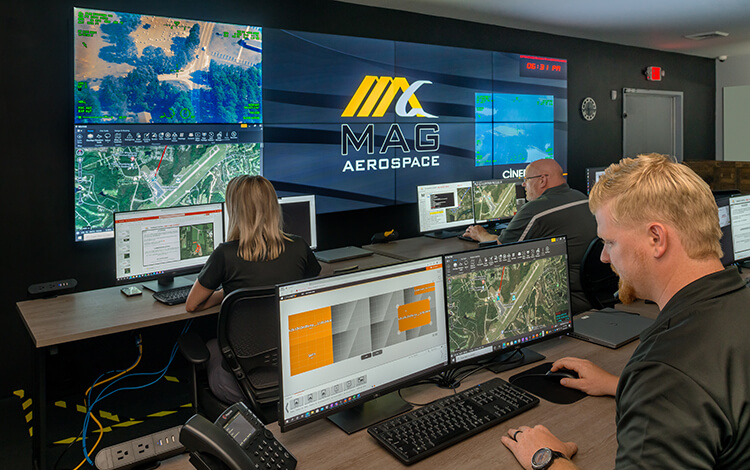
The landscape of modern warfare is undergoing a foundational shift, transitioning from two decades of counterinsurgency operations in permissive airspace toward Large-Scale Combat Operations (LSCO) in highly contested, Anti-Access/Area Denial (A2/AD) environments. At the center of this transition is the Joint Terminal Attack Controller (JTAC), the critical nexus of air-ground integration. However, the U.S. military is currently confronting compounding readiness crises across its personnel, aviation fleets, and training infrastructure. To establish a baseline for this analysis, the following critical statistics define the current operational environment for the fiscal years 2024 through 2026:
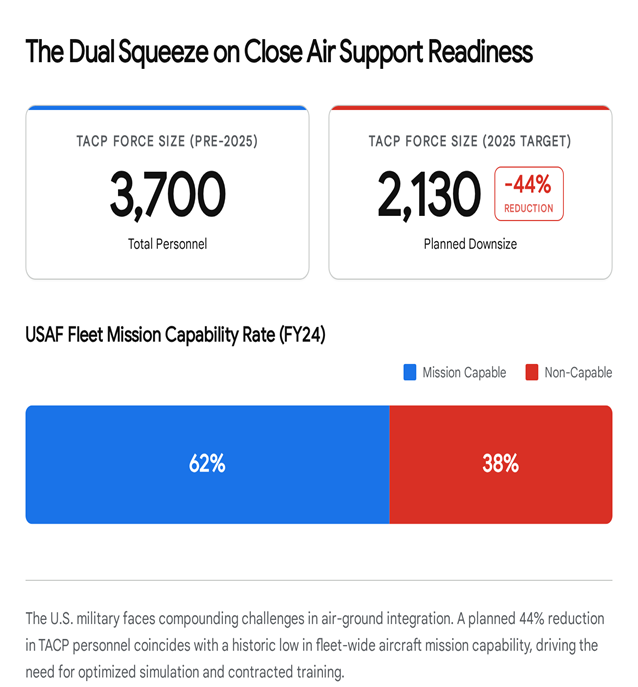
- Tactical Air Control Party (TACP) Downsizing: The U.S. Air Force is executing a massive structural reduction of its elite TACP career field, decreasing personnel authorizations from 3,700 down to 2,130 by 2025—an approximate 44% reduction—to pivot resources toward the Indo-Pacific theater.
- Aviation Readiness Deficits: In fiscal year 2024, the U.S. Air Force operated its smallest and oldest fleet in its 78-year history (5,025 aircraft), with a fleet-wide mission-capable rate plunging to 62%. This equates to roughly 1,900 aircraft being out of commission at any given time.
- Pilot and Aircrew Shortages: The military faces a persistent deficit of aviators, with the Air Force operating with over 1,150 empty fighter pilot billets and an overall pilot shortage hovering near 2,000 personnel.
- National Airspace Constraints: The Federal Aviation Administration (FAA) reported that over 40% of its air traffic control facilities were understaffed as of late 2024, suffering 1,400 controller losses annually, which severely restricts the availability of domestic airspace for live-fly military training.
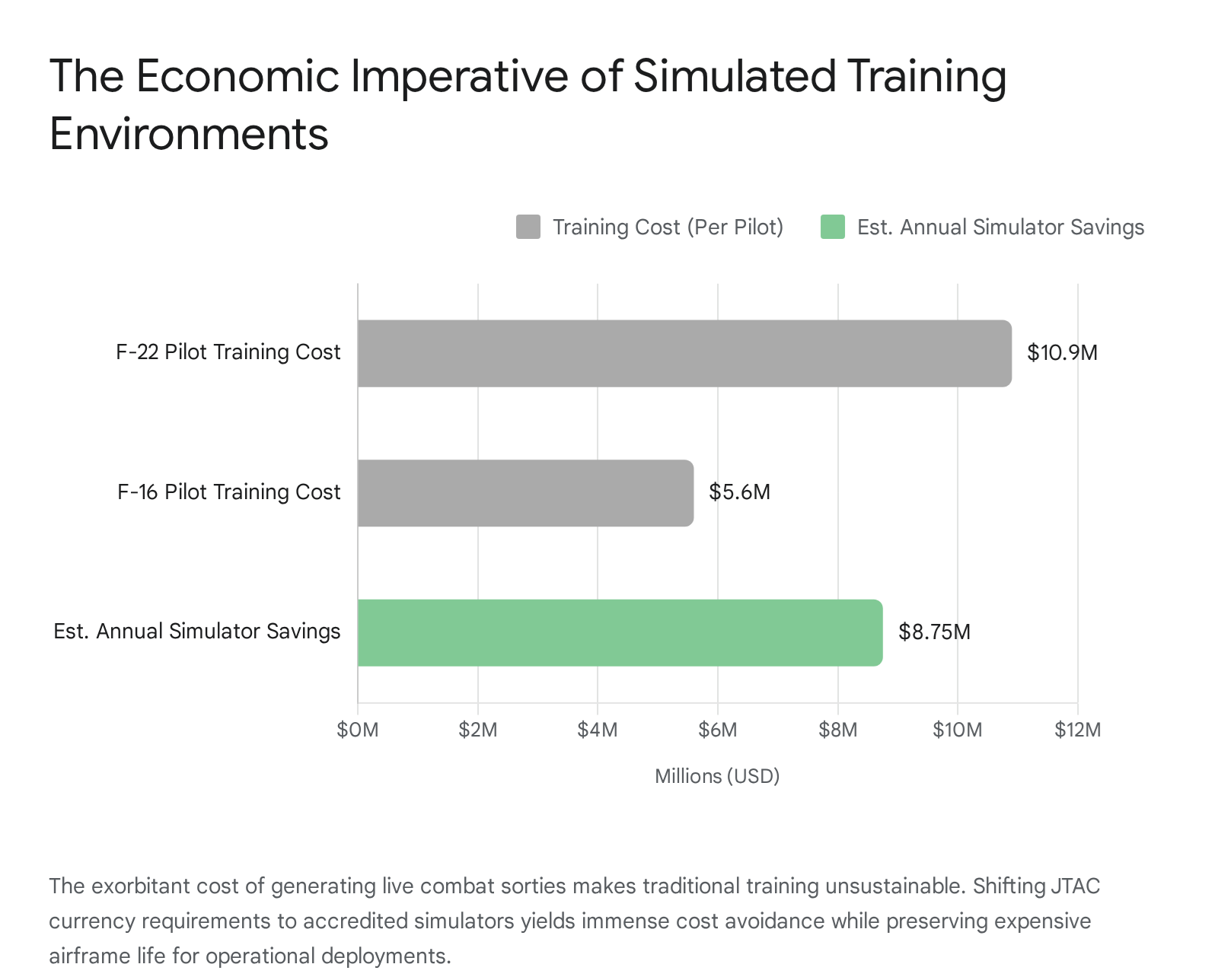
- The Economics of Live Flight: The cost of generating live combat sorties is exorbitant; training a single basic qualified fighter pilot costs between $5.6 million (F-16) and $10.9 million (F-22), making the use of live aircraft solely for JTAC currency training fiscally unsustainable.
- Simulation Cost Avoidance: Transitioning specific JTAC training requirements to accredited simulator environments yields an estimated $8.5 million to $11.0 million in annual cost savings per major training command, drastically reducing risk and preserving airframe lifespan.
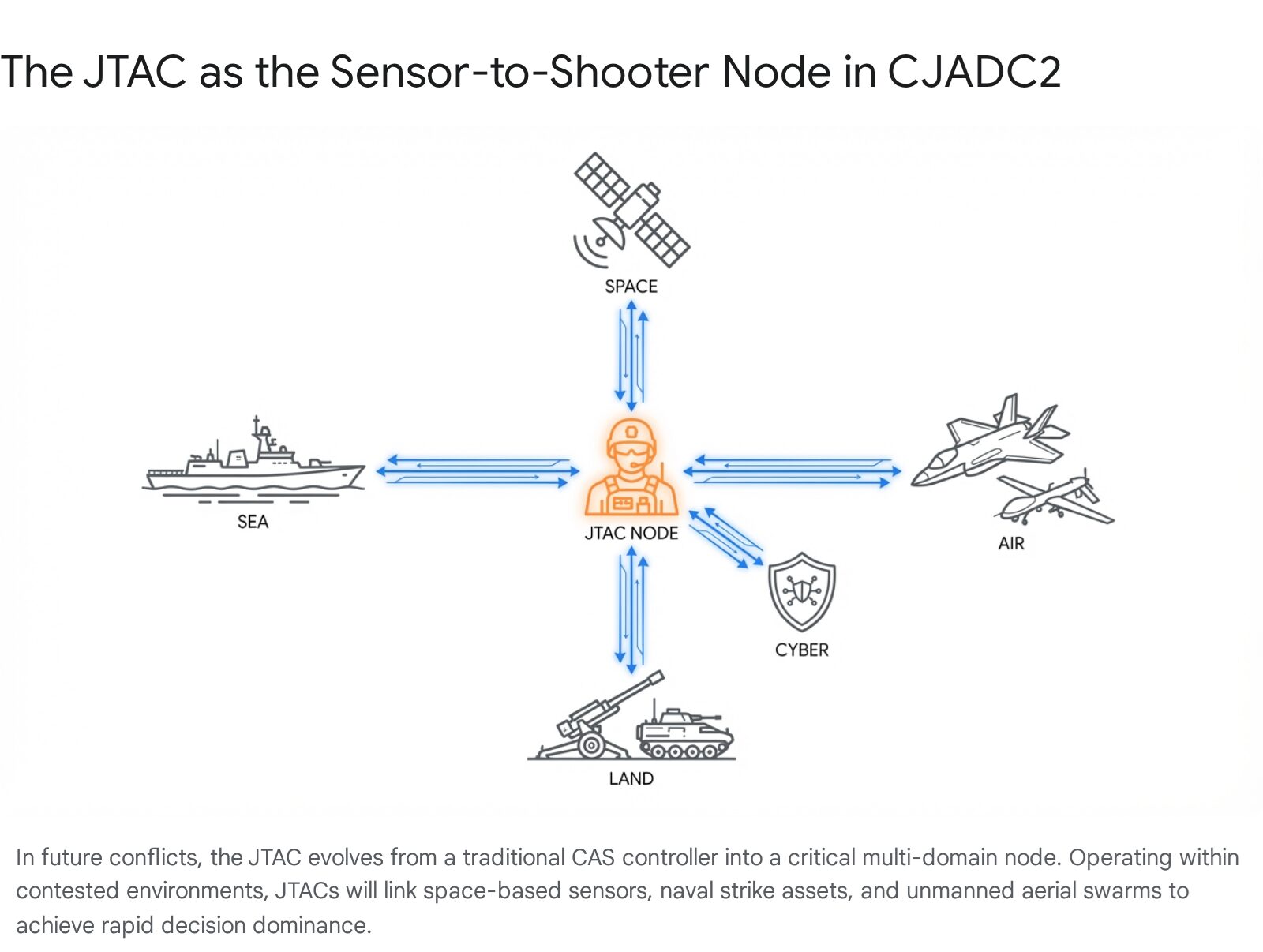
To bridge the widening gap between strategic requirements and available resources, the Department of Defense increasingly relies upon specialized defense contractors. Organizations such as MAG Aerospace provide the indispensable continuity, combat-proven instruction, and advanced Live, Virtual, and Constructive (LVC) simulation necessary to maintain the lethality of the Joint Force. As the military integrates the Combined Joint All-Domain Command and Control (CJADC2) architecture, the JTAC is evolving from a traditional Close Air Support (CAS) coordinator into a multi-domain sensor-effector node, requiring unparalleled training and technological fluency.
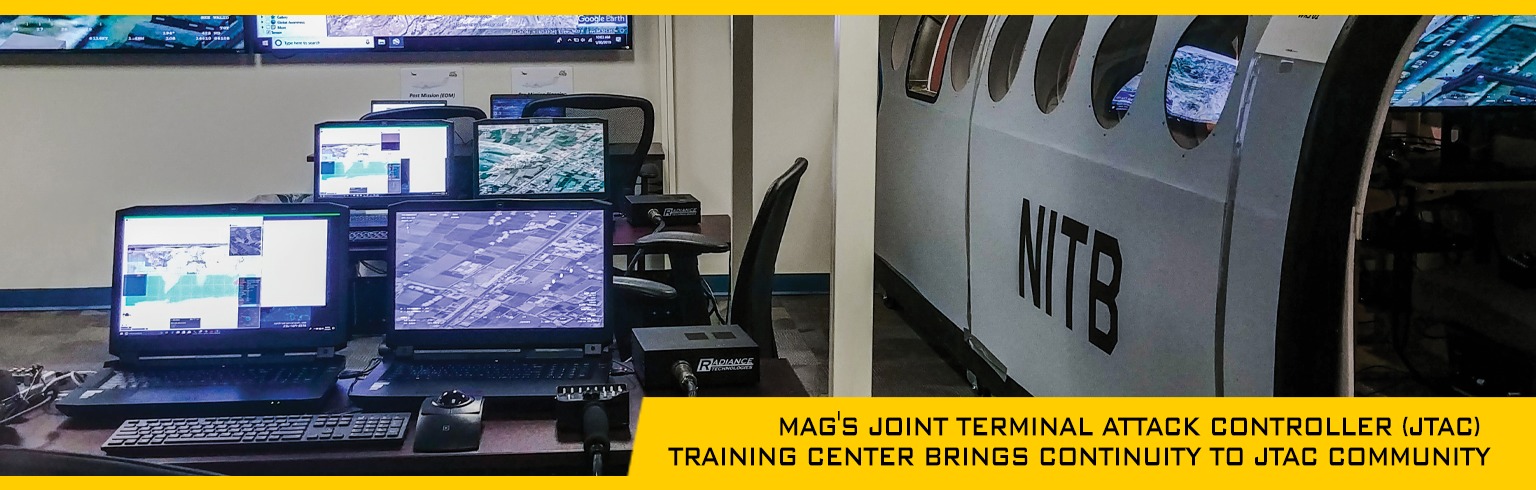
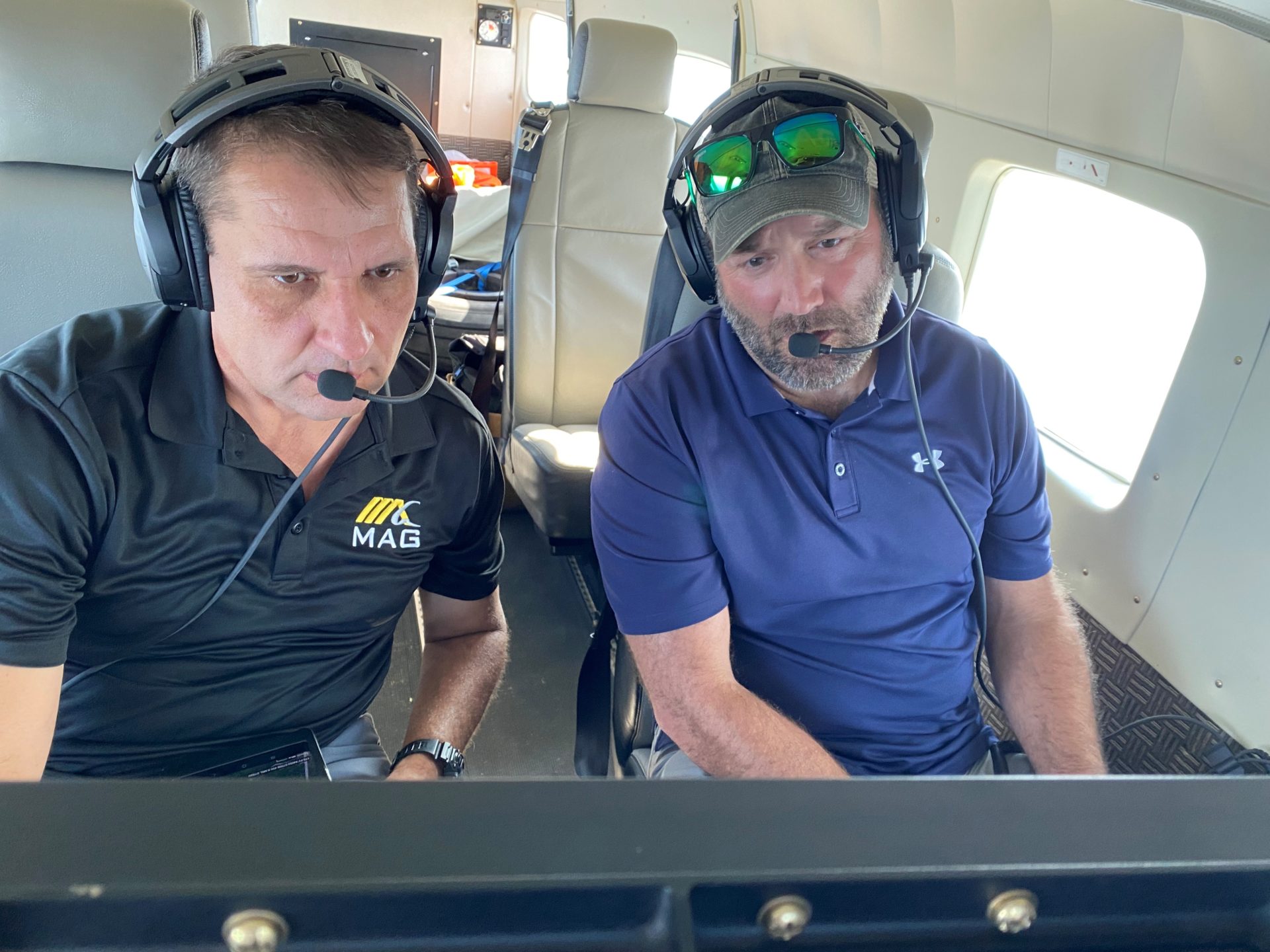
For years MAG has provided Joint Terminal Attack Controller (JTAC) expertise in training, program support, flight support, and live fire exercise support. This work is essential to the success of the JTAC mission. The withdrawal from the Middle East has had a substantial impact on the military, and the loss of combat-experienced JTACs is one of the more notable consequences. Armed with extensive combat experience, MAG’s instructors play a key role in helping the military bridge the experience gap with JTAC training.
JTACs play a critical role in combat operations and are responsible for coordinating the actions of ground forces and air assets to ensure that precision strikes are delivered accurately and safely. Continuity in the JTAC community is important for many reasons. JTACs are highly skilled and experienced personnel who take many years to train. When JTACs leave the service, it takes time and resources to train new JTACs to replace them.
The Work of JTACs
JTACs are typically forward deployed with ground forces, where they work closely with infantry, armor, and artillery units. They use a variety of sensors and equipment to track the movement of friendly and enemy forces and to identify and designate targets. JTACs also communicate with aircrews using specialized radios and laser designators to guide them to their targets.
JTACs play a vital role in a variety of military operations, including:
- Close air support: JTACs direct CAS strikes to support ground forces in close combat.
- Air interdiction: JTACs direct air strikes against enemy targets in the rear area, such as supply lines and command centers.
- Battlefield air interdiction: JTACs direct air strikes against enemy forces that are engaged in ground combat but are not in immediate contact with friendly forces.
- Air strikes against high-value targets: JTACs direct air strikes against high-value enemy targets, such as generals and other key leaders.
The Strategic Imperative of Close Air Support
Close Air Support (CAS) is formally defined by joint military doctrine as aerial warfare actions—such as airstrikes, strafes, or rocket attacks—conducted by fixed-wing or rotary-wing aircraft against hostile targets that are in close proximity to friendly forces. The defining characteristic of the CAS mission is not the platform delivering the ordnance, but rather the absolute necessity for detailed integration of each air mission with the fire and movement of ground forces. This requirement for extreme precision exists because the margin for error is measured in meters; a failure in communication, targeting, or airspace deconfliction inevitably results in catastrophic fratricide or the failure of the ground scheme of maneuver.
The Joint Terminal Attack Controller (JTAC) is the highly specialized, certified service member authorized to direct the action of combat aircraft engaged in CAS and other offensive air operations from a forward position. They are the critical connective tissue between the terrestrial battlefield and the aerospace domain.
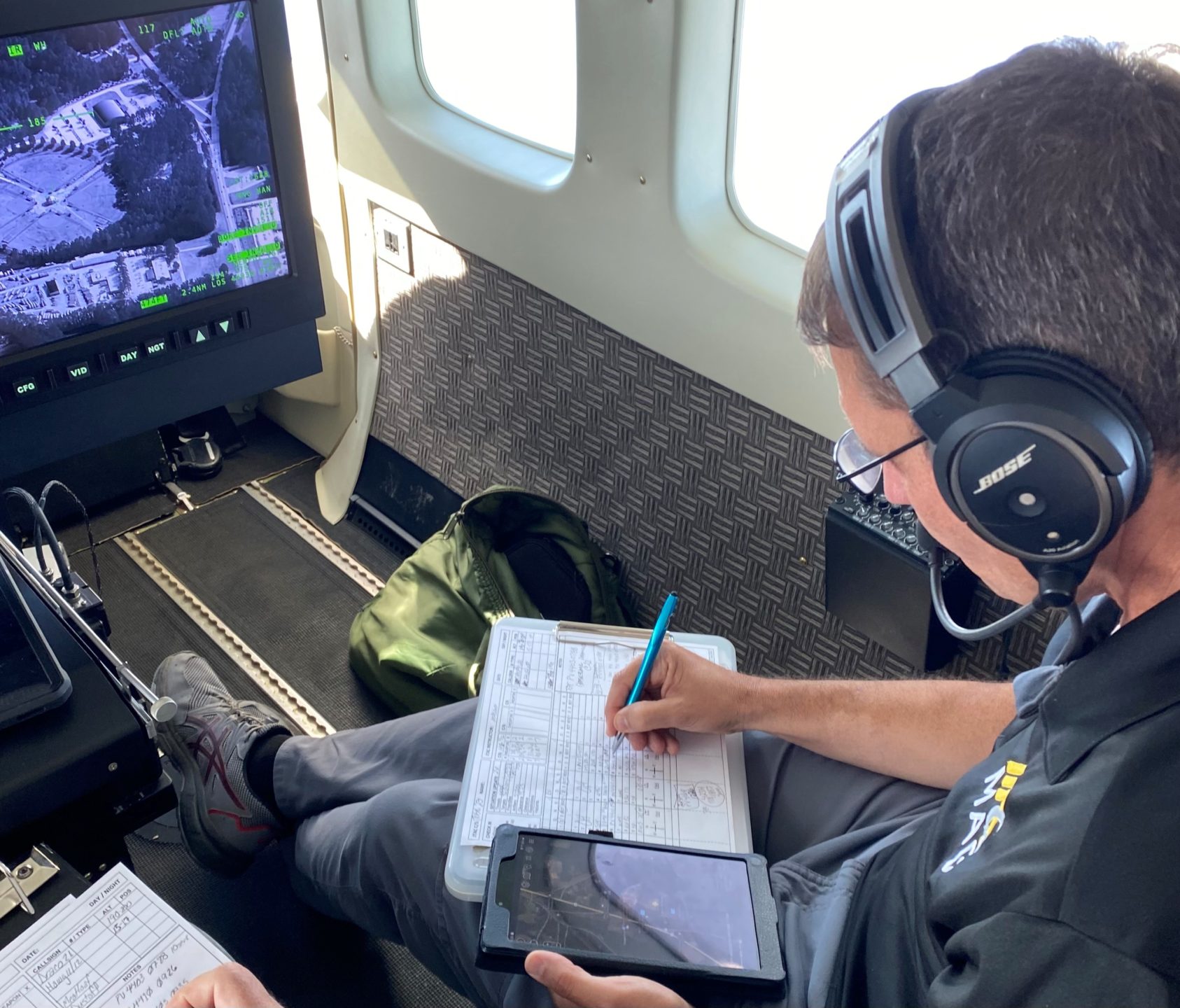
Historical Evolution of the JTAC
The history of terminal attack control is a testament to the continuous evolution of combined arms warfare. The foundational concepts of forward air control were experimented with by the U.S. Army during World War II, utilizing rudimentary radios to guide strikes. However, it was during the Vietnam War that the JTAC capability became a formalized, indispensable element of ground combat operations. In the dense, visually restrictive jungles of Southeast Asia, ground forces frequently found themselves engaged in close-quarters combat with numerically superior enemy formations. During pivotal engagements, such as the Battle of Ia Drang in 1965, early forward air controllers proved decisive, enabling U.S. forces to survive and defeat much larger North Vietnamese elements through the precise application of aerial firepower.
Following the Vietnam War, the U.S. military heavily invested in the maturation of CAS doctrine and technology. Throughout the Gulf War, the overarching Global War on Terror (GWOT), and sustained combat operations in Iraq and Afghanistan, JTACs became the centerpiece of tactical lethality. During these prolonged counterinsurgency campaigns, U.S. and coalition forces operated under conditions of absolute air supremacy. JTACs embedded with Army infantry battalions, Marine expeditionary units, and Special Operations Forces (SOF) routinely utilized advanced communications suites and laser designators to bring overwhelming, precision-guided firepower upon insurgent networks. In these environments, the JTAC was often the most lethal individual on the battlefield, capable of summoning the destructive power of an entire carrier strike group or bomber task force with a single radio transmission.
The Cognitive Load of Terminal Attack Control
The modern JTAC must possess an unparalleled depth of tactical and technical knowledge. Controlling complex, three-dimensional airspace is not merely reading GPS coordinates over a radio network. It requires a rapid, high-stakes cognitive synthesis of terrain analysis, enemy threat assessment, airspace deconfliction, and weaponeering.
Weaponeering—the precise calculation of the quantity and specific type of lethal means required to achieve a desired effect on a target—has evolved into a complex science. A JTAC must understand the exact blast radius, fragmentation pattern, and penetration capabilities of a vast array of munitions, from 500-pound laser-guided bombs to 30mm cannon fire, ensuring the selected weapon destroys the target without causing collateral damage to nearby friendly forces or civilian infrastructure. Furthermore, the JTAC must dynamically organize the battlefield geometry, ensuring that requested terrestrial artillery trajectories do not intersect with the flight paths of incoming fixed-wing or rotary-wing aircraft.
Doctrinally, JTACs are trained to utilize three distinct types of terminal attack control, depending on the tactical situation, the sensor capabilities available, and the level of risk to friendly forces:
- Type 1 Control: This method provides the highest degree of safety and control. It requires the JTAC to visually acquire both the attacking aircraft and the target for every weapon release.
- Type 2 Control: This is utilized when the JTAC requires control of individual attacks but is unable to visually acquire the attacking aircraft at weapons release, or is unable to visually acquire the target. In this scenario, the JTAC relies on accurate targeting data provided by other sensors, such as an aircraft’s targeting pod or a supporting drone.
- Type 3 Control: This method is employed when the JTAC grants the aircraft clearance for multiple attacks within a single engagement, subject to specific attack restrictions and geographic boundaries. This allows for a much faster operational tempo but requires deep trust between the controller and the aircrew.
Executing these controls flawlessly under the extreme physiological and psychological stress of combat requires rigorous, continuous training. Once a service member passes the demanding JTAC Qualification Course (JQC), they earn their certification, but they must meticulously maintain that qualification through a continuous, heavily audited cycle of live-fire exercises, simulator evaluations, and academic testing. A lapse in this currency immediately results in the revocation of their authority to control aircraft, highlighting the zero-defect nature of the profession.
The Modern Readiness Crisis: Personnel Shortages and Force Restructuring
Despite their proven indispensability, the JTAC community—alongside the broader military aviation ecosystem—is currently navigating an unprecedented readiness crisis. A confluence of shifting strategic priorities, high attrition rates, and severe equipment availability issues is forcing the Department of Defense to radically rethink how it generates, trains, and sustains combat power.
The Tactical Air Control Party (TACP) Downsizing
The most immediate shock to the air-ground integration community is the U.S. Air Force’s decision to drastically downsize and restructure its Tactical Air Control Party (TACP) career field. Recognizing that the future of warfare in the Indo-Pacific will be vastly different from the localized ground wars of the Middle East, the Air Force is executing a massive reduction in TACP force structure. The authorizations for the career field are being slashed by approximately 44%, dropping from roughly 3,700 personnel to just 2,130 by the end of 2025.
This dramatic consolidation involves shuttering several elite close-air support squadrons historically embedded at major Army installations, such as Fort Drum, Fort Bliss, Fort Riley, Fort Carson,
Fort Stewart, and Fort Campbell, and consolidating the remaining forces into just two primary locations. The strategic rationale driving this reduction is to align the Department of the Air Force with the National Defense Strategy, freeing up vital funding and personnel billets to pivot toward cyber warfare, space operations, and Joint All-Domain Command and Control (JADC2) initiatives required for high-end peer conflict with nations like China or Russia.
However, this structural reduction places an immense, outsized burden on the remaining JTACs. With fewer controllers available across the force, the proficiency, survivability, and lethality of the remaining operators must be absolute. The selection standards for Air Force Special Warfare have simultaneously increased, making it more difficult to qualify and further restricting the pipeline of new operators capable of filling the remaining billets. Lawmakers and military strategists have expressed profound alarm over this consolidation, warning that pulling close-air support airmen away from their aligned Army units will erode the mutual trust developed through continuous, integrated training, thereby increasing the risk of mission failure on future battlefields.
The Aircraft Deficit and Fleet Aging
The personnel shortage on the ground is mirrored by a severe shortage of capable assets in the air. The U.S. Air Force is currently operating its smallest and oldest fleet in its 78-year history, comprising roughly 5,025 total aircraft. In fiscal year 2024, the fleet-wide mission-capable rate—a critical metric indicating the percentage of aircraft able to perform their assigned missions on any given day—plunged to a historic low of 62%.
This dismal readiness rate equates to roughly 1,900 military aircraft being out of commission, grounded by maintenance requirements or supply chain failures, at any specific moment. The crisis is driven by what logisticians term “diminishing manufacturing sources” or “vanishing vendor syndrome,” where the industrial base can no longer produce the spare parts required to sustain aging airframes like the B-52 bomber or the A-10 Thunderbolt II. Even modern fifth-generation platforms like the F-35 Lightning II have suffered from profound supply chain bottlenecks and inadequate parts availability, severely capping their sortie generation rates.
Simultaneously, the military is facing an acute and persistent pilot shortage. The Air Force alone was operating with 1,150 empty fighter pilot billets in 2024, with total pilot deficits across the service hovering near 2,000 personnel. A combination of chronic burnout, high operational deployment tempos, lengthy and delayed training pipelines, and highly lucrative recruitment efforts from the commercial airline sector continue to siphon experienced aviators out of the military faster than they can be replaced.
Parallel Pressures: The National Airspace Strain
The constraints inhibiting realistic military training are not limited to the Department of Defense. The Federal Aviation Administration (FAA) is facing a parallel workforce crisis that directly impacts military flight operations within the contiguous United States (CONUS). As of late 2024, the FAA reported that over 40% of its air traffic control facilities were significantly understaffed. The administration established an 85% staffing threshold as its minimum functional goal, yet 118 critical terminal air control facilities fell short of this target.
The severity of the FAA shortage is stark; facilities like the Grand Forks Tower operated at a critical 53.3% of their target staffing levels, while Rochester Tower and Columbus Tower operated at 56.5% and 58.3%, respectively. In 2024 alone, the FAA experienced an attrition of 1,400 fully certified controllers and trainees, further exacerbating the strain on the national airspace system.
For military JTACs, who must frequently train in complex, integrated airspace that overlaps with civilian sectors, a strained national airspace system poses a massive logistical hurdle. Military training ranges require vast blocks of airspace to be temporarily restricted to allow for dynamic, unpredictable maneuvering by fighter jets and the deployment of live or inert ordnance. When commercial air traffic controllers are overburdened by increasing commercial flight volumes and severe understaffing, the flexibility required to seamlessly integrate and schedule military aviation training is drastically restricted, leading to canceled training sorties and degraded readiness for ground controllers.
The Economics of Air-Ground Integration: Live vs. Simulated Training
With a drastically reduced population of JTACs, fewer available mission-capable aircraft, and a heavily constrained national airspace system, the traditional military model of generating combat readiness exclusively through live-fire, live-fly exercises is no longer fiscally or logistically sustainable. The Department of Defense is under intense pressure to optimize every dollar spent on training, necessitating a massive shift toward simulation and contracted services.
The Exorbitant Cost of Live Flight
Generating a live CAS training sortie is an immensely expensive endeavor that quickly drains operational budgets. The life-cycle sustainment and hourly operational costs of modern military aircraft are staggering. According to comprehensive analyses by the RAND Corporation, adjusted for current economic baselines, the cost of training a single military aviator is highly dependent on the specific platform.
|
Military Aviation Platform |
Estimated Cost to Train a Basic Qualified Pilot (Millions USD) |
Role / Classification |
| C-17 Globemaster III | $1.1 Million | Strategic Airlift |
| C-130J Super Hercules | $2.5 Million | Tactical Airlift |
| F-16 Fighting Falcon | $5.6 Million | Multi-Role Fighter / CAS |
| B-1B Lancer | $7.3 Million | Strategic Bomber |
| B-52 Superfortress | $9.7 Million | Strategic Bomber |
| F-22 Raptor | $10.9 Million | 5th Gen Air Dominance |
When a live fighter jet is launched solely to support JTAC currency training—for example, flying repetitive holding patterns over a domestic bombing range simply to allow a JTAC to practice a 9-line transmission over the radio without dropping any live ordnance—the military incurs massive hourly operating costs. More critically, these non-combat training flights consume precious airframe fatigue life. As the Air Force aggressively moves to retire legacy, dedicated CAS platforms like the A-10 Thunderbolt II by 2028, JTACs must increasingly rely on advanced 4th and 5th-generation multi-role fighters (like the F-35 and F-15EX) for their training. These advanced platforms are vastly more expensive to operate per flight hour and are heavily tasked with global deterrence missions, meaning diverting them for basic JTAC currency training is an inefficient use of a scarce strategic asset.
The Financial and Tactical Value of Simulation
To alleviate this unsustainable financial and logistical burden, the military has aggressively pursued advanced simulation. Over the past decade, exponential advances in computing power, mixed reality, and high-fidelity physics engines have transformed military simulators from basic procedural familiarization tools into highly immersive, realistic tactical environments.
The cost avoidance realized through the adoption of accredited JTAC simulators is profound. Independent analyses and Department of Defense reports indicate that shifting a significant portion of JTAC training requirements to simulator environments can result in direct cost savings of $8.5 million to $11.0 million annually for a single major training command, such as the Expeditionary Warfare Training Group Atlantic (EWTGLANT).
Beyond the massive direct financial savings, high-fidelity simulators provide distinct tactical training advantages that cannot be replicated on a live physical range:
- Safety and Risk Mitigation: JTACs can practice highly complex, “danger-close” fire missions—where the margin of error between neutralizing an enemy combatant and striking friendly forces is negligible—without any actual risk to human life or multi-million dollar equipment.
- Repetition and Rapid Reset: Simulators allow for an accelerated learning curve through rapid resets. If a JTAC makes a critical error in airspace deconfliction or target correlation, the scenario can be instantly paused, debriefed by an instructor, and restarted. This high-repetition, muscle-memory building environment is physically impossible to achieve when coordinating live aircraft holding in a physical airspace block.
- Spectrum Contestation and EW Replication: In a live training environment within the United States, it is legally and practically difficult to simulate full-scale electronic warfare (EW) or GPS-denied scenarios due to FAA regulations and interference with civilian infrastructure. Simulators, however, can perfectly and safely replicate the intense radio jamming, spoofing, and communications degradation that are expected in a conflict with a technologically advanced near-peer adversary.
Live, Virtual, and Constructive (LVC) Training Architectures
While accredited simulators are invaluable for building baseline proficiency and rehearsing specific emergency procedures, they cannot entirely replace the psychological friction, physical fatigue, and environmental unpredictability of live combat operations. To bridge the gap between cost-effective simulation and realistic field exercises, the military has adopted the Live, Virtual, and Constructive (LVC) training architecture.
In a mature LVC environment, live actors (such as a JTAC operating on a physical, austere bombing range) interact seamlessly with virtual assets (such as an Air Force pilot flying a high-fidelity simulator halfway across the country) and constructive entities (computer-generated enemy forces, civilian populations, or automated air defense systems).
This interconnected architecture allows a JTAC standing in a training area in Georgia to look through their physical Next-Generation Handheld Targeting System (NGHTS) and receive a simulated, perfectly correlated video downlink from an F-35 pilot operating a simulator dome in Nevada. As industry experts and senior defense officials note, today’s airmen and ground controllers are entering a battlespace characterized by unmanned drone swarms, collaborative combat aircraft (CCA), and overwhelming information management requirements. Integrating LVC capabilities into daily training scenarios is the most effective method to ensure personnel reap the financial benefits of simulation without losing the physical stressors required to forge combat-ready warfighters.
MAG Aerospace: Bridging the Experience Gap and Providing Continuity
With the strategic withdrawal from the Middle East and the official end of major combat operations in Afghanistan, the U.S. military lost a massive generation of combat-experienced JTACs to natural retirement and transition into the private sector. This “experience gap” is one of the most severe, yet underreported, consequences of the post-GWOT era. As new, inexperienced controllers enter the drastically downsized TACP community, they lack the foundational combat repetitions and the visceral understanding of friction that their predecessors acquired during thousands of real-world engagements in Iraq and Afghanistan.
This is precisely where MAG Aerospace fulfills a critical national security requirement. Operating as a premier defense contractor, MAG Aerospace provides the military with unparalleled JTAC expertise in training, program management, flight support, and live-fire exercise execution. The organization serves as the institutional memory and the stabilizing force for the broader air-ground integration community.
The Value of Combat-Proven Instructors
MAG Aerospace actively mitigates the military’s experience deficit by aggressively recruiting and hiring former, highly decorated JTACs from across the military spectrum, with a particular emphasis on operators who have served in elite Special Operations Forces (SOF) units. These instructors bring decades of real-world, under-fire experience directly into the classroom and the simulation dome, ensuring that the hard-won lessons of the past twenty years are not lost to history.
Trevor Thomas, a JTAC Program Manager at MAG Aerospace, succinctly captures the ethos and the vital role of the organization’s instructional cadre:
“With the wars in the Middle East coming to an end, the military has been losing a lot of experienced and operational JTACs. MAG has been able to recruit and hire former JTACs from across the military spectrum. Most, if not all our guys have served in the Special Operations community in some capacity… I feel like it’s my duty to pass my knowledge on to the next generation. I hope that I can add some tools to their tool belt that can help them in the future. We are a tight-knit group and if there is an issue or a question that one of us has, someone has experienced it before and has the answer.”
This level of mentorship is invaluable. MAG’s instructors understand the subtle tactical nuances that cannot be effectively conveyed in a doctrinal manual—how to maintain strict radio discipline while under effective enemy fire, how to anticipate an aircraft’s fuel limitations (“bingo” fuel) during an extended engagement, and how to read the chaotic, fluid geometry of a modern battlefield.
Comprehensive Training Services and Contracted Aviation
To prepare the next generation of controllers, MAG Aerospace has engineered a comprehensive JTAC training program that encompasses three primary, interdependent pillars :
- Classroom Instruction: Expert-led, deep-dive academics focusing on air traffic control, joint operations, fire control, and complex weaponeering.
- Simulator Training: Utilizing advanced, accredited simulation systems—such as Virtual Battlespace 4 (VBS4) and FLIRSIM—to provide high-fidelity, risk-free repetitions in dense urban or contested environments. This ensures JTACs can fulfill their annual continuation training and evaluation requirements without draining military O&M (Operations and Maintenance) budgets.
- Live-Fire Training: Orchestrating highly realistic, real-world field exercises that force JTACs to coordinate live ordnance drops while managing the physical exhaustion of ground maneuver.
To fully support the live-training requirement, MAG provides the military with contracted aircraft and specialized personnel. A critical component of this capability is MAG Aerospace’s strategic leadership connection to Top Aces, the world leader in contracted adversary air (ADAIR) and specialized JTAC training support. Boasting an unblemished safety record of over 140,000 accident-free flight hours, this capability provides the military with dedicated, contractor-owned aircraft to serve as CAS platforms during live exercises.
Utilizing contracted ADAIR and CAS platforms significantly reduces the operational burden on the Air Force and Navy’s own exhausted fighter fleets. This allows active-duty military aircraft to prioritize operational deployments, deterrence patrols, and high-end peer-conflict training, while highly capable contracted aircraft handle the repetitive, essential load of JTAC currency generation.
MAG Fills a Critical Need for JTAC Training
MAG brings stability to the JTAC community in several ways. MAG provides the military with high-quality JTAC training that prepares them for the challenges they will face in combat. MAG also fills the critical need of annual training and evaluations that allow JTACs to remain certified and deployable. If a JTAC does not maintain their training and certifications, they will lose their JTAC qualification and their ability to serve in the capacity. MAG’s driving force and focus is always the training needs of the JTACs which helps MAG ensure the military has a steady pipeline of qualified JTACs.
Over the years, MAG instructors have trained hundreds of JTACs and the dedicated support they receive from MAG means a lot to the crews and for the instructors who see the JTACs develop as they learn more and progress through training.
MAG also provides the military with contracted aircraft and personnel to support JTAC training. This can include providing air targets for JTACs to practice controlling or providing intelligence, surveillance, and reconnaissance (ISR) support. This helps to reduce the burden on the military’s own resources and allows the military to focus on other priorities.
MAG’s JTAC Training Successes
MAG has been a leading provider of JTAC training services to the US military for many years and has a deep understanding of the skills and knowledge that JTACs need to be successful.
Here are some examples of how MAG Aerospace has helped the military train JTACs:
- In 2018, MAG Aerospace was awarded a contract to provide JTAC and Small Unmanned Aerial System (SUAS) Program Managers (PM) for all CONUS and OCONUS AFSOC Special Tactics Squadrons.
- In 2020, MAG Aerospace launched its Kinetic Strike Training Program (KSTP), which provides a comprehensive training program for JTACs and other personnel who support close air support operations.
- In 2023, MAG was awarded the Joint Terminal Attack Controller (JTAC) Program Support task order to continue their support of the 1st Special Forces Command (A) JTAC Program. MAG will provide JTAC expertise in training, program support, flight support, and live fire exercise support.
MAG’s JTAC training has become known for providing high-quality training that is realistic and challenging. In part, because they boost a room full of experienced JTACs who have been there and done it. Providing an invaluable asset to the military, the personnel being trained, and ultimately the security of the nation. MAG’s training programs combined with their experience play an important role in ensuring the U.S. military has the best JTACs in the world.
The Future Battlespace: CJADC2 and the Multi-Domain JTAC
As the United States military rigorously prepares for potential conflicts with technologically advanced near-peer adversaries in the Indo-Pacific or European theaters, the fundamental doctrinal framework of warfare is shifting away from isolated, service-specific actions toward Combined Joint All-Domain Command and Control (CJADC2).
CJADC2 is an incredibly ambitious, DoD-wide initiative designed to securely connect sensors and shooters from all military services—the Air Force, Army, Marine Corps, Navy, and Space Force—along with allied NATO partners, into a single, seamlessly integrated digital network. The strategic objective is to process vast amounts of battlefield data, understand the environment instantly, and direct joint forces faster than the adversary can observe and react, achieving absolute “decision advantage”.
The JTAC as the Tactical Quarterback
Within the sprawling CJADC2 construct, the JTAC is undergoing a radical evolution. They are no longer simply ground-pounders equipped with a radio calling in airstrikes from loitering bombers. Instead, the JTAC is evolving into a highly sophisticated multi-domain sensor-effector node—the ultimate “tactical quarterback” of the battlefield.
Operating as highly mobile, low-signature stand-in forces positioned deep within an adversary’s weapons engagement zone (WEZ), future JTACs will act as the vital human-in-the-loop for a massive, automated sensor network. A JTAC might utilize advanced optics to detect an enemy surface-to-air missile (SAM) site, process that data through an edge-computing device to verify the target, and seamlessly pass the precise coordinates not just to an overhead fighter jet, but simultaneously to a submerged Navy Virginia-class submarine, a Space Force orbital targeting asset, or a swarm of AI-driven collaborative combat aircraft (CCA).
Integrating Unmanned Systems and Digital Capabilities
This technologically advanced future is not theoretical; it is already being rigorously tested and fielded. In recent military demonstrations, forward-deployed JTACs have successfully utilized Android Team Awareness Kits (ATAK) and advanced mobile ad-hoc networks (like TrellisWare radios) to autonomously control the Electro-optical/Infrared (EO/IR) sensors mounted on Gray Eagle Extended Range (GE-ER) Unmanned Aircraft Systems.
By leveraging this open-architecture digital network, JTACs successfully transmitted digital 9-lines for CAS and digital ‘Call for Fires’ for terrestrial artillery with the push of a button, entirely bypassing vulnerable and slow voice communications. This Digitally Aided Close Air Support (DACAS) vastly improves tactical efficiency, drastically reduces transmission latency, and significantly mitigates the risk of human error under the psychological stress of combat. Furthermore, operating digitally reduces the radio-frequency signature of the JTAC team, making them harder for enemy electronic warfare units to locate and target.
MAG Aerospace remains at the vanguard of this technological integration. By incorporating Artificial Intelligence, resilient data architecture, and rapid prototyping into their overarching training methodologies—driven by industry innovators like Hollis Cash, MAG Aerospace’s VP and Chief Architect—they ensure that the JTACs of tomorrow are not merely familiar with these systems, but are absolute masters of them.
Choose MAG’s JTAC Training
MAG Aerospace provides high-quality training to Joint Terminal Attack Controllers (JTACs). MAG’s JTAC training program is designed to prepare students for the rigorous demands of the job and to ensure that they are equipped with the skills and knowledge they need to be successful.
MAG’s JTAC training services include:
- Classroom instruction: MAG instructors teach JTACs the skills they need to control close air support and other air operations. This includes instruction on air traffic control, fire control, and joint operations.
- Simulator training: MAG uses simulators to provide JTACs with realistic training in a variety of scenarios. This allows JTACs to practice their skills without the risk of danger.
- Live-fire training: MAG provides JTACs with live-fire training opportunities. This allows JTACs to practice their skills in a real-world environment.
While the military is taking a few steps to address the shortage of JTACs, the shortage is expected to continue in the near future, making MAG’s involvement and ability to train JTACs even more critical.
Over the last couple of decades, we have seen how critical experienced military personnel are to the mission. They bring a wealth of knowledge, skills, and understanding that is essential to success. MAG’s Special Mission Training team takes a great deal of pride in taking all their experience and instilling it in today’s JTACs knowing they helped train personnel who are still deploying to places worldwide and conducting ongoing operations.
Conclusion: Securing the Decisive Advantage
The United States military is currently navigating a profound historical inflection point. The two-decade luxury of operating in uncontested airspace with abundant resources has been abruptly replaced by the austere realities of A2/AD environments, severely constrained aircraft readiness, and a massive structural downsizing within the special warfare and terminal attack control communities.
In this new era of great-power competition, technology is vital, but the individual, highly trained warfighter remains the ultimate weapon. The Joint Terminal Attack Controller is the indispensable lynchpin that guarantees air-ground lethality, orchestrates the chaos of the multi-domain battlefield, and prevents catastrophic fratricide. However, creating, certifying, and maintaining a combat-ready JTAC is an exceptionally expensive, time-consuming, and highly perishable endeavor that the military struggles to sustain organically.
Specialized defense contractors like MAG Aerospace provide the critical stabilizing force for the Department of Defense. By supplying combat-proven instructors drawn from the highest echelons of Special Operations, deploying state-of-the-art simulation facilities, and managing contracted aviation support through strategic partnerships, MAG effectively bridges the dangerous experience gap left by the end of the Global War on Terror. Their aggressive integration of Live, Virtual, and Constructive (LVC) training environments and forward-looking capabilities ensures that as the military transitions fully into the CJADC2 paradigm, the JTAC community will not just survive the technological transition—they will dominate the future battlespace.
Frequently Asked Questions (FAQ)
1. What is a Joint Terminal Attack Controller (JTAC)? A JTAC is a highly skilled, certified military service member who, from a forward position, directs the actions of combat aircraft engaged in Close Air Support (CAS) and other offensive air operations. They are responsible for intimately coordinating the integration of overhead aerial strikes with ground maneuver elements to maximize lethality, achieve tactical objectives, and ensure the safety of friendly forces by preventing fratricide.
2. Why is there currently a shortage of JTACs and military pilots? The shortage is driven by several compounding strategic and personnel factors. The U.S. Air Force is facing an overall deficit of nearly 2,000 pilots due to high operational tempos, burnout, and aggressive recruitment from commercial airlines. Simultaneously, the military is intentionally downsizing its Tactical Air Control Party (TACP) career field by roughly 44% (reducing from 3,700 to 2,130 personnel by 2025) to pivot financial and human resources toward cyber, space, and the Indo-Pacific theater. High attrition rates, extremely rigorous ongoing certification requirements, and the retirement of GWOT-era veterans further exacerbate the shortfall.
3. How much does it cost to train military pilots, and how does that impact JTAC training? Training a basic qualified fighter pilot is an immense financial investment. According to baseline estimates, it costs approximately $5.6 million to train an F-16 pilot and nearly $10.9 million for an F-22 pilot. Because flying live, advanced 4th and 5th-generation sorties purely for JTAC radio practice is correspondingly expensive and consumes valuable airframe lifespan, the military heavily relies on contracted simulators and adversary air (ADAIR) to offset these massive costs while preserving combat aircraft for actual deployments.
4. How does simulation improve JTAC training and military readiness? Simulators provide a highly realistic, risk-free environment for JTACs to practice incredibly complex, danger-close fire missions. Accredited simulators, such as those utilizing Virtual Battlespace 4 (VBS4) and FLIRSIM, allow for endless repetition, immediate instructor debriefing, and the replication of complex Electronic Warfare (EW) or GPS-denied environments that are legally or practically difficult to simulate in live domestic airspace. Utilizing these simulators can result in cost avoidance of $8.5 million to $11.0 million annually for major military training commands.
5. What is the role of a JTAC in Combined Joint All-Domain Command and Control (CJADC2)? In the CJADC2 construct, the JTAC evolves from a traditional CAS controller into a critical multi-domain sensor-effector node. Operating deep within contested, anti-access environments, JTACs will use advanced digital networks (like ATAK) to seamlessly link space-based sensors, naval strike assets, cyber capabilities, and unmanned aerial swarms, bypassing traditional voice communications to achieve rapid decision dominance over adversaries.
6. How does MAG Aerospace support JTAC training and combat readiness? MAG Aerospace acts as a premier training and integration partner for the U.S. military. They actively recruit combat-experienced former JTACs from the Special Operations community to serve as expert instructors, effectively bridging the military’s loss of GWOT experience. MAG provides comprehensive classroom instruction, advanced LVC simulator training, and contracted aircraft (through strategic partnerships like Top Aces) for live-fire exercises, ensuring a continuous, cost-effective pipeline of highly qualified, combat-ready controllers for the Joint Force.
Originally published January 2024
Updated March 2026
